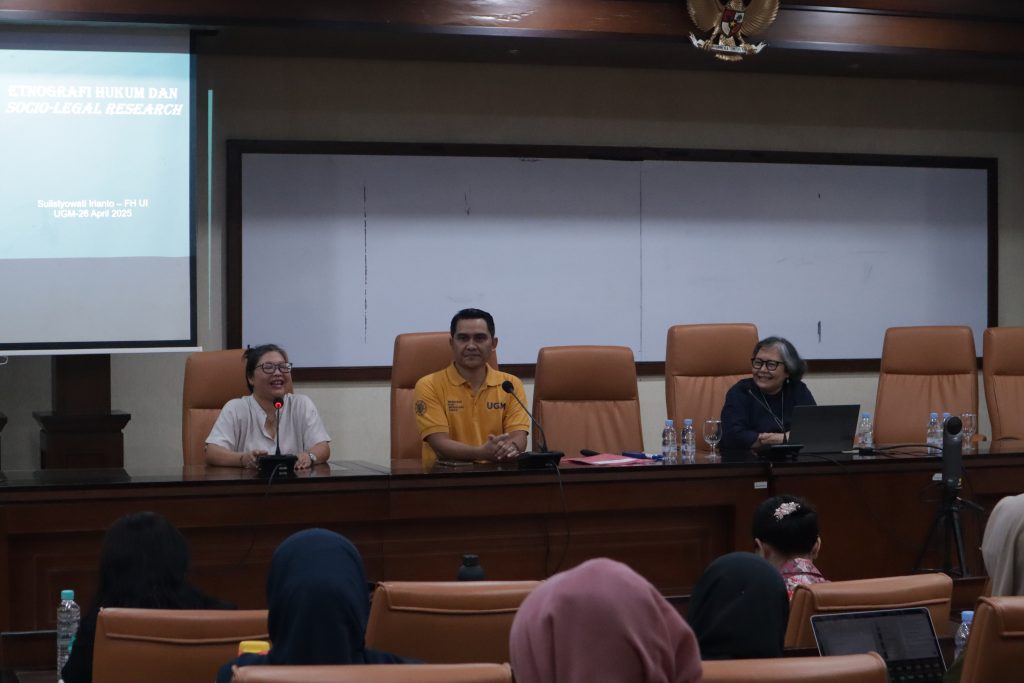
In an effort to strengthen students’ academic and methodological capacity to understand legal practice in a more contextual and equitable manner, the Master of Law Program, Faculty of Law, Universitas Gadjah Mada (MIH FH UGM) held a Guest Lecture and Training on Legal Ethnographic Research on Saturday, April 26, 2025, at Building 3.1.1, Faculty of Law, UGM.
This event featured Prof. Dr. Dra. Sulistyowati Irianto, M.A. (Professor at the Faculty of Law, University of Indonesia) as the keynote speaker and was moderated by Dr. Yance Arizona, S.H., M.H., M.A. he discussion focused on strengthening the socio-legal research, particularly the use of legal ethnography to understand how the law operates in real-life societal contexts.
Through this approach, students are encouraged to view law not merely as a normative text, but as a layered social practice—often steeped in power dynamics and frequently failing to support vulnerable groups, such as poor women, migrant workers, and indigenous communities. The discussion also highlighted the importance of legal pluralism, case reconstruction through courtroom observation, and ethics in empirical legal research.
This activity equips students with critical methodological approaches through ethnographic studies, courtroom observations, and analyses of legal pluralism, with the aim of uncovering structural biases and inequalities in legal practice, particularly toward vulnerable groups such as women and migrant workers. In the context of Sustainable Development Goals (SDGs), this activity contributes to SDG 4 (Quality Education) by introducing contextual and reflective legal research methods; SDG 5 (Gender Equality) by highlighting legal injustices against women; SDG 10 (Reduced Inequalities) by addressing issues of social marginalization within the legal system; and SDG 16 (Peace, Justice, and Strong Institutions) by strengthening a critical perspective on legal institutions to make them more inclusive and substantively just.
By emphasizing the importance of the relationship between legal theory and social practice, this activity is part of the MIH FH UGM’s commitment to producing legal researchers and practitioners with strong analytical skills, a contextual approach, and a commitment to the values of social justice. It is hoped that the legal ethnography approach will enrich students’ insights in writing theses, conducting advocacy, and formulating legal policies that are more humane and inclusive.
Author: Master of Laws Program, Universitas Gadjah Mada