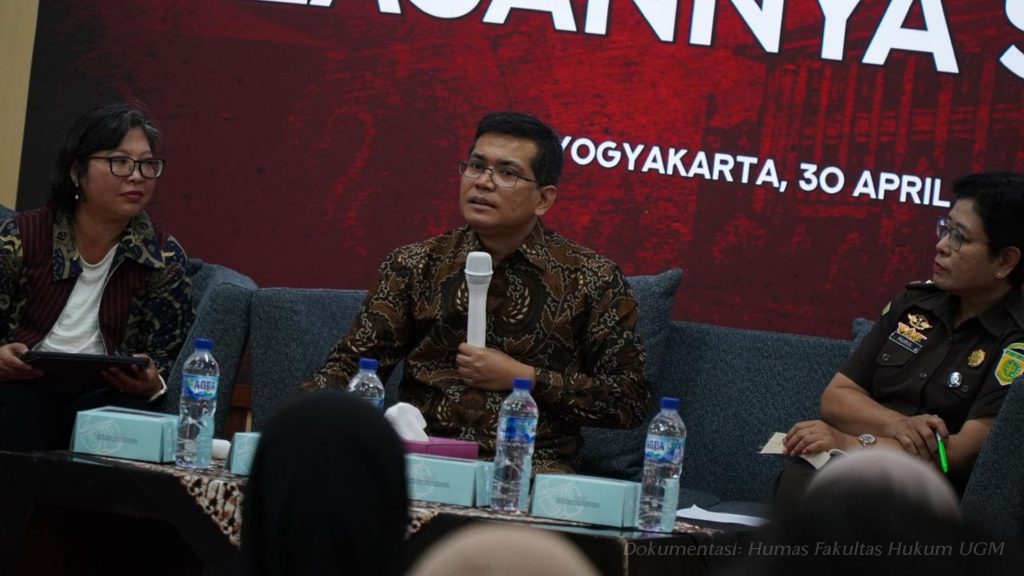
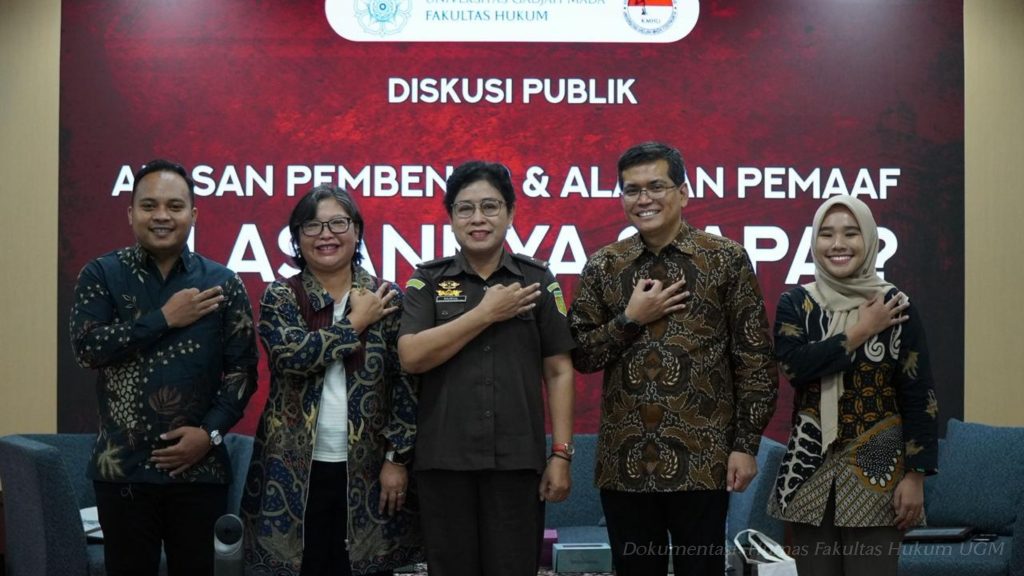
The Litigation Law Master’s Family (KMHLi) of the Faculty of Law, Universitas Gadjah Mada, held a public discussion on the conceptualization of justifications (alasan pembenar) and excuses (alasan pemaaf) in the National Criminal Code, titled “Justifications and Excuses: Whose Reasons?” on Thursday (30/4) at the Auditorium of Building B, Faculty of Law UGM. The event brought together academics and legal practitioners to examine Articles 31 to 44 of Law No. 1 of 2023 on the National Criminal Code before approximately 100 participants.
One of the speakers, Senior Prosecutor at the Special Region of Yogyakarta High Prosecutor’s Office, Nurul Fransisca Damayanti, S.H., M.H., presented the issue from a prosecutorial perspective. Prosecutors play a crucial role in formulating justifications and excuses from the early stages through indictments. This step is essential to ensure substantive justice, protect defendants, and maintain legal balance so that individuals are not punished for situations that should not be criminally sanctioned.
Another speaker, Vice Chief Judge of the Wates District Court, Dr. Supandriyo, S.H., M.H., emphasized the vital role of judges in assessing grounds for the elimination of criminal liability through rigorous evidentiary processes. He stressed that judges must not merely act as rigid “mouthpieces of the law,” but rather as enforcers of justice who balance legal principles with humanity. Judges are required to ascertain whether the alleged act actually occurred, whether the defendant is the rightful perpetrator, and whether all elements of the offense have been legally fulfilled.
Only after these evidentiary stages are satisfied can judges proceed to a deeper examination to determine the final verdict. This includes whether there are justifications (vrijspraak/acquittal), where the unlawfulness of the act is removed and the defendant is declared not guilty, or excuses (ontslag van rechtsvervolging/discharge from prosecution), where the act remains unlawful but the personal culpability of the defendant is negated.
This process underscores the importance of thoroughly examining grounds for the elimination of criminal liability through witness testimony, evidence, and even psychological conditions or pressures underlying the act. Such rigor ensures that judicial decisions remain accountable and are not merely shortcuts to absolve individuals.
Academic from the Faculty of Law UGM, Sri Wiyanti Eddyono, S.H., LL.M. (HR), Ph.D., explained that the National Criminal Code introduces significant reforms by providing clearer conceptual distinctions that were previously ambiguous in the old code. She emphasized that the determination of a criminal act does not end with the fulfillment of offense elements, but must distinguish between justifications, which eliminate the unlawfulness of the act (focusing on the act itself), and excuses, which remove the offender’s culpability despite the act remaining unlawful (focusing on the individual).
Academic from the Faculty of Law UGM, Sri Wiyanti Eddyono, S.H., LL.M. (HR), Ph.D., explained that the National Criminal Code introduces significant reforms by providing clearer conceptual distinctions that were previously ambiguous in the old code. She emphasized that the determination of a criminal act does not end with the fulfillment of offense elements, but must distinguish between justifications, which eliminate the unlawfulness of the act (focusing on the act itself), and excuses, which remove the offender’s culpability despite the act remaining unlawful (focusing on the individual).
This activity also aligns with the Sustainable Development Goals (SDGs), particularly Goal 16 (Peace, Justice, and Strong Institutions), which emphasizes the importance of fair, transparent, and accountable justice systems. In addition, the discussion supports Goal 4 (Quality Education) by strengthening academic capacity and legal understanding among students and practitioners. By promoting critical analysis of justifications and excuses, this initiative contributes to advancing a more equitable justice system grounded in human values.
Authors: Uun Zahrotunnisa, S.H. & Nurlaila Hasim, S.H. (KMHLi FH UGM)