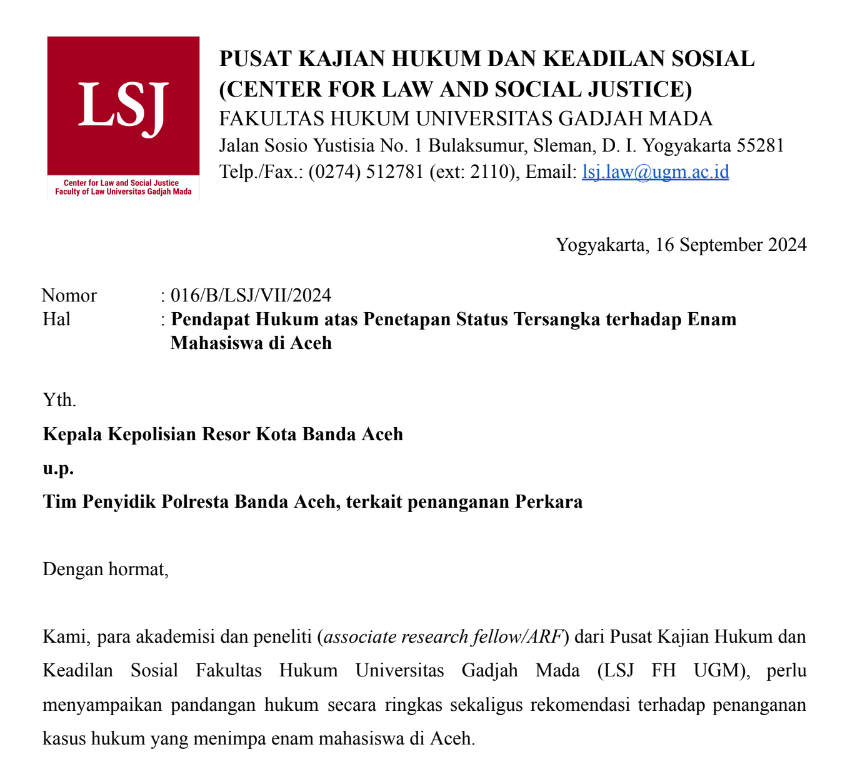
On Monday (September 16, 2024), the LSJ FH UGM released its Legal Opinion on the Suspect Status of Six Students in Aceh. Through a press release, the Banda Aceh Police named six students, including Y (23) and R (25), RB (25), Y (23), J (24), and TM (23), out of 16 who demonstrated in front of the Aceh DPR building, as suspects for hate speech.
This case is one of a series of criminalizations of freedom of opinion and expression, ultimately symbolizing the decline of democracy. This is despite guarantees for freedom of opinion and expression being enshrined in national and international human rights instruments inherent in the Indonesian legal system.
The LSJ FH UGM's legal opinion contains eight points. Several of these points highlight the police's erroneous distinction between criticism and hate speech. Furthermore, the police are not a group but rather a state apparatus, and therefore, criticism of them is a public effort to monitor the performance of government institutions.
The LSJ FH UGM also included several regulations that protect citizens' critical expression, such as the 1945 Constitution of the Republic of Indonesia; Law No. 12 of 2005; Law No. 2 of 2002; Law No. 39 of 1999; and the National Commission on Human Rights' National Standard of Conduct No. 5.
In this case, the LSJ FH UGM recommended four points to the Indonesian National Police (c.q. the Banda Aceh Police Chief). First, revoke the suspect status of the six Acehnese students charged with hate speech. Second, respect and promote the Surabaya Principles for Academic Freedom (2017), particularly regarding Principle 5, which states that "the authorities have a responsibility to respect, protect, and ensure the necessary steps to guarantee academic freedom." Third, remind the Indonesian National Police to act steadfastly professionally, uphold ethics, prioritize a humanitarian approach, never resort to violence, torture, or abuse, and avoid dirty and manipulative methods. Fourth, comply with, uphold, and follow developments in legal doctrine related to human rights values and standards, while upholding the principles of a democratic state based on the rule of law, as mandated by the constitution, in national life.
This legal opinion was submitted to the Banda Aceh Legal Aid Institute (LBH) for forwarding to the Banda Aceh Police. Through this legal opinion, it is hoped that law enforcement officers will be able to distinguish between criticism and critical expression, thereby preventing similar criminalization cases from occurring again.
Legal opinion and Recommendation for Meila can be accessed through this link: bit.ly/PendapatKasusMahasiswaAceh
Writer : Markus Togar Wijaya (LSJ)