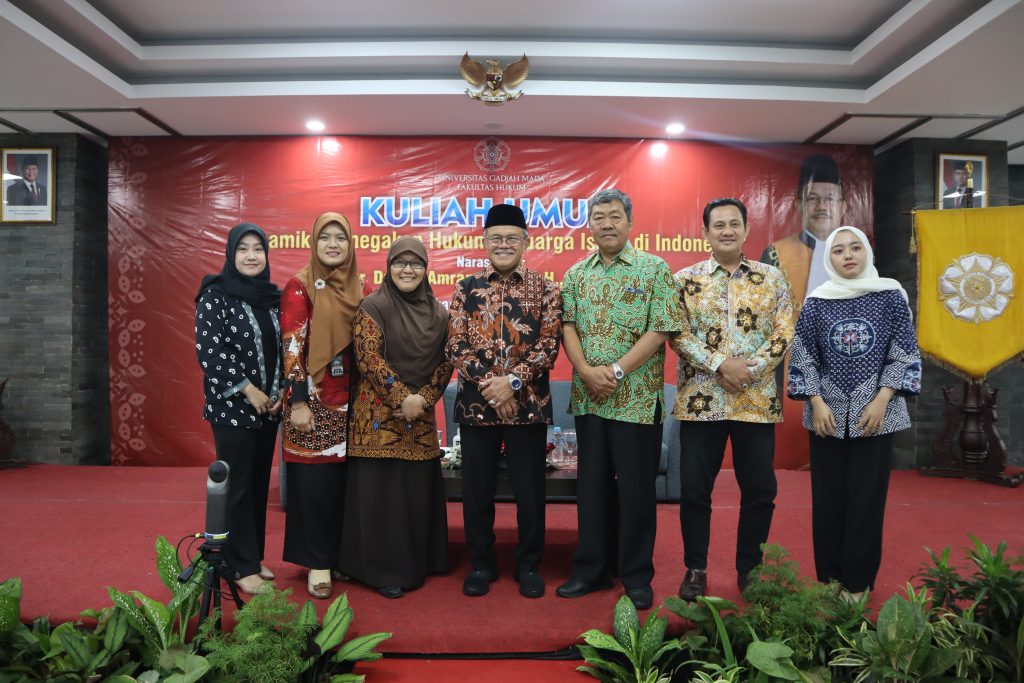
The Department of Islamic Law at the UGM Faculty of Law hosted a public lecture on the topic “The Dynamics of Enforcing Islamic Family Law in Indonesia.” This public lecture was held on Thursday, February 27, 2025, at the Auditorium of Building B, UGM Faculty of Law. Participants included students enrolled in the courses Islamic Marriage and Inheritance Law (HPKI) and PLKH Religious Courts, as well as master’s students from the UGM Faculty of Law. The public lecture featured a guest speaker who is both a practitioner and an academic: Prof. Dr. Drs. H. Amran Suadi, S.H., M.Hum., M.M., who serves as the Junior Chair of the Religious Chamber of the Supreme Court of the Republic of Indonesia for the 2017–2024 term and is a Full Professor at UIN Sunan Ampel Surabaya.
The public lecture began with an introduction by the moderator, Dr. Hartini, S.H., M.Si., Head of the Department of Islamic Law at the Faculty of Law, UGM. Dr. Hartini explained the purpose of the public lecture, which was to provide insight into the dynamics of enforcing Islamic family law in Indonesia, particularly in the courts within the Religious Court system. Through this public lecture, students are expected to gain a better understanding of various legal phenomena in society and their enforcement, both in the field of marriage law and in the field of Islamic inheritance law, such as registered and unregistered marriages, children born out of wedlock, mandatory bequests, adopted children, and others.
During the public lecture, Prof. Amran Suadi explained the concept of Islamic family law, its development and dynamics, as well as reforms in Islamic family law—including updates to the Compilation of Islamic Law, Supreme Court regulations and circulars, and court rulings. The Supreme Court plays a crucial role in the process of reforming Islamic family law. It fulfills this role through the authority and functions vested in the Supreme Court—namely, through the rulings it issues, from courts of first instance up to the Court of Cassation—as well as through its regulatory functions exercised via PERMA and SEMA instruments.
The reform of Islamic family law is also carried out through plenary sessions. Since the first session was held in 2012, numerous resolutions from the plenary sessions of the Religious Chambers have been formalized through SEMA. At least 25 major issues have been addressed through this plenary mechanism, 14 of which pertain to the rights of women and children. Some of these issues include child custody, marriage, annulment of marriage, itsbat nikah, divorce, divorce for civil servants and members of the Indonesian National Armed Forces (TNI) and National Police (POLRI), iddah alimony, mut’ah, and madhiyah alimony, child recognition, and others. This demonstrates the Supreme Court’s role in responding to the evolving dynamics of enforcing Islamic family law in Indonesia.
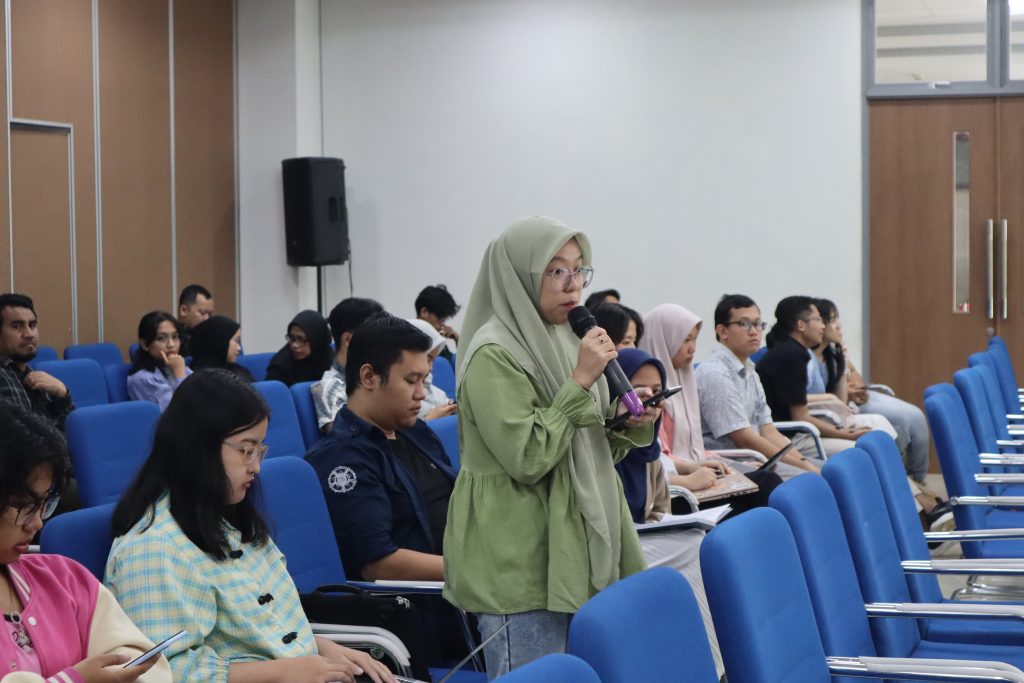
Throughout the lecture, Prof. Amran Suadi also shared many of his experiences as a judge in the Religious Courts, explaining the specific nature of Islamic marriage law in Indonesia and its unique aspects in certain practices, as well as the considerations judges take into account when ruling on cases related to Islamic family law.
The public lecture concluded with three rounds of Q&A sessions, demonstrating the participants’ extraordinary enthusiasm for exploring issues related to Islamic family law. The speaker provided comprehensive responses, offering insights not only from an academic perspective but also from practical experience in the Religious Courts. This public lecture served not only as an educational platform but also as a means to foster collaboration and strengthen cooperation among institutions, particularly between the Department of Islamic Law and the Supreme Court, as well as its subordinate agencies.
The UGM Faculty of Law, through the Department of Islamic Law, continues to strive to provide excellent legal education and promote the sustainable development of legal scholarship. This effort is also aligned with the fourth indicator of the Sustainable Development Goals (SDGs), namely quality education.
Author: Dita Elvia Kusuma Putri (Instructor, Department of Islamic Law)