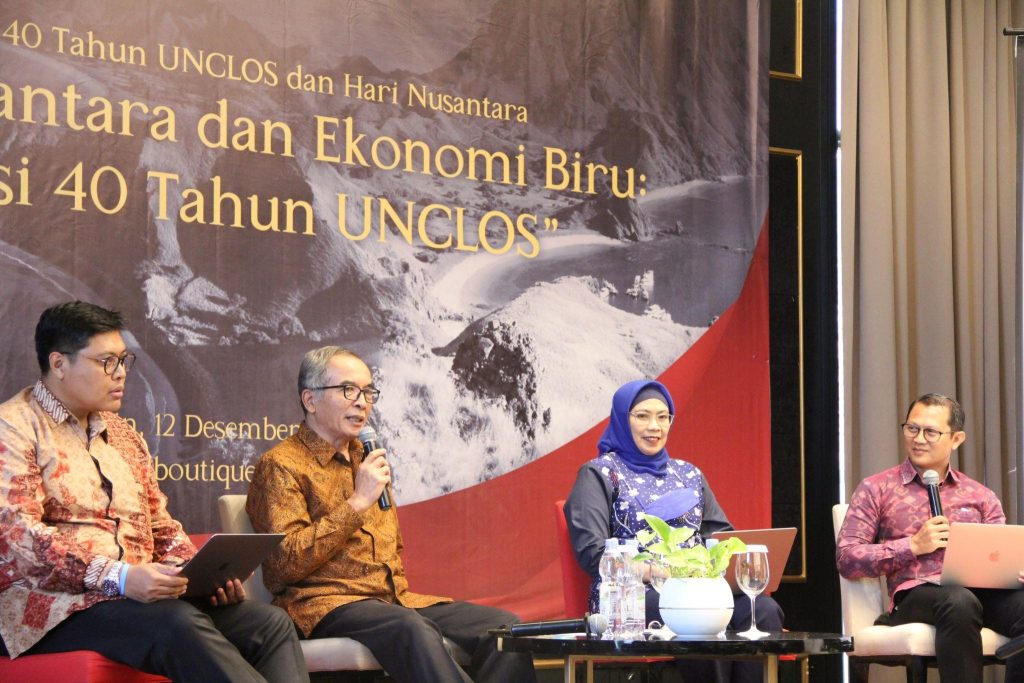
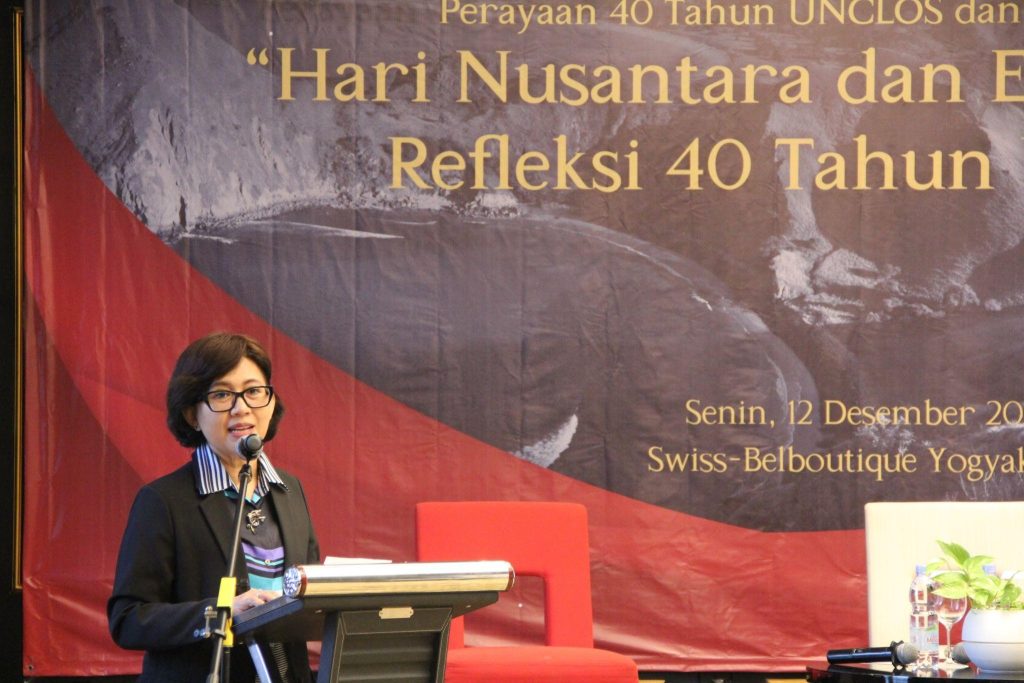
Indonesia's Ministry of Marine Affairs and Fisheries and FH UGM jointly held a seminar celebrating the 40th anniversary of the United Nations Convention on the Law of the Sea (UNCLOS), titled "Archipelago Day and the Blue Economy: Reflecting on 40 Years of UNCLOS." It took place on Monday, December 12, 2022, in the Pandawa Room at the Swiss-Bell Boutique Hotel Yogyakarta.
The seminar was opened with remarks from FH UGM Dean Dahliana Hasan, S.H., M.Tax., Ph.D.; UGM Rector Prof. dr. Ova Emilia, M.Med.Ed., Sp.OG(K)., Ph.D.; and Indonesia's Minister of Marine Affairs and Fisheries, Ir. Sakti Wahyu Trenggono, M.M.
In a video message, the Minister recounted the history of the Juanda Declaration, championed by past leaders, which eventually led to UNCLOS. He stressed that serious attention from government and academia is needed to prepare strategic steps addressing maritime issues, including cultivating the next generation of experts.
The Minister also outlined five priority programs of the Ministry based on the Blue Economy concept: (1) expanding conservation areas, with a target of 30% closed conservation zones to support oxygen production, carbon absorption, and fish-sorting functions; (2) implementing measured, quota-based fishing policies across six designated fishing zones; (3) developing environmentally friendly aquaculture in coastal and inland waters, focused on high-value products like shrimp, crab, lobster, seaweed, and fish; (4) protecting coastal areas and small islands from damage caused by uncontrolled economic activity; and (5) promoting a "Love the Sea" month as part of Indonesia's commitment to keeping oceans clean and free of plastic waste.
“These five priority programs need support from all stakeholders, including national and international laws and regulations,” Sakti added.
Seminar and Q&A
The first session covered "The History of the Juanda Declaration, Indonesia's Struggle in the International Law of the Sea Convention, and the Current State of UNCLOS Implementation,". moderated by Dr. Tini Martini, S.H., M.Soc.Sci., a senior legislative drafting expert at the Ministry of Marine Affairs and Fisheries.
Five speakers presented: (1) L. Amrih Jinangkung, S.H., LL.M. (Director General of Legal Affairs and International Treaties, Ministry of Foreign Affairs), speaking via Zoom on maritime and blue economy issues in the G20 context and future foreign policy priorities;. (2) Prof. Hasjim Djalal, M.A. (Professor of International Law, Universitas Padjajaran), speaking via Zoom on "Indonesia and 40 Years of UNCLOS"; (3) Prof. Dr. dr. Sutaryo, Sp.A(K) (a figure known for his attention to Indonesian maritime issues), on "Indonesia and 65 Years of the Djuanda Declaration"; (4) Prof. Stuart Kaye (Director of ANCORS, University of Wollongong), via Zoom, on "The Reflection of UNCLOS and its Nexus with Blue Economy"; and (5) First Admiral Kresno Buntoro, Ph.D. (Deputy Head of the Legal Development Agency of the Indonesian National Armed Forces), on "UNCLOS and Law Enforcement at Sea: Challenges and Hopes Ahead."
The speakers agreed that UNCLOS provides protection for the blue economy and marine ecosystems, and that Indonesians should be grateful to the figures who fought for the country's maritime legal sovereignty. They noted that ocean-economy welfare can be measured against the UN Sustainable Development Goals ,and achieving UN Sustainable Development Goals requires good ocean governance including through norm-building processes as a form of achieving good ocean governance. Discussion of maritime law was tied to real-world cases and enforcement, which should rest on principles such as effective command and control, effective intelligence gathering and distribution, effective international law, international partnerships, effective domestic law, availability of assets, and well-trained human resources.
After the presentations, participants engaged in Q&A and discussion, touching on national and international maritime cases such as gaps in understanding of maritime boundaries and Indonesia's Archipelagic Sea Lanes (ALKI), resolving maritime disputes, and implementing the blue economy.
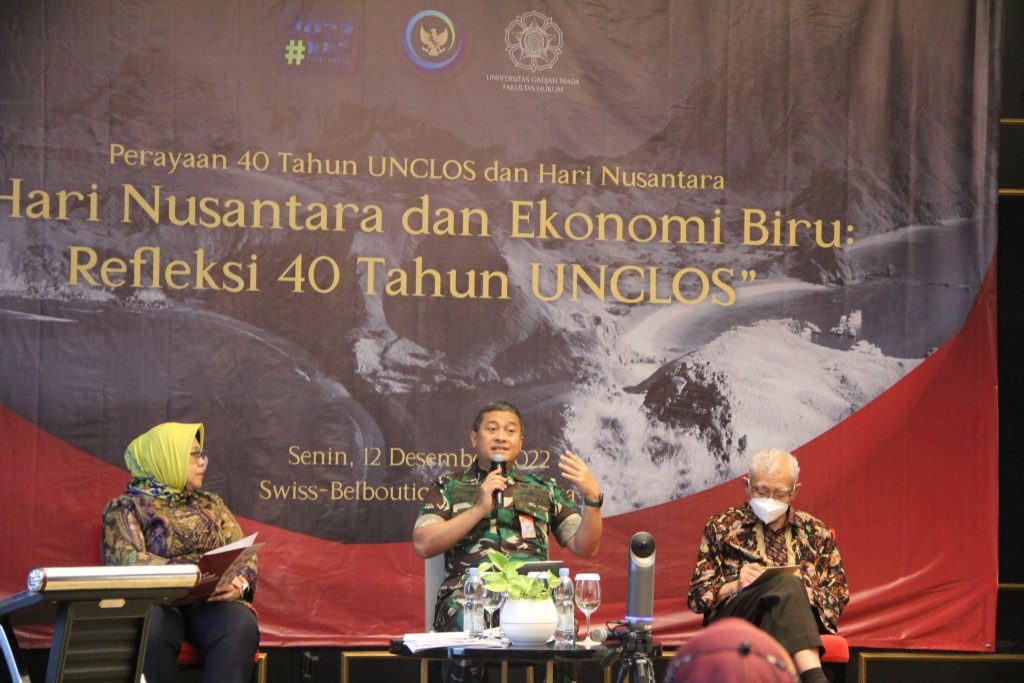
Talkshow and Discussion
The second session was a talkshow on "Future Challenges of UNCLOS," moderated by I Made Andi Arsana, S.T., M.E., Ph.D., a lecturer in UGM's Geodetic Engineering Department.
Three speakers took part: (1) Zaki Mubarok, Ph.D. (Coordinator for Law of the Sea and Treaties, Legal Bureau of the Ministry of Marine Affairs and Fisheries), on the Ministry's priority programs and UNCLOS; (2) Dhiana Puspitawati, S.H., LL.M., Ph.D. (lecturer, Faculty of Law, Universitas Brawijaya), on "Reflecting on 40 Years of UNCLOS and Indonesia: Legal Gaps in Indonesia"; and (3) Prof. Dr. Marsudi Triatmojo, S.H., LL.M. (lecturer, FH UGM), on "The Role of Educational Institutions in Preparing Law of the Sea Experts."
The session was framed as an interactive discussion, with participants actively raising questions on topics like empowering practitioners, maritime sustainable development, and strengthening regulation. Recommendations emerging from the speakers included that Indonesia should continue playing an active role in international forums related to implementing the blue economy , including venturing beyond its own jurisdictional waters — and that collaboration between academics and practitioners is needed to build strong expertise in the field.
The seminar was intended to build participants' awareness and knowledge about ocean protection and encourage continued attention to law-of-the-sea issues to help preserve marine sustainability.