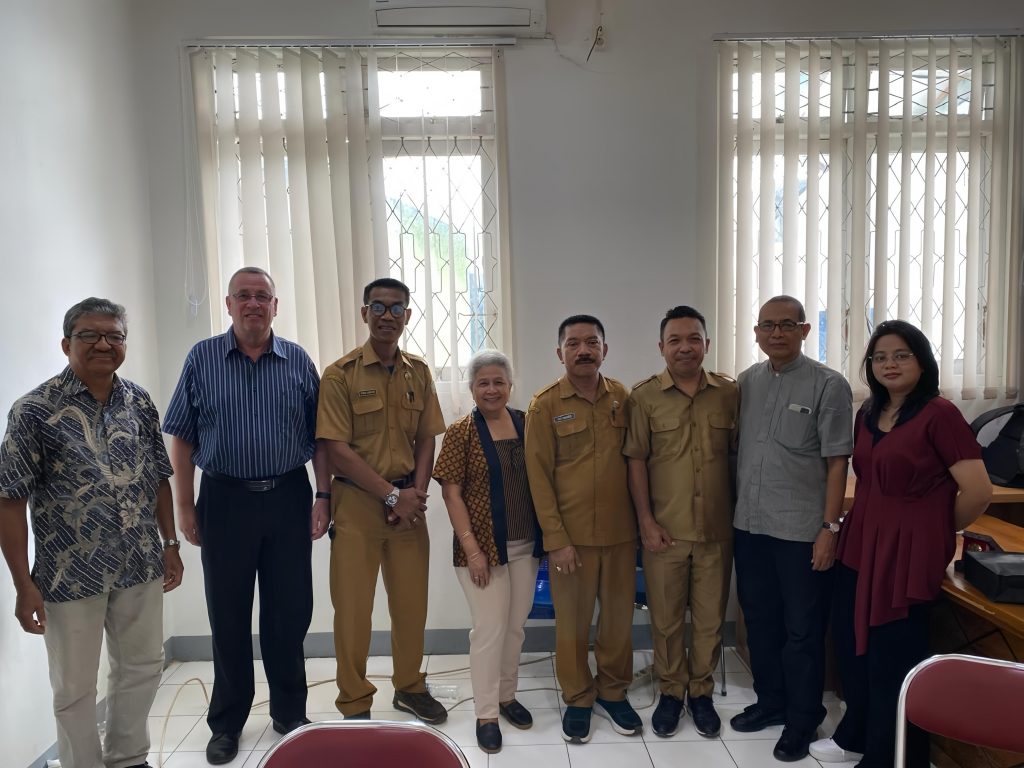
As part of a series of capacity-building activities, the Department of Agrarian Law at the Faculty of Law, Gadjah Mada University, conducted an academic visit to the Office of Public Works, Spatial Planning, Housing, and Settlement Areas of West Manggarai Regency. The event took place on Tuesday (June 24, 2025). The event was held at the agency’s office located in Gorontalo, Komodo Subdistrict, West Manggarai, from 9:00 AM to 12:00 PM WITA. The visit was attended by six representatives from the Department, namely Dr. Jur. Any Andjarwati, S.H., M.Jur., as Department Head; Prof. Dr. Nurhasan Ismail, S.H., M.Si.; Prof. Dr. Thomas Schmitz; Dr. Rikardo Simarmata, S.H.; Rafael Edy Bosko, S.H., M.IL.; and Anggita Mustika Dewi, S.H., M.Kn.
The discussion addressed spatial planning policies, land use, and water resource management in the Labuan Bajo area and its surroundings. Topics covered included the alignment between spatial planning and on-the-ground practices, potential conflicts in land use, the utilization of coastal zones, and water distribution for tourism, community, and agricultural needs. This visit also served as an opportunity to understand the realities of implementing the Regional Spatial Plan (RTRW) as well as the various dynamics and conflicts surrounding land use in this nationally strategic tourism area.
This activity aims to deepen academic understanding of contemporary agrarian issues and enrich teaching materials in the field of agrarian law. In addition to bridging the gap between theory and practice, this visit is expected to open avenues for collaboration between the academic community and local governments in achieving equitable and sustainable land management.
This visit is closely linked to various Sustainable Development Goals (SDGs). First, this activity supports SDG 4 on quality education by strengthening academic understanding of spatial planning and agrarian issues, as well as enriching teaching materials based on real-world field experiences. Furthermore, discussions on spatial planning policies and the management of strategic tourism areas support SDG 11 on inclusive, safe, resilient, and sustainable cities and human settlements. Discussions regarding water distribution for communities, tourism, and agriculture also reflect contributions to SDG 6 on clean water and sanitation, which emphasizes the importance of equitable and sustainable access to water. Additionally, issues regarding the use of coastal areas and the protection of strategic zones support SDG 13 on climate action and SDG 15 on terrestrial ecosystems, by prioritizing the importance of environmental protection in spatial planning. Finally, the collaboration between academics and local governments in this initiative demonstrates the concrete implementation of SDG 17 on partnerships for the goals, which emphasizes the importance of multi-stakeholder synergy in supporting sustainable development.
Writer: Part-time Staff, Department of Agrarian Law, Faculty of Law, UGM