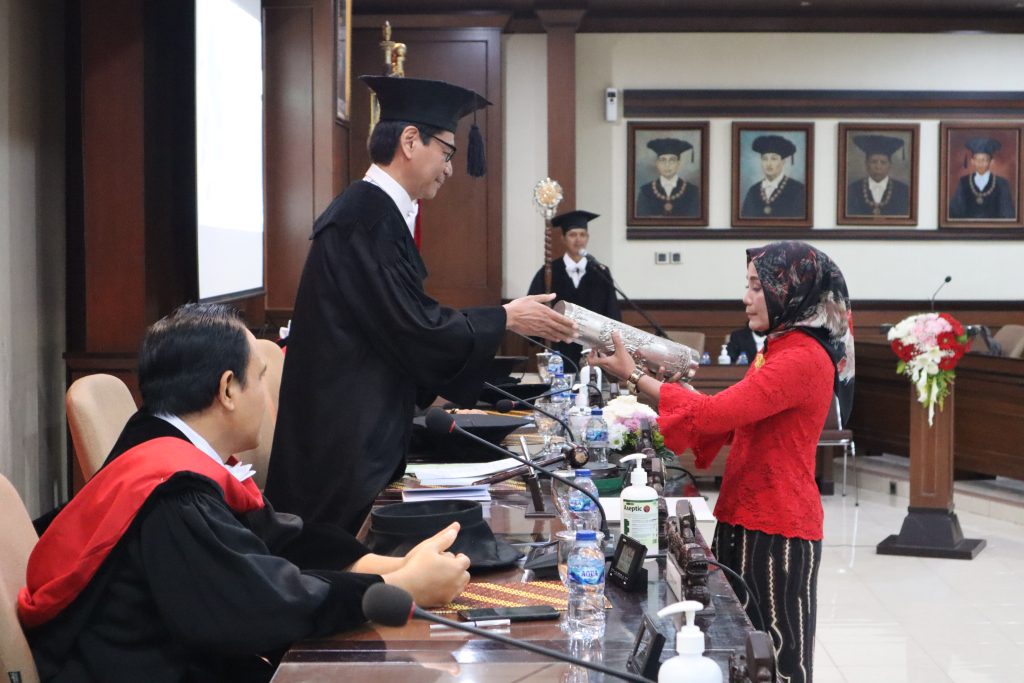
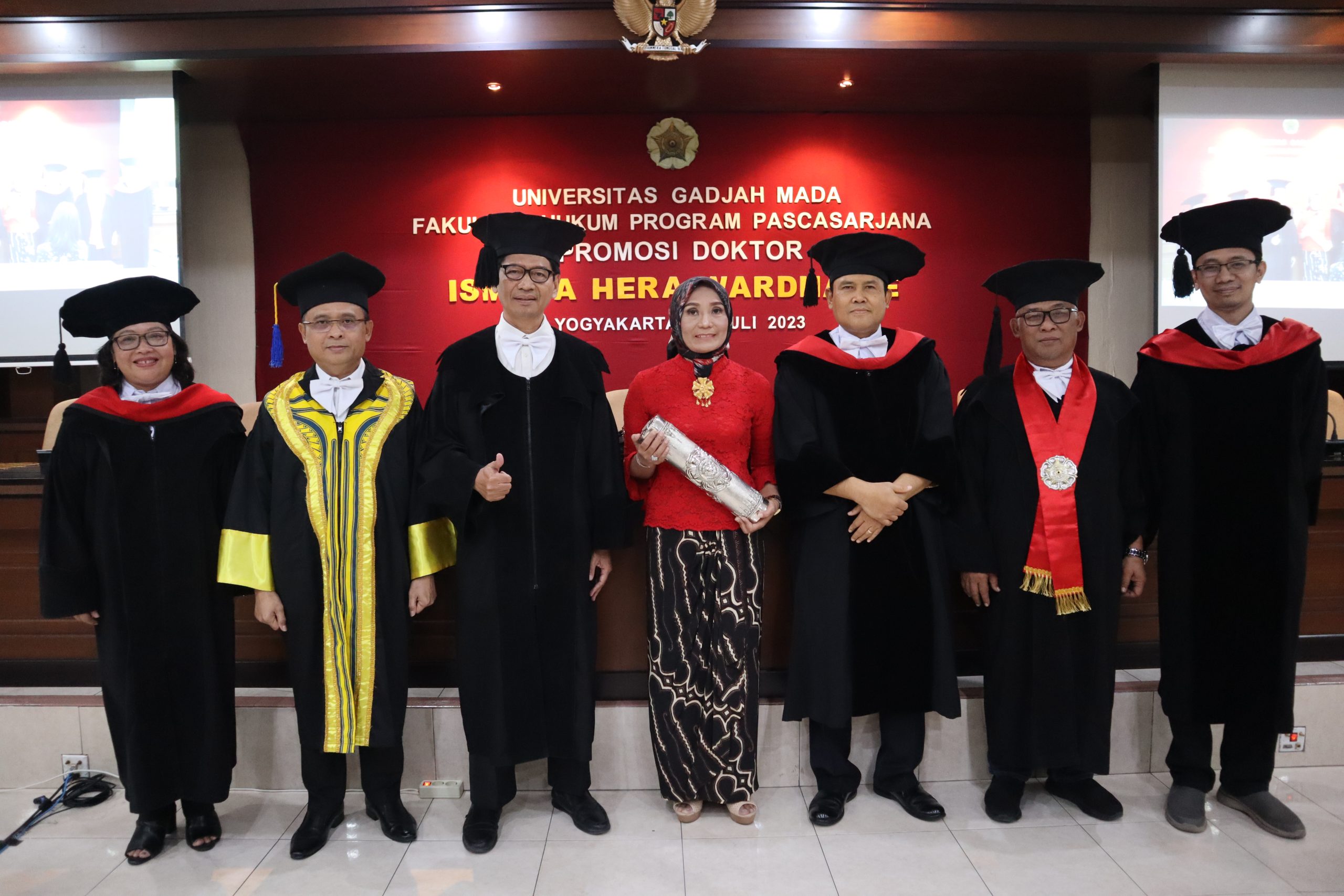
Ismaya Hera Wardhanie, S.H., M.Hum., recently defended her doctoral dissertation at the Faculty of Law, Gadjah Mada University, with a research paper titled “Legal Reconstruction of the Restitution of State Financial Losses in Corruption Crimes through the Additional Penalty of Payment of Restitution” on Friday (February 28). For this doctoral defense, the supervisor was Prof. Dr. Edward O.S. Hiariej, S.H., M.Hum., and the co-supervisor was Dr. Supriyadi, S.H., M.Hum. Meanwhile, the examination committee consisted of Hanafi Amrani, S.H., M.H., LL.M., Ph.D.; Prof. Dr. Marcus Priyo Gunarto, S.H., M.Hum.; Sri Wiyanti Eddyono, S.H., LL.M. (HR).; Ph.D., Richo Andi Wibowo, S.H., LL.M., Ph.D., and Prof. M. Hawin, S.H., LL.M., Ph.D., who served as the chair of the examination committee.
There are two main topics of discussion in the doctoral candidate’s dissertation. The first examines the legal issues surrounding the recovery of financial losses to the state in corruption cases through the additional penalty of restitution. The second proposes a legal framework to optimize the recovery of financial losses to the state in corruption cases through the additional penalty of restitution.
In this dissertation, the doctoral candidate cites the 2020 Corruption Perceptions Index (CPI), which shows that the perception of corruption in Indonesia stands at 37 on a scale of 0–100, where a score of 0 indicates “highly corrupt” and a score of 100 indicates “highly clean.” The doctoral candidate also refers to 2020 data from Indonesia Corruption Watch (ICW), which reveals that of the 1,218 corruption cases in Indonesia, the largest number—321 cases—were committed by civil servants (ASN), followed by 286 cases involving the private sector.
Meanwhile, according to Law No. 20 of 2001, corruption is a criminal offense that causes financial or economic loss to the state. The element of financial or economic loss to the state is clearly stipulated in Articles 2 and 3 of the Law on the Eradication of Corruption (UUPTPK). If the state suffers economic or financial loss, efforts must be made to recover such losses.
“Essentially, law enforcement officials must use all available legal tools or instruments to recover losses caused by acts of corruption,” the doctoral candidate emphasized. In this context, restitution is used as one means of compensating the state for its losses. According to the Anti-Corruption Law, restitution for financial losses to the state can be carried out through three legal instruments: criminal, civil, and administrative law. Legally, the defendant must pay restitution within one month after the court’s decision becomes final and binding. However, the subsequent stage—the seizure of the convicted person’s assets—is not clearly addressed in the Corruption Eradication Law.
“In practice, however, the enforcement of criminal sanctions for corruption has yielded suboptimal results, as evidenced by the high backlog of restitution payments at prosecutors’ offices across Indonesia,” explained the doctoral candidate. This stems from court rulings that set disproportionate amounts for restitution and substitute prison sentences. Another factor stems from differences of opinion between prosecutors and judges regarding the imposition of penalties on corruption perpetrators.
In this open defense, Ismaya Hera Wardhanie, S.H., M.Hum., successfully defended her research and was declared to have passed with a grade of A/B and the distinction of “highly satisfactory.” It is hereby announced that Ismaya Hera Wardhanie, S.H., M.Hum., is the 258th doctoral candidate to pass the examination at the UGM Faculty of Law and the 5,920th doctoral graduate of Gadjah Mada University.
Author: PDIH
Editor: Public Relations