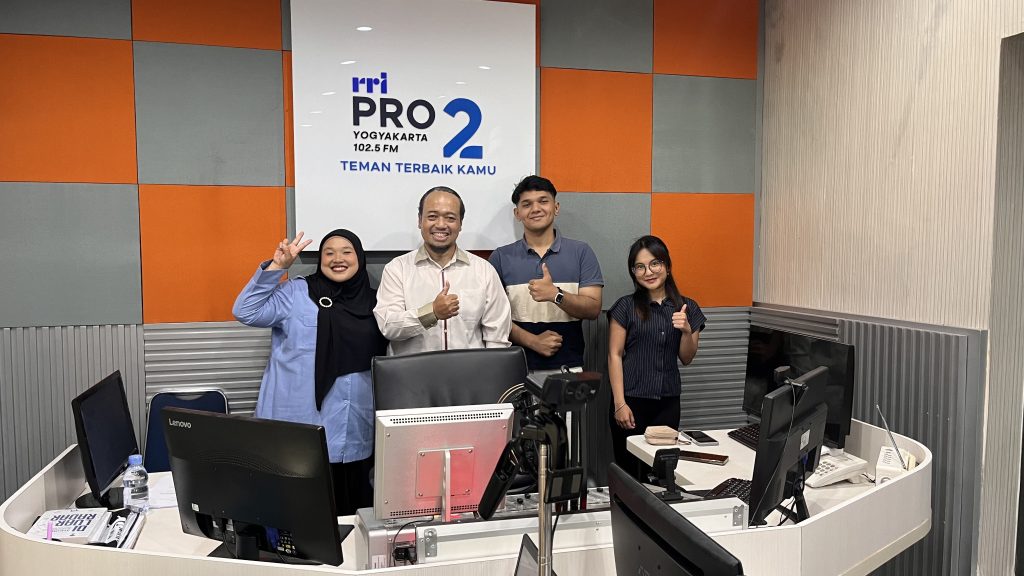
In this rapidly evolving digital age, electronic transactions via e-commerce have become an integral part of people’s lifestyles. However, this convenience is often not accompanied by adequate legal literacy, leading to various disputes between sellers and buyers. In response, a team of law students from Gadjah Mada University (UGM) Faculty of Law, members of the ALSA Local Chapter UGM, hosted a legal awareness program on RRI PRO 2 Yogyakarta radio on Wednesday (December 3, 2025) at 12:00 PM WIB.
This event featured a collaboration between academics from different generations: Eko Rial Nugroho, S.H., M.H., a professor of civil law at the Islamic University of Indonesia (UII), and Nigel Abdullah, an undergraduate student majoring in civil law at FH UGM. Hosted by broadcaster Vina Mufiana, the discussion addressed the crucial topic titled “Electronic Contracts in E-commerce Apps.” This event was part of the Legal Outreach Grant program organized by the Center for Legal Consultation and Assistance (PKBH) at the UGM Faculty of Law, in which Nigel Abdullah, along with his team—Claudia Nathasya Ronalaff Hutahean and Theresia Averina Florentina—sought to provide inclusive legal education that directly benefits the broader public.
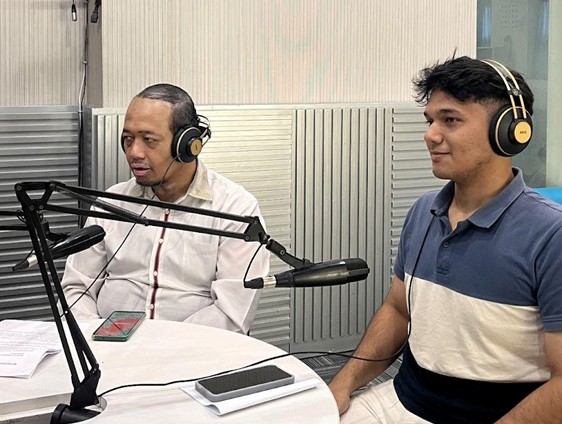
During this interactive discussion, the conversation focused on the validity of electronic agreements, a topic that is often misunderstood. Eko Rial Nugroho, S.H., M.H., highlighted the phenomenon of minors checking out items without their parents’ permission. Legally, although the age of majority under the Civil Code is 21, legal practice in Indonesia now refers to the age of 18. Transactions conducted by minors are considered to violate the subjective requirement of a contract, namely legal capacity. As a legal consequence, such contracts are deemed voidable. This means the contract remains valid as long as no party voids it; however, parents have the legal right to void the transaction and restore the situation to its original state.
Furthermore, Nigel Abdulah explained the concept of agreements in the digital realm. Contrary to the common assumption that agreements must be in writing or bear a wet signature, civil law recognizes the concept of a “silent agreement.” The act of clicking the checkout button or transferring money is considered a valid form of consent because a “meeting of minds” has occurred. Transfer receipts and transaction histories within the app are also recognized as valid legal evidence under the ITE Law.
The discussion also touched on the practice of exculpatory clauses, in which sellers often include unilateral rules such as “Purchased items cannot be returned.” The speakers emphasized that such clauses are prohibited by the Consumer Protection Law and are null and void. Consumers are still entitled to compensation if the goods they receive are defective—even without an unboxing video—provided the defect can be proven. Regarding dispute resolution, the public is advised to pursue civil proceedings or mediation through the Consumer Dispute Resolution Board (BPSK) to have their rights restored, rather than criminal proceedings, which are more time-consuming and costly.
This legal education initiative is strongly aligned with the goals of sustainable development. First, SDG No. 4 (Quality Education). This broadcast provides access to non-formal legal education to the general public via radio, enhancing digital literacy and inclusive consumer law awareness. Second, SDG No. 12 (Responsible Consumption and Production). By understanding their rights and obligations in electronic transactions, the public is encouraged to become smart and critical consumers, while businesses are encouraged to act honestly and refrain from using harmful clauses. Third, SDG No. 16 (Peace, Justice, and Strong Institutions). Knowledge of dispute resolution mechanisms (civil vs. criminal) and the existence of the BPSK provide the public with access to justice, ensuring that the law protects the interests of all parties fairly and transparently.
Writer: Theresia Averina Florentina