Amid an academic routine filled with assignments, students sometimes forget that the law isn’t just about articles and clauses. It’s also about people. That is the spirit championed by the Asian Law Students’ Association (ALSA) Local Chapter at Gadjah Mada University (LC UGM) through the organization of the ALSA Care Legal and Coaching Clinic (CLCC) 2025, a series of activities that are not only informative but also full of empathy.
This year, ALSA LC UGM successfully organized the ALSA CLCC LC UGM 2025 event series under the theme “Empowered to Be Heard, Protected to Be Healed.” CLCC is one of ALSA LC UGM’s key programs, which this year focused on ensuring the right to health for people living with HIV/AIDS (PLHIV) and sought to expand and promote collaborative strategies to achieve sustainable HIV/AIDS services.
The ALSA CLCC LC UGM 2025 activities consisted of several main components: the Pre-Event, Social Event, and Legal Event. These three components were designed to complement one another, ranging from raising public awareness about the issue, to community empowerment, and advocacy.
Pre-Event
This year’s CLCC Pre-Event was divided into two activities. First, the HIV Awareness Booth, held from Monday, September 29, 2025, to Tuesday, September 30, 2025, at the UGM Philosophy Cafeteria. The booth featured a photo booth, a “Spin the Fact” wheel, and the distribution of educational pamphlets. The goal of the booth is to improve students’ literacy and knowledge about HIV/AIDS through educational and interactive means.
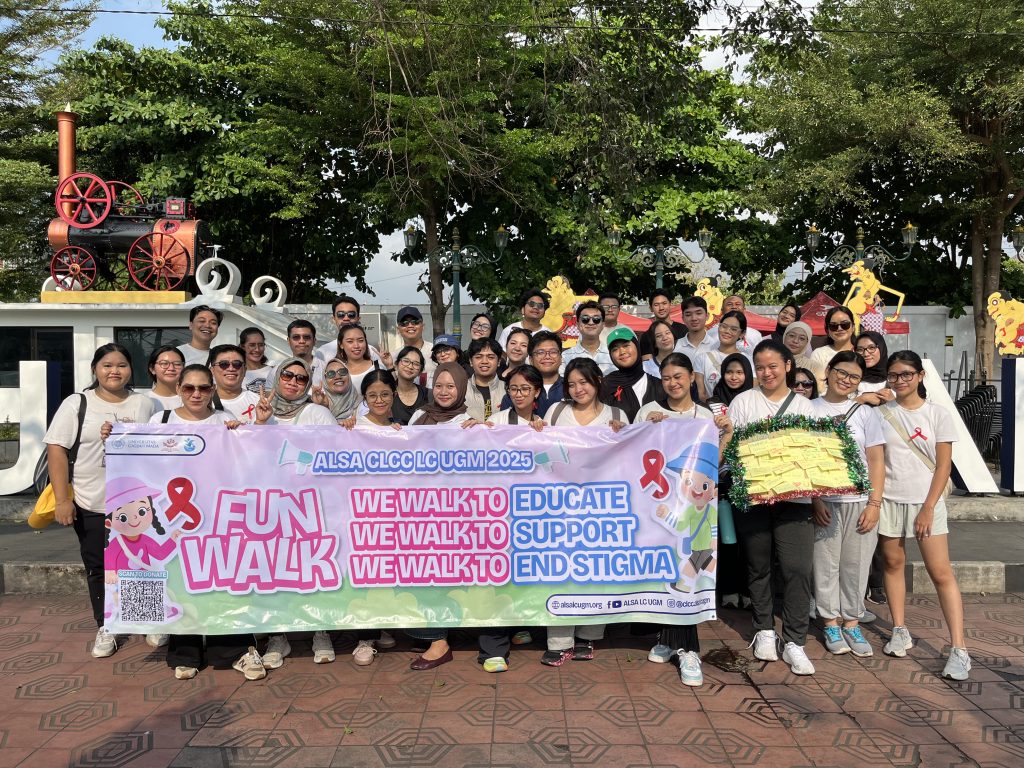
Second, a Fun Walk with friends from the Victory Plus Foundation in Yogyakarta along Tugu Golong Gilig Street on Sunday (October 19, 2025). This series of events directly demonstrates to the public that everyone has the right to a healthy life free from negative stigma. This Fun Walk aims to uphold the spirit of “Zero New Infections, Zero Discrimination, Zero AIDS-related Deaths” as part of the national “Three Zeros” target, which is also emphasized by the central government through various health regulations, including Health Law No. 17/2023 and DIY Regional Regulation No. 3/2023 on HIV/AIDS prevention and control.
Social Event
The Social Event held on Saturday (November 1, 2025) was a deeply human-centered activity. The event was divided into two sessions. The first was a journaling session led by Claudia Zulfiana S.Psi., M.Psi., a professional psychologist. During this session, members of the Victory Plus Foundation learned to find peace and acceptance within themselves through guided reflection and a sharing session. This was followed by a crafting session to make bag charms—an activity that may seem very simple but is believed to create a warm atmosphere and provide a safe space for members of the Victory Plus Foundation to explore their creativity.
This social event was organized jointly by HPU FH UGM and the Victory Plus Foundation in Yogyakarta, an NGO that has long played a vital role in providing psychosocial support, tracking patients who have discontinued ARV treatment, conducting educational programs, and offering counseling to partners of people living with HIV. The Victory Plus Foundation has long relied on grants from the Global Fund for its operations. These grants are now at risk of being cut off due to policies by international donors—particularly the United States—which have decided to halt the majority of global health funding through USAID. This threat highlights just how fragile support for people living with HIV (PLHIV) becomes when international funding is cut off.
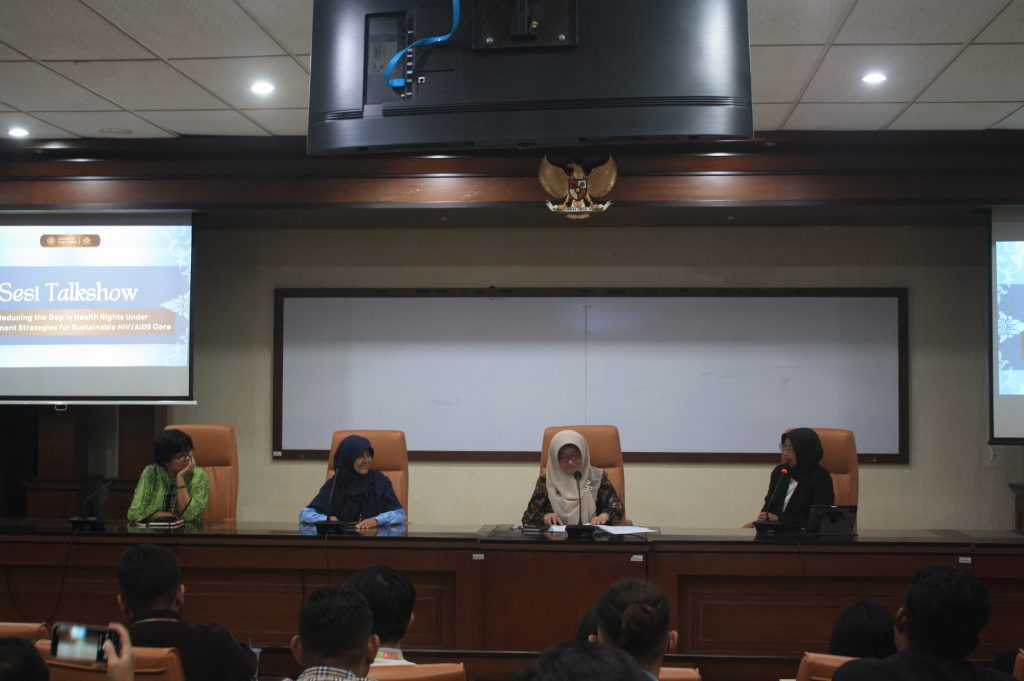
The highlight of the ALSA CLCC UGM 2025 series of activities is the Legal Event. This event is presented in the form of a talk show held on Tuesday, November 4, 2025, at the UGM Faculty of Law, with the theme “Reducing the Gap in Health Rights through Government Strategies for Sustainable HIV/AIDS Care.” The event featured three speakers: Prof. dr. Yanri Wijayanti Subronto, Ph.D., Sp.PD-KPTI, a clinician and academic specializing in infectious diseases such as HIV/AIDS; drg. Emma Rahmi Aryani, M.M., Head of the Yogyakarta City Health Office; and dr. Ari Kurniawati, MPH. Head of the Communicable and Non-Communicable Disease Control Section at the DIY Health Office. During this session, the panelists analyzed HIV/AIDS issues from a policy perspective and through the real-world experiences of medical professionals.
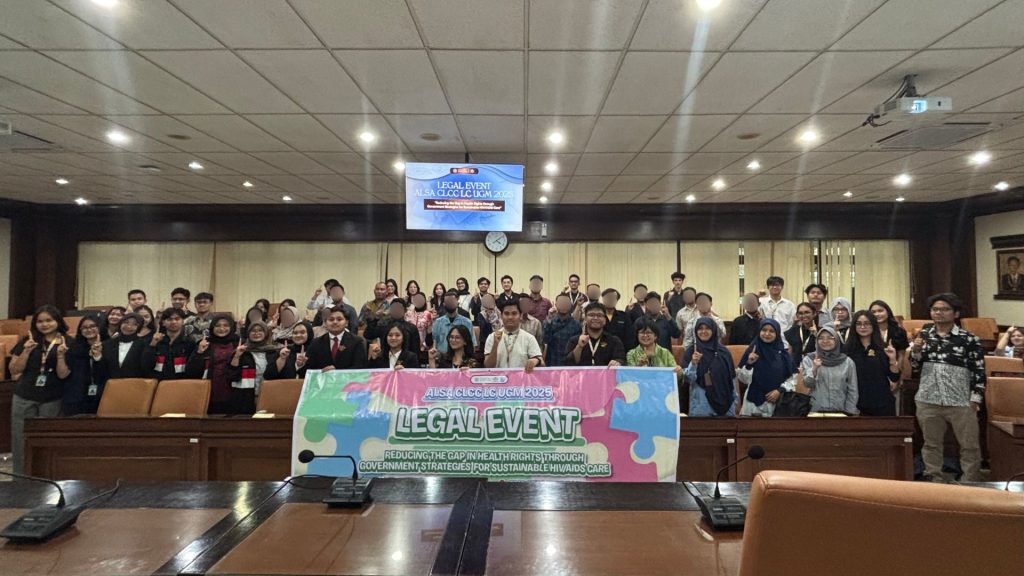
The results of the discussion confirmed and reinforced that stigma remains the greatest and most fundamental barrier in the Outreach phase, as findings in the Policy Brief show that 71% of cross-sectional studies documented a significant association between stigma and non-adherence to ARV therapy. This negative stigma causes PLHIV to hesitate to get tested, fear disclosing their status, and consequently delay accessing treatment. This situation has a direct impact on the “Identify” stage, where the population that needs to be reached remains the hardest to identify due to various social, administrative, and financial barriers. As a result, many new cases are not detected until they have reached the late stages of the disease, highlighting how far we still are from achieving effective screening in the field.
During the “Treat and Retain” phase, the challenges become more complex because they are directly linked to the sustainability of funding and coordination among institutions and agencies. Although Indonesia has begun domestic production of ARVs, threats to the efficiency of the state budget could undermine the stability of drug distribution in regions such as the Special Region of Yogyakarta (DIY). Meanwhile, during the “Retain” phase, challenges often arise due to suboptimal cross-regional coordination. This results in high rates of patients lost to follow-up, some of which are even triggered by stigma from the health agencies or service providers themselves. This Legal Event ultimately aims to emphasize that HIV/AIDS is not merely a common disease, but encompasses a broader issue that demands synergy in policy-making, forms of social support, and a rapid, sustainable response from the government.
The ALSA LC UGM 2025 Policy Brief highlights the theme “HIV/AIDS Financing Strategies to Close the Health Rights Gap,” which addresses the urgency of the funding crisis for HIV/AIDS services in the Special Region of Yogyakarta (DIY) due to the potential withdrawal of foreign donors, who have long been the mainstay of the sustainability of health programs for people living with HIV/AIDS (PLWHA). Reliance on Global Fund grants poses a serious risk if a well-thought-out transition strategy is not prepared immediately. In their analysis, the authors also identified major obstacles to the implementation of the STOP strategy (Screen, Treat, Optimize, Retain), particularly regarding stigma, early screening, the stability of antiretroviral (ARV) drug distribution, and high rates of patients dropping out of treatment (lost to follow-up).
As a solution, this policy brief recommends developing a strategy for funding self-reliance through innovative mechanisms such as the “Zimbabwe AIDS Levy”—a scheme for raising funds from a specific tax that is managed transparently and allocated to ensure the sustainability of HIV/AIDS support and services. In addition, a humanitarian approach is also considered crucial through the implementation of Popular Opinion Leaders (POL) training for health workers to change the culture of service delivery and reduce discrimination. It is hoped that these recommendations will encourage preventive measures by the local government so that Yogyakarta can achieve its goal of becoming AIDS-free by 2030 without relying on foreign funding. The full Policy Brief can be accessed via bit.ly/PolicyBriefALSACLCCLCUGM.
The ALSA CLCC 2025 series of activities makes a tangible contribution to achieving the Sustainable Development Goals (SDGs) through various forms of education, advocacy, and community empowerment. This program supports SDG 3 (Good Health and Well-being) by improving public health literacy, strengthening understanding of HIV/AIDS, and promoting sustainable health services for people living with HIV/AIDS. In the context of education, these activities also advance SDG 4 (Quality Education) by providing inclusive, evidence-based learning spaces for both students and the general public. Efforts to combat stigma and discrimination against people living with HIV also contribute to SDG 10 (Reduced Inequalities) by creating a safer and more equitable environment for vulnerable groups. Furthermore, the development of policy briefs, multi-stakeholder dialogues, and policy advocacy align with SDG 16 (Peace, Justice, and Strong Institutions), as they strengthen equitable and responsive health governance. All of these activities also demonstrate the power of inter-institutional collaboration—among student organizations, government agencies, and community support organizations—thereby simultaneously supporting SDG 17 (Partnerships for the Goals). Thus, ALSA CLCC 2025 is not only an educational movement but also a vital part of the younger generation’s contribution to strengthening sustainable development.
Author: Myiesha Maleyka Gunawan (ALSA LC UGM)