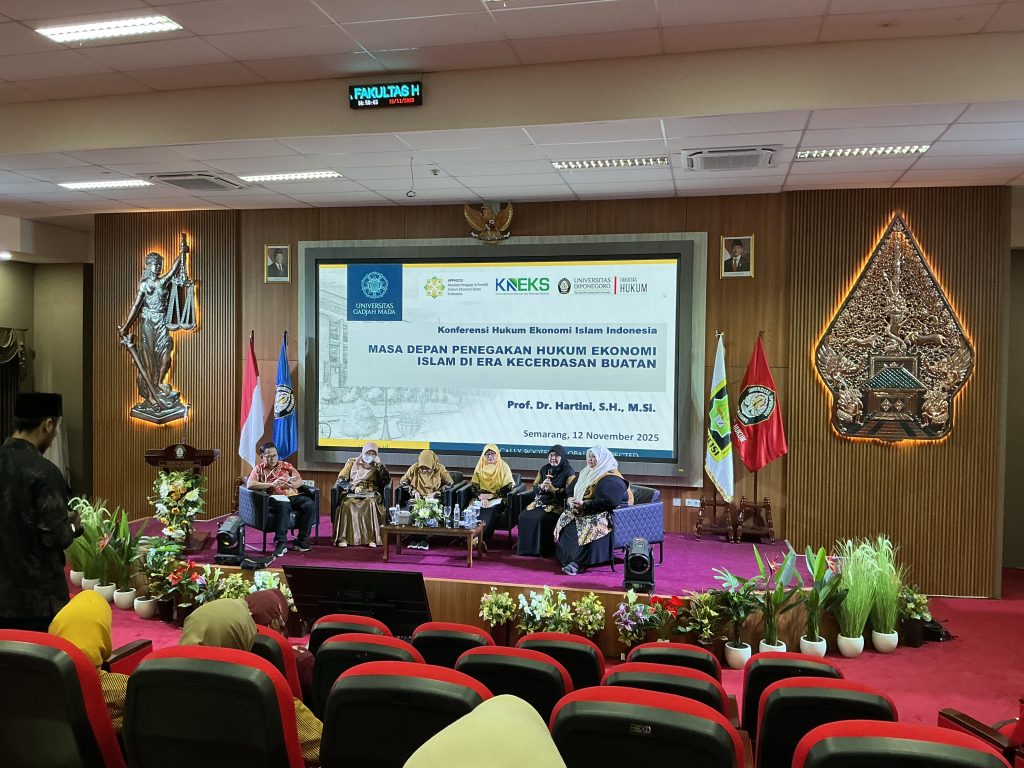
The Association of Indonesian Teachers and Researchers in Islamic Economic Law (APPHEISI), in collaboration with the National Committee on Sharia Economics and Finance (KNEKS) and the Faculty of Law at Diponegoro University, organized a new Islamic Economic Law Conference with the theme “The Transformation of Indonesian Sharia Economic Law in the Era of Artificial Intelligence.” The event took place on Friday (September 12, 2025) at the Faculty of Law, Diponegoro University. At this conference, Prof. Dr. Hartini, S.H., M.Si., from the Department of Islamic Law at the Faculty of Law, UGM, had the opportunity to serve as a speaker in the plenary session alongside four other academics from various universities: Prof. Dr. Helza Nova Lita, S.H., M.Hum., from Padjadjaran University; Prof. Dr. Neneng Nurhasanah, Dra., M.Hum., from Bandung Islamic University, Prof. Ro’fah Setyowati, S.H., M.H., Ph.D., from Diponegoro University, and Dr. Fiska Silvia Raden Roro, S.H., M.M., LL.M., from Airlangga University. The event was also attended by KH. Sholahudin Al Aiyub, M.Si., Chair of the MUI’s Sharia Economics and Halal Division and Executive Director of KNEKS (National Committee on Sharia Economics and Finance), as well as lecturers and researchers in Islamic economic law from various universities in Indonesia.
On that occasion, Prof. Dr. Hartini, S.H., M.Si., delivered a presentation on “The Future of Enforcing Islamic Economic Law in the Era of Artificial Intelligence.” She explained that one indicator of a well-functioning rule-of-law state is its success in enforcing the law. Law enforcement is the process of making efforts to ensure the upholding or proper functioning of applicable legal norms that have been established as guidelines for behavior in legal transactions or relationships within human society and the state. Some of the recommendations presented by Prof. Dr. Hartini, S.H., M.Si, include the following: 1) It is necessary to reconceptualize evidence in Sharia civil cases; 2) Formulate regulations governing the legal status of artificial intelligence (AI)—whether as a legal entity distinct from individuals or legal entities, or as a legal entity other than individuals or legal entities; 3) Examine the legal implications of this legal status on legal liability; 4) Artificial intelligence (AI) is more appropriately utilized as a reference tool and a means of improving administrative efficiency, rather than as a decisive factor in the resolution of Sharia economic disputes, since the case resolution process relies heavily on intuition and the interconnections between legal facts that can only be possessed and understood by humans, 5) The use of blockchain-based smart contracts needs to be discussed, given that one of the challenges is that blockchain systems are generally accessed via cryptocurrency. Regarding cryptocurrency as a commodity or asset, the 7th Decision of the Ijtima Ulama of the Indonesian Fatwa Commission on the Law of Cryptocurrency states that crypto assets are not permitted to be used as a means of transaction, and 6) Intellectual property rights related to AI-generated products and their implications for security interests. The session featured very active discussions, both from the presenters and the participants.
This event is closely linked to two SDG goals, namely SDG 4 (Quality Education) and SDG 16 (Peace, Justice, and Strong Institutions). This conference contributes to SDG 4 by enhancing the quality of education and research in Islamic economic law to make it more adaptable to technological advancements. In addition, recommendations regarding the importance of AI regulation, legal accountability, and limitations on the use of AI in sharia economic dispute resolution support SDG 16, by promoting the development of a stronger, fairer, and more accountable legal system in Indonesia.
Author: Dita Elvia Kusuma Putri (Instructor, Department of Islamic Law)