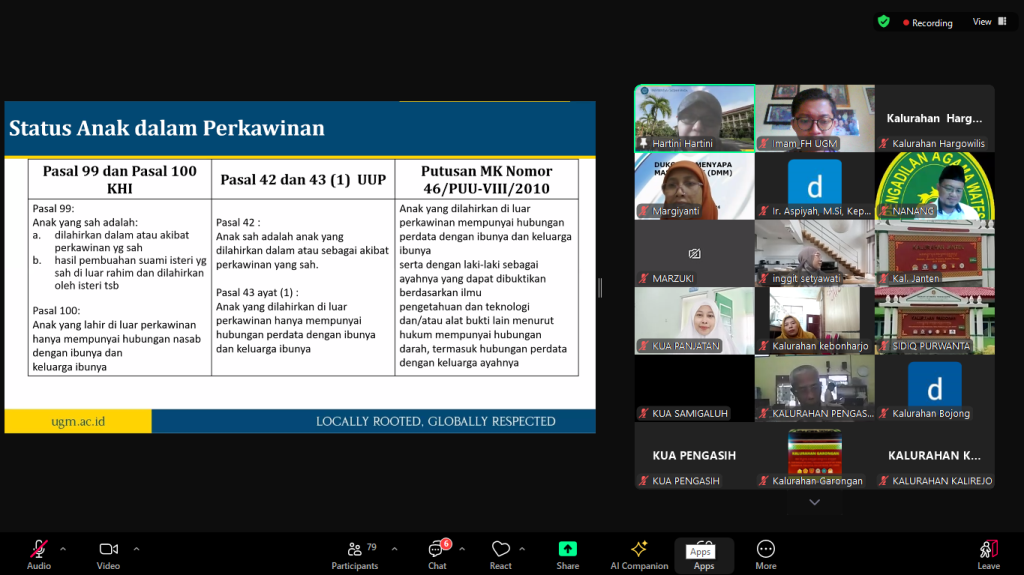
The Kulon Progo Regency Government, through the Population and Civil Registration Office, held the "Dukcapil Menyapa Masyarakat" (Dukcapil Greets the Community) event. The event, held on Monday (26/08/2024), raised the theme "Recording Children Born Out of Wedlock on Population Documents." The event was held online via Zoom meeting. The event was attended by 115 people, consisting of village heads from across Kulon Progo Regency, Heads of KUA from across Kulon Progo Regency, and employees within the Kulon Progo Regency Population and Civil Registration Office. In this event, lecturer and Head of the Department of Islamic Law, Faculty of Law, UGM, Dr. Hartini, S.H., M.Si., had the opportunity to be a resource person and provide answers during the discussion session.
Dr. Hartini presented material on “The Status of Children in Marriage and Its Implications for the Registration of Population Documents”. Dr. Hartini’s presentation was intended to enrich the academic theoretical perspective. This was to complement the previous material which was a practical perspective. The material was delivered by the Head of the Population and Civil Registration Office of Kulon Progo Regency, Ir. Aspiyah, M.Si., with the title “Recording of Children Born Out of Wedlock on Population Documents” and Judge and Chief Justice of the Wates Religious Court, Nanang Moh. Rofi’i Nurhidayat, S.Ag., on “Practice of the Authority of Religious Courts in Determining the Status of Children”.
Dr. Hartini's response sparked a more comprehensive and in-depth discussion. Her presentation broadened the scope of issues related to the application of various religious court authorities. One example is the recognition of found children through the istilhaq institution, which falls under the jurisdiction of religious courts. However, it is not yet widely practiced by the community. Furthermore, Dr. Hartini also addressed various issues related to the registration of illegitimate children based on academic research.
Such activities need to be continuously enhanced to foster stronger cross-sectoral collaboration to address the issue of fulfilling civil rights for children, particularly those born out of wedlock. Regardless of the circumstances of a child's birth, based on the principle of the child's best interest, they are still entitled to proper population registration as stipulated in the Child Protection Law (Law Number 23 of 2002 in conjunction with Law Number 35 of 2014).
Writer : Mastri Imammusadin (Department of Islamic Law)