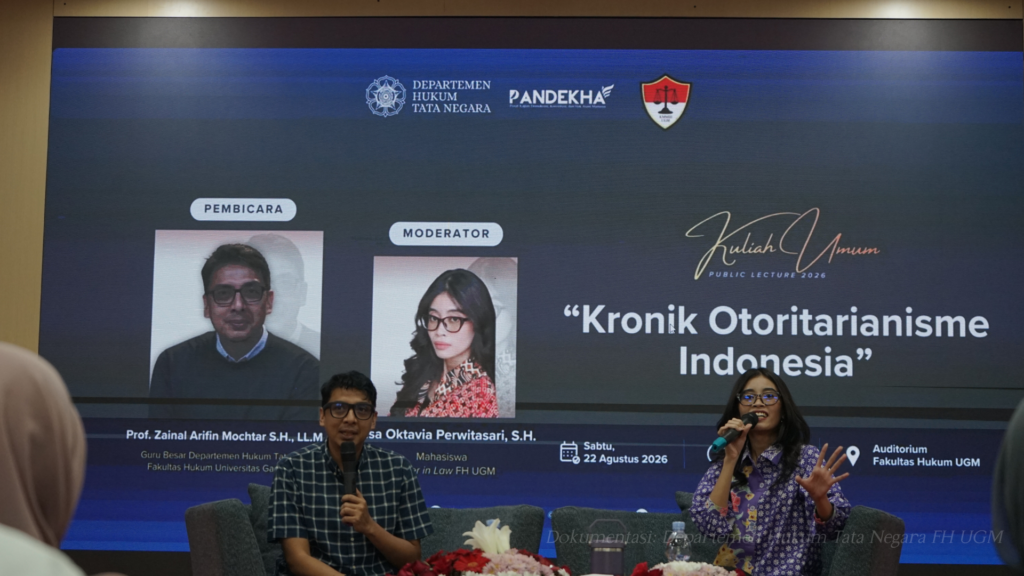
The Department of Constitutional Law of the Faculty of Law, Universitas Gadjah Mada (FH UGM), in collaboration with the Center for the Study of Democracy, Constitution, and Human Rights (PANDEKHA) FH UGM and the UGM Faculty of Law Master of Laws Student Association (KMMIH FH UGM), held a public lecture titled “A Chronicle of Indonesian Authoritarianism.” The public lecture took place on Saturday, August 22, 2026, at the FH UGM Auditorium. The event was organized for undergraduate students enrolled in the regular and International Undergraduate Program (IUP) who are taking courses offered by the Department of Constitutional Law or pursuing a concentration in Constitutional Law.
The public lecture featured Prof. Dr. Zainal Arifin Mochtar, S.H., LL.M., Professor of Constitutional Law at FH UGM and author of Kronik Otoritarianisme Indonesia (A Chronicle of Indonesian Authoritarianism), who discussed how authoritarianism has developed and transformed throughout Indonesia’s constitutional history. Before the presentation, Prof. Andy Omara, S.H., M.Pub&Int.Law., Ph.D., Head of the Department of Constitutional Law at FH UGM, delivered the opening remarks. The discussion was moderated by Anisa Oktavia Perwitasari, S.H., a Master of Laws (LL.M.) student at FH UGM and a junior researcher at PANDEKHA, who introduced the relevance of past experiences of authoritarianism to the current dynamics of power and democracy in Indonesia.
Prof. Zainal Arifin Mochtar opened his presentation by addressing the fundamental question of why states require power to regulate social life. According to him, the need for authority must always be accompanied by limitations to prevent power from developing into unchecked authority. Such limitations can be established through the separation of powers among the executive, legislative, and judicial branches, as well as the division of authority between the central and regional governments. From this framework, he turned to the central question explored in A Chronicle of Indonesian Authoritarianism: how authoritarianism can persist, change form, and operate even within a system that is formally characterized as democratic. He explained that the book combines analyses of law, norms, institutions, political competition, and the accumulation of power with archival research and news reports from different periods to provide a more critical understanding of the development of political power.
He explained that the history of Indonesian authoritarianism can be understood through three main periods. First, the period from 1945 to 1959, when President Soekarno’s power became increasingly concentrated, culminating in the Presidential Decree of July 5, 1959, which dissolved parliament on the grounds of safeguarding the state and democracy. Second, the New Order period, when President Soeharto’s power was supported by three main forces: the Armed Forces of the Republic of Indonesia (ABRI), the bureaucracy, and Golkar. The consolidation of political parties through the policy of party fusion narrowed political competition, while the dominance of the bureaucracy and Golkar made government power increasingly difficult to control. Third, the post-Reformasi period following 1998, when the fall of Soeharto was not fully accompanied by changes in political actors and power structures. Established forces subsequently reconsolidated, meaning that several reform agendas—including strengthening regional autonomy, abolishing the military’s dual function, and combating corruption—did not fully achieve their intended objectives.
To examine the development of authoritarianism in the present day, Prof. Zainal outlined several patterns that can be observed in everyday political life. First, victory in an election should not be understood as an absolute mandate for leaders to do whatever they wish, because sovereignty ultimately rests with the people and the exercise of power must remain subject to oversight. Second, democratic backsliding can occur gradually through leaders who have been legitimately elected, rather than always through coups or overt violence. Third, constitutional powers can be exercised aggressively in ways that appear formally lawful while simultaneously undermining the balance among state institutions. Fourth, political competition may continue to exist formally, while its outcome can nevertheless be predictable from the outset. Fifth, law can shift from serving as an instrument for limiting power to becoming a tool for legitimizing the actions of those in power. This final pattern illustrates a shift from a state governed by law toward the use of law in the interests of political power. He also highlighted economic inequality as a factor that strengthens oligarchy, whereby the concentration of wealth and control over resources can influence the distribution of political power.
The discussion also featured an interactive question-and-answer session between participants and the speaker, allowing for deeper exploration of the history and patterns of authoritarianism in Indonesia. One topic examined how younger generations can avoid repeating the trajectory of Reformasi activists who eventually became part of the very power structures they had once criticized. Prof. Zainal Arifin Mochtar emphasized the importance of maintaining consistency in critical thinking through the use of scientific methods, while also recognizing that access to higher education is a privilege that carries a social responsibility toward society.
The question-and-answer session also addressed the relationship between democracy and authoritarianism, the need to develop alternative political forces to counter concentrations of power and oligarchy, and how citizens make political choices amid limited alternatives. Prof. Zainal Arifin Mochtar concluded his presentation by emphasizing that understanding constitutional law requires more than simply reading constitutional texts; it also requires a critical examination of the practices of power underlying those texts. In his view, law students must maintain a critical stance so that educational institutions do not merely become instruments for legitimizing those in power. The public lecture is expected to broaden students’ understanding of the dynamics of authoritarianism in Indonesia while encouraging younger generations to understand, monitor, and critically assess the exercise of state power in a more responsible manner.
This public lecture is also expected to support the realization of the Sustainable Development Goals (SDGs), in particular SDG 16 on Peace, Justice, and Strong Institutions, which promotes the strengthening of the rule of law, the accountability of state institutions, and the prevention of abuses of power as the foundation for inclusive and responsive institutions, as well as SDG 10 on Reduced Inequalities, which encourages the narrowing of disparities through guarantees of meaningful political participation and equal representation for all citizens in public policymaking processes.
Author : Muhammad Imam Maulana (PANDEKHA FH UGM)