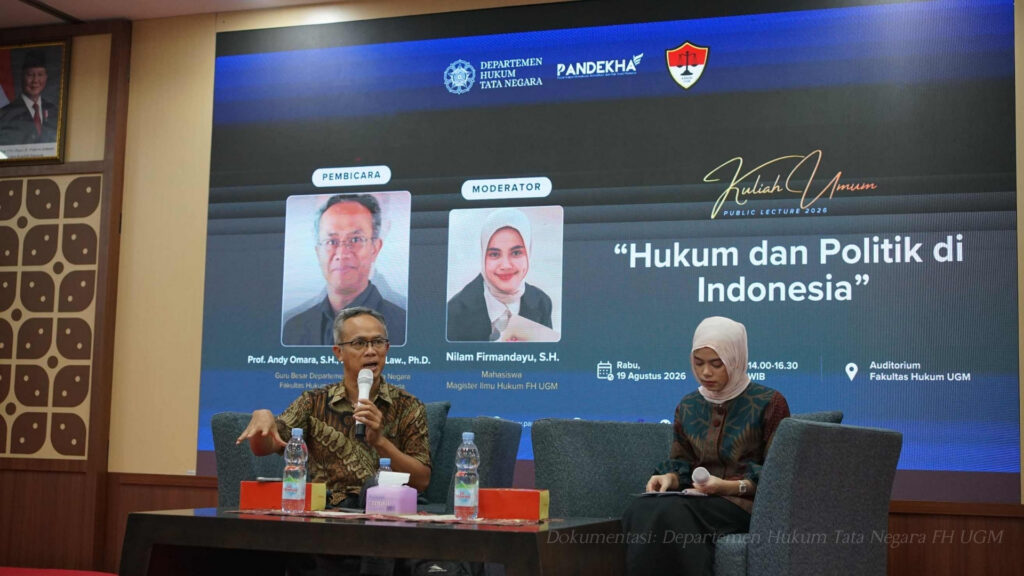
The Department of Constitutional Law at the Faculty of Law, Universitas Gadjah Mada (FH UGM), together with the Centre for Democracy, Constitutional Law, and Human Rights (PANDEKHA) FH UGM and the Graduate Law Students' Association (Keluarga Mahasiswa Magister Ilmu Hukum/KMMIH) FH UGM, organized a public lecture themed "Law and Politics in Indonesia". The lecture was held on Wednesday, August 19, 2026, at the Auditorium of the UGM Faculty of Law. It served as the inaugural lecture for undergraduate students from both the regular and the International Undergraduate Program (IUP) streams enrolled in courses offered by the Department of Constitutional Law or pursuing the Constitutional Law concentration.
The lecture featured Prof. Andy Omara, S.H., M.Pub. & Int.Law., Ph.D., Professor in the Department of Constitutional Law at FH UGM and an expert in constitutional law, comparative constitutional law, and law and politics. Nilam Firmandayu, a Master of Laws student at FH UGM and junior researcher at PANDEKHA, served as moderator. She opened the discussion by drawing attention to the phenomenon of political fatigue syndrome a condition of public exhaustion at the reality of politics, which fuels excessive disillusionment with a system of governance perceived as ineffective and as eroding public legitimacy.
Prof. Andy Omara opened his presentation by explaining that the relationship between law and politics in Indonesia can be read through three possibilities: law as a goal, law as a means of political interests in which law is subordinated to politics or law as an obstacle to excessive political interests. He cited the revision of the Corruption Eradication Commission Law (UU KPK) as a shift from law as a goal of anti-corruption efforts to law as a tool of political interests a pattern he argued was also visible in the Job Creation Law (UU Cipta Kerja) and the revisions to the National Armed Forces Law (UU TNI) and the National Police Law (UU Polri).
He argued that a democratic constitution does not automatically guarantee democratic practice as evidenced by Indonesia's history of operating widely divergent political systems under the same 1945 Constitution, from liberal democracy to guided democracy, to Pancasila democracy under the New Order, to emerging democracy in the post-Reform era. He highlighted the six key promises of the 1999-2002 constitutional amendments: the strengthening and limitation of the presidential system, decentralization, a constitutional guarantee of human rights, the rule of law, checks and balances mechanisms, and direct electoral democracy all of which, he argued, stand in stark contrast to current practice.
He outlined several indicators of democratic backsliding including re-centralization through policies such as the Merah Putih Village Cooperative (Koperasi Desa Merah Putih/KDMP) and the Free Nutritious Meals program, which carry a top-down character; a shift from the rule of law to rule by law; weakened parliamentary oversight functions due to an oversized government coalition; restricted powers for the Judicial Commission (Komisi Yudisial) and the Regional Representative Council (DPD); and the erosion of judicial independence illustrated by the DPR's unilateral removal of Constitutional Court Justice Aswanto and the conflict of interest in the Constitutional Court's ruling on the candidacy of Gibran Rakabuming Raka. He also criticized the reckless use of the Electronic Information and Transactions Law (UU ITE) as a tool for silencing freedom of expression and academic freedom, rather than as an instrument for securing electronic transactions as originally intended.
The session also included an interactive Q&A between participants and the speaker to deepen the discussion of law and politics in Indonesia. In response to one participant's question about plans to establish a State University of the Republic of Indonesia (Universitas Republik Indonesia/URI), Prof. Andy Omara stated that he saw no adequate urgency for such a policy given that hundreds of universities already exist across Indonesia and the policy was not preceded by a proper academic paper or feasibility study. He questioned whether citizens' constitutional rights to education, and other considerations, might be compromised by budget allocations directed to a new institution.
The Q&A session also touched on administrative discretion, the correlation between the middle class and the quality of democracy, the limits of acceptable democratic backsliding in emergency situations, the possibility of structural reforms toward federalism or parliamentarianism, and the influence of political interests on the determination of the presidential candidacy threshold (presidential threshold). Prof. Andy Omara closed his presentation by emphasizing that understanding law requires more than reading the text alone it also demands engagement with the academic paper and the legislative deliberation transcripts behind a law, so that law students are not trapped in a textual interpretation that loses sight of the political context underpinning it.
This public lecture is hoped to enrich students' understanding of the dynamics of law and politics in Indonesia, while fostering a critical disposition among the younger generation toward accountable governance grounded in the rule of law. The lecture is also hoped to support the realization of the UN Sustainable Development Goals (SDGs) specifically SDG 16 (Peace, Justice, and Strong Institutions), which promotes the strengthening of the rule of law, institutional accountability, and the eradication of corruption and abuse of power as the foundation of inclusive and responsive institutions; and SDG 10 (Reduced Inequalities), by promoting reduced inequality through the guarantee of meaningful political participation and equal representation for all citizens in the public policymaking process.
Author : Muhammad Imam Maulana (PANDEKHA FH UGM)