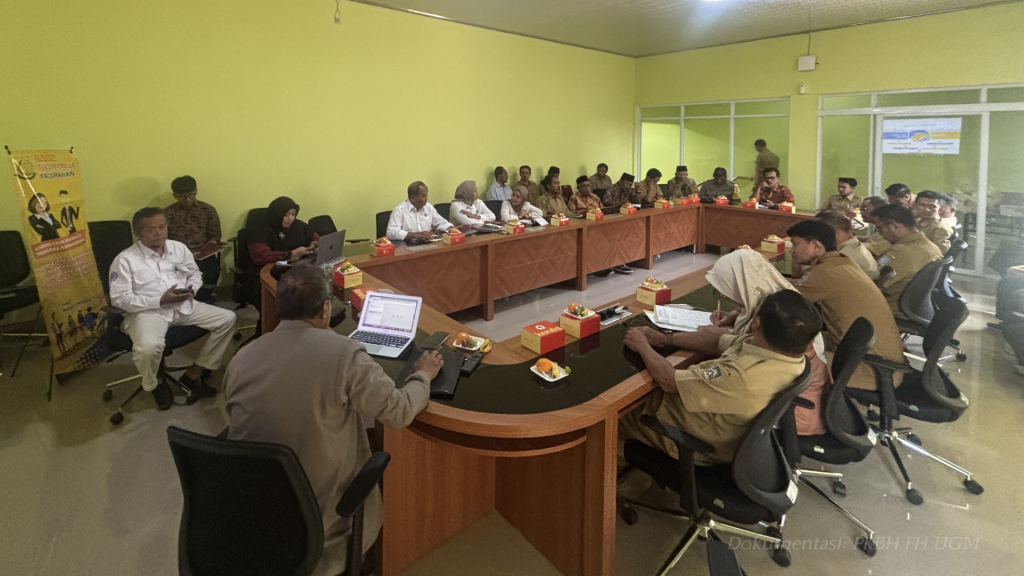
On Monday, July 13, 2026, the Faculty of Law, Universitas Gadjah Mada (FH UGM), through its Center for Legal Consultation and Aid (PKBH), in collaboration with the High Prosecutor's Office of the Special Region of Yogyakarta (Kejati DIY), successfully organized a collaborative legal dissemination event titled "Suluh Praja." The event was held at the Tirtomartani Village Office, Kalasan Sub-district (Kapanewon), Sleman Regency. This legal dissemination serves as a form of multi-sectoral synergy, bringing together academia through the presence of FH UGM lecturers and Law Enforcement Officials (APH) represented by State Attorneys from Kejati DIY. The event aimed to enhance legal awareness and address various empirical issues regarding the topics of Village Treasury Land Management, Islamic Inheritance Law, and Neighboring Rights and Obligations for all Tirtomartani Village Officials (Pamong).
The event commenced with a warm welcome from the Village Head (Lurah) of Tirtomartani, Mr. H. Indra Gunawan, S.H., who warmly received and highly appreciated the implementation of the "Suluh Praja" Legal Dissemination. The agenda then proceeded with a presentation on the Main Tasks and Functions (Tupoksi) of the Civil and Administrative Law Division (Datun) delivered by representatives from Kejati DIY.
Moving into the core session of the dissemination, the first presentation on Village Treasury Land was delivered by Dr. Rimawati, S.H., M.Hum. In her presentation, Dr. Rimawati thoroughly analyzed the latest regulatory legal frameworks concerning the utilization of village treasury land in DIY. She elaborated on the classifications of permissible land use under the governor's regulation, thereby providing a solid legal foundation for village officials to execute land utilization legally, accountably, and free from the risks of malpractice or misappropriation.
Subsequently, the second presentation regarding Islamic Inheritance Law was delivered by Dr. Yulkarnain Harahab, S.H., M.Si. During his presentation, he highlighted the urgency of understanding equitable Islamic inheritance law within rural communities to minimize the potential for family-related civil disputes. Dr. Yulkarnain emphasized the importance of mastering the fundamentals of Islamic inheritance law applicable in Indonesia as a normative asset for providing public education, while concurrently facilitating the orderly, just, and harmonious settlement and administration of citizens' inheritance.
The presentation session concluded excellently with the third topic on Neighboring Rights and Obligations, presented by Prof. Dr. Tata Wijayanta, S.H., M.Hum. Professor Tata dissected the civil law aspects governing neighborhood social interactions, including property right boundaries, neighborhood tolerance, and community-based dispute resolution. He asserted that a balanced understanding of neighboring rights and duties serves as a primary pillar in fostering social stability and harmony at the village level. Following the lectures, the event transitioned into a question-and-answer session between the speakers and the village officials. This discussion session was met with immense enthusiasm, where the questions raised across each topic clearly reflected the numerous real-world dilemmas currently encountered by the village administration in the field.
In line with the main theme of the event, this program is expected to contribute to SDG Goal 4 in terms of enhancing the legal understanding of village officials. Furthermore, this legal dissemination aligns with SDG Goal 10 in reducing inequalities by protecting the civil rights of the community, SDG Goal 11 which aims to build safe, resilient, and sustainable settlements, and SDG Goal 16 to promote peace, justice, and strong institutions starting from the grassroots level of village governance. Through tangible contributions synchronized with the Sustainable Development Goals (SDGs) principles, FH UGM consistently moves forward in fulfilling the Three Pillars of Higher Education (Tri Dharma Perguruan Tinggi), particularly in the field of community service.
Author: Faizal Cahya Adhyaksa (PKBH FH UGM)