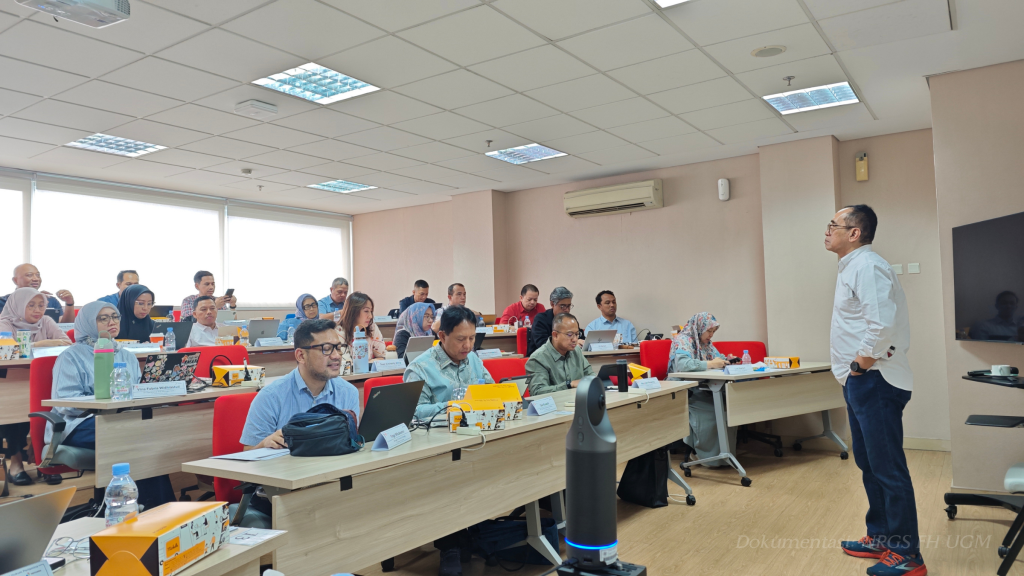
Universitas Gadjah Mada Faculty of Law, through the Natural Resources Governance Studies (NRGS), in collaboration with PT Pertamina (Persero) through Pertamina Corporate University, continued the implementation of the Pertamina Mini Master of Law Program 2026 by entering its fourth week of learning. The program was held on Saturday and Sunday, June 6–7, 2026, at the UGM Master of Law Program Campus in Jakarta.
The 2026 Pertamina Mini Master of Laws Program is a strategic training initiative designed to strengthen legal literacy and understanding among participants from PT Pertamina (Persero) and its subsidiaries. The program is specifically tailored for professionals without a legal background, equipping them with practical and relevant legal knowledge to support strategic decision-making in the context of business, corporate governance, and the energy industry.
In its fourth week, the learning sessions were conducted in two parallel classes, namely Class A and Class B, with materials focusing on corporate organizational law, commercial contracts, public finance law, and capital market law. The series of materials was designed to provide participants with a more comprehensive understanding of legal aspects related to corporate structures, contractual relationships, state financial management, as well as capital market instruments and obligations.
As part of the learning evaluation, activities on Saturday, June 6, 2026, began with the implementation of Pre-Test 2. This evaluation aimed to measure participants’ initial understanding before entering the advanced learning sessions in the fourth week. Through the pre-test, participants were also expected to reassess their understanding of legal concepts acquired in previous weeks and connect them with the new materials to be studied.
On Saturday, June 6, 2026, participants attended sessions on Corporate Organizational Law and Commercial Contracts. The Corporate Organizational Law session was delivered by Prof. Dr. Drs. Paripurna, S.H., M.Hum., LL.M., Professor of Business Law at the Faculty of Law, Universitas Gadjah Mada. The session discussed the definition, legal consequences, and corporate liability, including the structure of limited liability companies and the responsibilities of directors, commissioners, and shareholders. The discussion was important in strengthening participants’ understanding of how business entities are operated, supervised, and held accountable in corporate practice.
On the same day, participants also received a session on Commercial Contracts delivered by Dr. Raden Ajeng Antari Innaka Turingsih, S.H., M.Hum., Lecturer in Civil Law at the Faculty of Law, Universitas Gadjah Mada. The session discussed the termination of obligations, elements and parties in contracts, invalidity of agreements, as well as the development of electronic contracts and business contract strategies. Through this session, participants were encouraged to understand contracts not only as legal documents but also as risk management instruments in business relationships.
On Sunday, June 7, 2026, the learning sessions continued with Public Finance Law and Capital Market Law. The Public Finance Law session was delivered by Dwi Haryati, S.H., M.H., Lecturer in State Administrative Law at the Faculty of Law, Universitas Gadjah Mada. The discussion covered the history and sources of state financial law, as well as regulations concerning State-Owned Enterprises (SOEs) and their relationship with state finances. This session provided participants with an understanding of the position of public finance law in managing public institutions and business entities related to state interests.
Meanwhile, the Capital Market Law session was delivered by Prof. Dr. Nindyo Pramono, S.H., M.S., Professor of Business Law at the Faculty of Law, Universitas Gadjah Mada. The session discussed securities derivative instruments, such as rights, warrants, bonds, and mutual funds, as well as the concept of public offerings, internal processes, reporting obligations, and prospectuses. Through this learning session, participants gained a deeper understanding of capital market instruments and the legal obligations attached to fundraising activities and corporate reporting.
Throughout the fourth week, participants demonstrated high enthusiasm through active and interactive discussions. Questions raised during the sessions reflected a strong connection between the learning materials and practical needs in corporate environments, particularly in understanding corporate organization, business contracts, financial management, and capital market mechanisms. This highlights the importance of strengthening legal literacy among non-legal professionals to support better corporate governance.
The implementation of the fourth week of the Pertamina Mini Master of Law Program 2026 further strengthens the commitment of FH UGM, NRGS, and PT Pertamina (Persero) in building synergy between academia and industry. Through this program, participants are expected not only to gain conceptual legal understanding but also to apply such knowledge in supporting professional, accountable, and integrity-driven corporate decision-making.
The program also represents an active contribution toward achieving the Sustainable Development Goals (SDGs), particularly SDG 4 (Quality Education), SDG 8 (Decent Work and Economic Growth), SDG 16 (Peace, Justice and Strong Institutions), and SDG 17 (Partnerships for the Goals).
Author: Sahira Sajjadia Luthfia (NRGS)