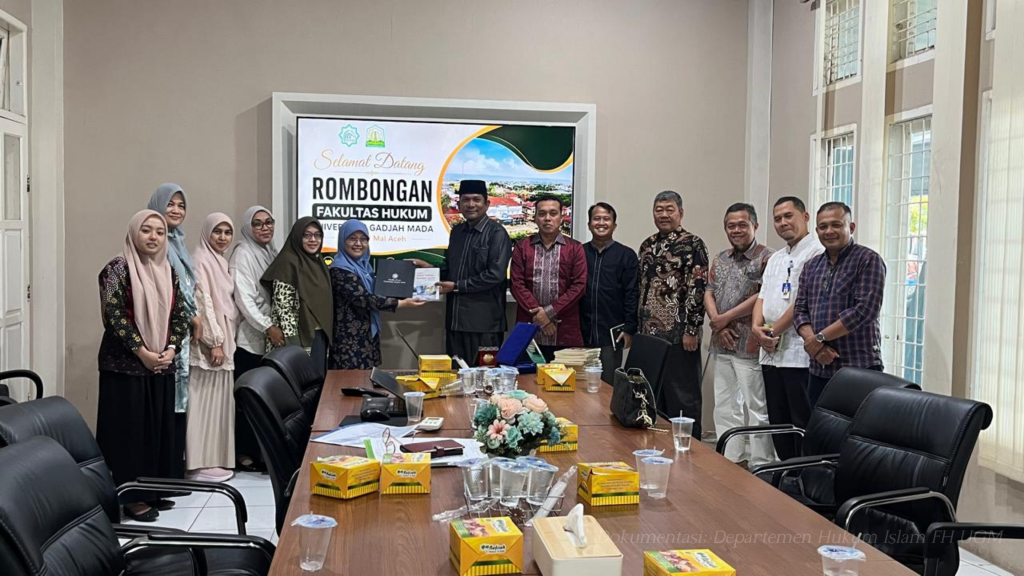
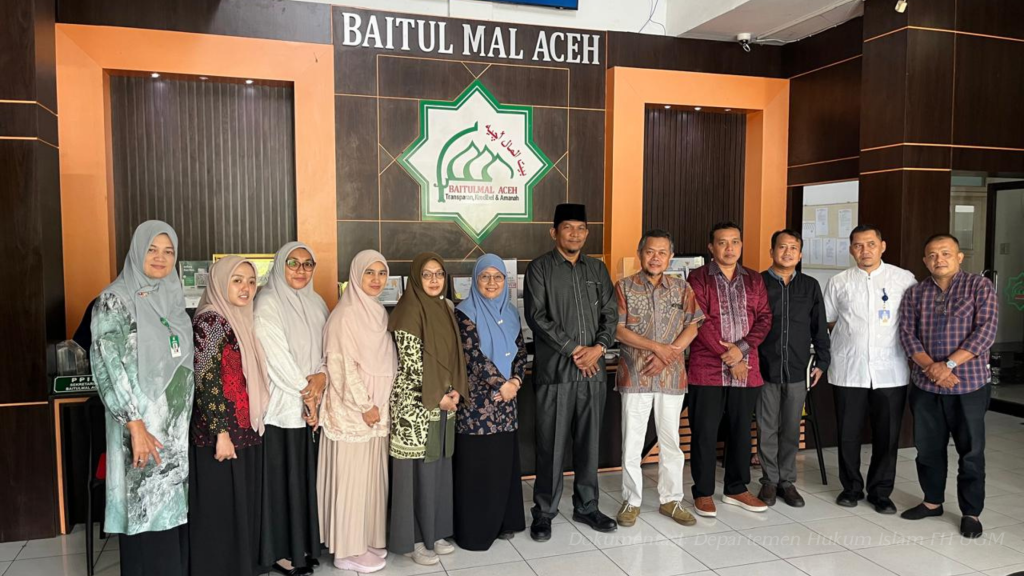
Banda Aceh, 5 June 2026 – The Department of Islamic Law, Faculty of Law, Universitas Gadjah Mada (FH UGM), conducted a benchmarking visit to Baitul Mal Aceh (BMA) to explore the governance practices of religious assets from the perspectives of Islamic law and institutional management. This activity was part of efforts to strengthen Islamic law studies while creating opportunities for institutional collaboration in the implementation of the University’s Tri Dharma (Education, Research, and Community Service).
The delegation from the Department of Islamic Law FH UGM was welcomed by representatives of Baitul Mal Aceh, led by BMA Board Member Fahmi M. Nasir, MCL, for a discussion on the duties, functions, and practices of managing religious assets under the institution’s authority. During the meeting, participants gained insights into the role of Baitul Mal Aceh in safeguarding, maintaining, managing, and developing zakat, infaq, waqf assets, and other religious assets. In addition, Baitul Mal Aceh also holds authority in supervising guardianship based on Islamic law, which represents one of the distinctive institutional characteristics of Aceh Province.
Prof. Dr. Hartini, S.H., M.Si., Head of the Department of Islamic Law FH UGM, stated that this benchmarking visit serves as an important part of developing Islamic law education and research, which is not only oriented toward normative aspects but also toward the implementation of law within institutional practices. Through this visit, participants gained the opportunity to directly understand how Islamic law is applied in the governance of institutions that function to support public welfare and the interests of the community.
During the discussion session, Baitul Mal Aceh presented various programs and policies that have been implemented, ranging from the management of zakat, infaq, and waqf to the productive development of religious assets. In addition to discussing regulatory and institutional governance aspects, the discussion also highlighted various challenges and opportunities in developing religious asset management amid the social and economic dynamics of society.
Beyond serving as an academic and knowledge-sharing forum, this meeting also opened opportunities for broader cooperation between the Faculty of Law UGM and Baitul Mal Aceh. Both institutions discussed follow-up plans in the form of a Cooperation Agreement (PKS) focused on the implementation of the University’s Tri Dharma, covering education, research, and community service. Through this collaboration, various joint programs are expected to be realized, such as collaborative research, academic seminars, curriculum development, and community service activities that contribute to strengthening religious asset governance and the development of Islamic law in Indonesia.
This benchmarking activity reflects FH UGM’s commitment to continuously expanding academic networks with various strategic institutions and enriching practice-based learning experiences for the academic community. Through a deeper understanding of religious asset governance in Aceh, this initiative is expected to generate innovations and ideas that support the development of Islamic law that is adaptive, inclusive, and oriented toward public benefit.
This activity contributes to the achievement of the Sustainable Development Goals (SDGs), particularly SDG 4 (Quality Education) through strengthening practice-based learning and academic capacity development, as well as SDG 17 (Partnerships for the Goals) through the development of networks and cooperation between FH UGM and Baitul Mal Aceh in implementing the University’s Tri Dharma.
Author: Dita Elvia Kusuma Putri (Department of Islamic Law)