The Constitutional Court as the guardian of constitution is at the forefront of maintaining and accommodating the constitutional rights of citizens. In guarding the constitution, of course the role of every citizen is very important to maintain the upholding of law and justice.
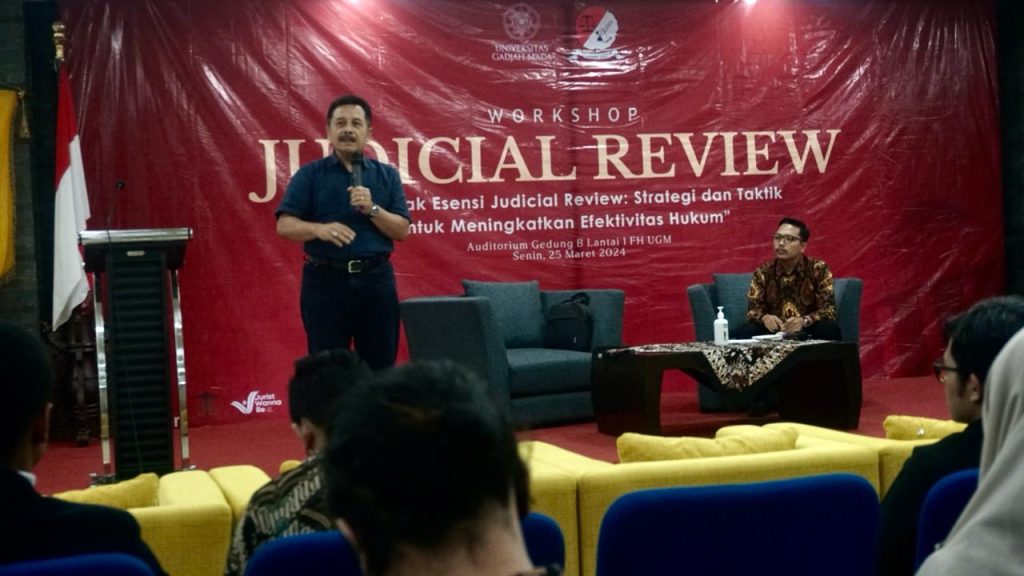
Considering the importance of this, the Extended Family of Business and State Law Students (KMMH) held a Judicial Review on Monday (03/25/2024) judicial review workshop was opened by the Head of the Master of Law Study Program, Universitas Gadjah Mada, Irna Nurhayati, S.H., M.Hum., LL.M at the Auditorium of Building B, Faculty of Law, UGM. A total of one hundred participants registered to attend the workshop, both Law Faculty students at various Yogyakarta Universities, Legal Aid Institutes (LBH), and other stakeholders.
The activity with the theme "Uncovering the Essence of a Judicial ReviewStrategies and Tactics to Increase Legal Effectiveness" invited two resource persons who are experts in their fields. The first resource person, Viktor Santoso Tandiasa, S,H., M.H. is a managing partner at the Law Firm VST and Partners with experience in handling cases of Judicial Review of Legislation at the Supreme Court and Constitutional Court as well as cases at the State Administrative Court for dozens of years. The second resource person, Dr. I Dewa Gede Palguna, S.H., M.Hum. as a Judge of the Constitutional Court of the Republic of Indonesia in 2003-2008 and 2015-2020, Lecturer at the Faculty of Law, Udayana University, with various breakthroughs in thought supported by professional case handling. The first material with the topic of Application Preparation Practice, was guided directly by Moderator Naufal Rizqiyanto, S.H. as the administrator of KMMH.
Viktor Santoso Tandisa presented material on the practice of making applications. In this material, Viktor Santoso explained several discussion points. Some of them are related to several categories of cases that are not included in the main case examination (listening to statements from the parties), namely: The applicant does not have(legal standing); the object being requested is not the authority of the constitutional court; and the application has lost its object before entering the agenda for the main case examination. Viktor Santoso emphasized that an Application can be said to be Obscure Libel (vague/unclear) if it meets several indicators, namely: there is a discrepancy between the application's arguments in the posita and petitum, the arguments are in the posita but not in the petitum or vice versa, there are requests from the Applicant in the Petitum that contradict each other and do not provide alternative choices.
In delivering his material, Viktor Santoso did not forget to share strategies and tactics with participants when they were about to submit an application to the Constitutional Court. As explained, "In making an application, in addition to paying attention to the constitutional rights that have been violated which can be seen at the level of law, making an application also requires strategies and tactics so that the application is granted by the Constitutional Court." Among them is the acceleration technique (stealing a head start). For example, when there is an issue that is widely discussed in judicial review at the Constitutional Court, the applicant must be able to steal a head start by becoming the first applicant at the Constitutional Court. This is intended so that the application file becomes the first file examined by the Constitutional Court.
The activity was then continued by Dr. I Dewa Gede Palguna who presented the material on the Constitutional Court's procedural law. Dr. I Dewa Gede Palguna began his speech by quoting the statement of Justice Robert Jackson, the Supreme Court Justice of the United States "We are not final because we are infallible, but we are infallible only because we are final" (We are not final because we cannot be wrong, but we cannot be blamed only because we are final). This is an alarm that the final interpreter of the constitution (the Constitutional Court is also the final interpreter of the constitution).
Dr. I Dewa Gede Palguna explained important points regarding the procedural law of the Constitutional Court, namely related to the petition, type and nature of the trial, parties in the judicial review of the law, and the combination of examination of the petition, up to the verdict. "If the judicial review of a law contains more than one petition, the Court can combine its examination in the trial examination and he intended combination does not reduce the rights of the Petitioners in presenting witnesses, experts, and/or other evidence," he explained.
Not only presented with theory, all participants were also given the opportunity to practice directly in compiling an application by following the official application format of the Constitutional Court provided by the resource person. Participants were then formed into teams by the committee to make applications based on the results of the analysis of the position case against several rules that were considered to be in conflict with the constitution. Several position cases analyzed were Article 31 paragraph (1) of the Supreme Court Law, Article 299 of the Election Law, and Article 70 paragraph (3) of Law No. 12 of 2012 concerning Higher Education.
The application preparation process lasted for 75 minutes. During the practice of compiling the application, the discussion space between participants and the resource person remained open. This was to help participants interact with the resource person when making the application. The results of the application preparation by each team were then reviewed by the resource person directly.
The practice of preparing judicial review application is to hone the skills of students and the community so that they are able to directly practice providing objective legal opinions in submitting judicial review application to the Constitutional Court. This is an effort to guard the constitution and uphold justice. Like the adage conveyed by the Chairman of KMMH Ulil Albab, S.H. in his closing remarks"Fiat justitia pareat mundus (even if the sky falls, justice must still be upheld)."
The workshop on judicial review ended with feedback and question and answer session. Given the importance of understanding and skills like this, the speakers hope that the spirit of guarding and upholding the constitution will be maintained so that activities like this will continue in the future. This activity is also a form of support not only for the UN Sustainable Development Goals (SDGs) point 4 concerning Quality Education, but also SDGs point 16, namely Peace, Justice, and Strong Institutions.
Writer : Sulastri Sangadji, S.H