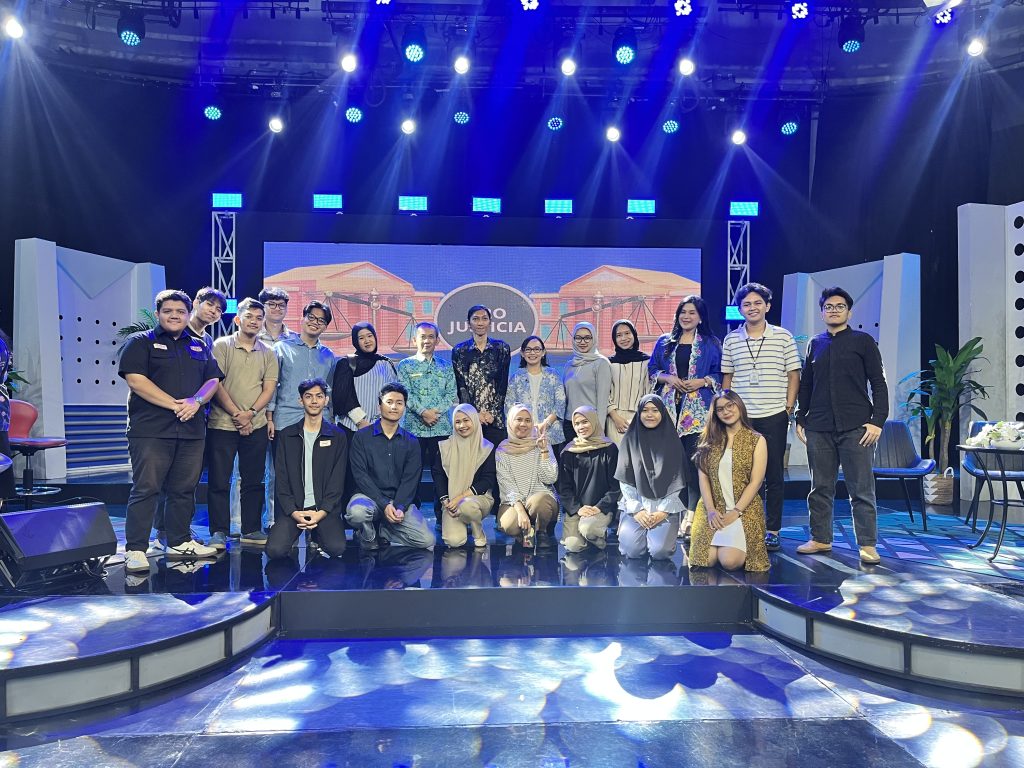
Through the Legal Education Grant program implemented by the Center for Legal Consultation and Assistance, the Indonesia Center for Tax Law (ICTL) at the Faculty of Law, Gadjah Mada University (UGM) hosted a broadcast on the topic “Electricity Tax Incentive Policies and the Future of Green Transportation in Indonesia.” The broadcast took place on Tuesday (December 9, 2025) at TVRI Yogyakarta. It successfully explored the issue of tax incentives for electric vehicles from legal, technical, and socio-economic perspectives—all of which are closely tied to people’s daily lives and mobility. The program featured critical discussions involving expert panelists and active audience participation.
This legal education broadcast is part of a community service initiative aimed at enhancing public understanding of tax incentive policies for electric vehicles, while also promoting public legal awareness of the role of taxation in supporting the transition toward environmentally friendly and sustainable transportation. This topic was chosen in line with Indonesia’s commitment to reducing carbon emissions and its efforts to achieve sustainable development in the transportation sector.
The discussion took place in an interactive format for approximately one hour, featuring speakers from both academic and professional backgrounds, namely Dahliana Hasan, S.H., M.Tax., Ph.D. (Dean and Professor in the Department of Tax Law at the Faculty of Law, UGM), Anugrah Anditya, S.H., M.T. (Professor in the Department of Tax Law at the Faculty of Law, UGM), and Yusup Widodo, S.H., M.M. (Senior Tax Advisor at the DIY Regional Office of the Directorate General of Taxes). The speakers discussed issues related to Value-Added Tax (VAT), Sales Tax on Luxury Goods (PPnBM), Motor Vehicle Tax (PKB), and Motor Vehicle Transfer Tax (BBNKB) from legal, economic, and public policy perspectives.
Through this broadcast, the public is encouraged to understand that tax incentives for electric vehicles are a strategic fiscal tool for internalizing the environmental impacts of fossil-fueled vehicle use, while also promoting behavioral change toward cleaner transportation. At the same time, the discussion also highlighted the challenges of policy implementation, including issues regarding the targeting of incentives, the potential for misuse of incentives, and the importance of establishing equitable tax incentive policies to prevent widening social inequality.
This broadcast, themed “Electricity Tax Incentive Policies and the Future of Green Transportation in Indonesia,” aligns with the UGM Faculty of Law’s commitment to supporting the Sustainable Development Goals (SDGs). This program directly contributes to SDG 7 on affordable and clean energy by promoting the adoption of electric vehicles as part of environmentally friendly energy diversification. Furthermore, discussions on tax incentives and the development of electric vehicle infrastructure help accelerate progress toward SDG 9 on industry, innovation, and infrastructure by supporting the national electric vehicle industry ecosystem. Discussions regarding the use of electric vehicles in urban mobility are also aligned with SDG 11 on sustainable cities and communities, as green transportation is viewed as a key element in reducing pollution and improving the quality of life for the public. Furthermore, discussions on responsible energy consumption and vehicle use support SDG 12, particularly in promoting behavioral changes toward the use of low-emission energy sources. Overall, the event’s focus on reducing carbon emissions and addressing climate change risks directly contributes to SDG 13.
Author: Rio Putra Dewanto (Department of Tax Law)