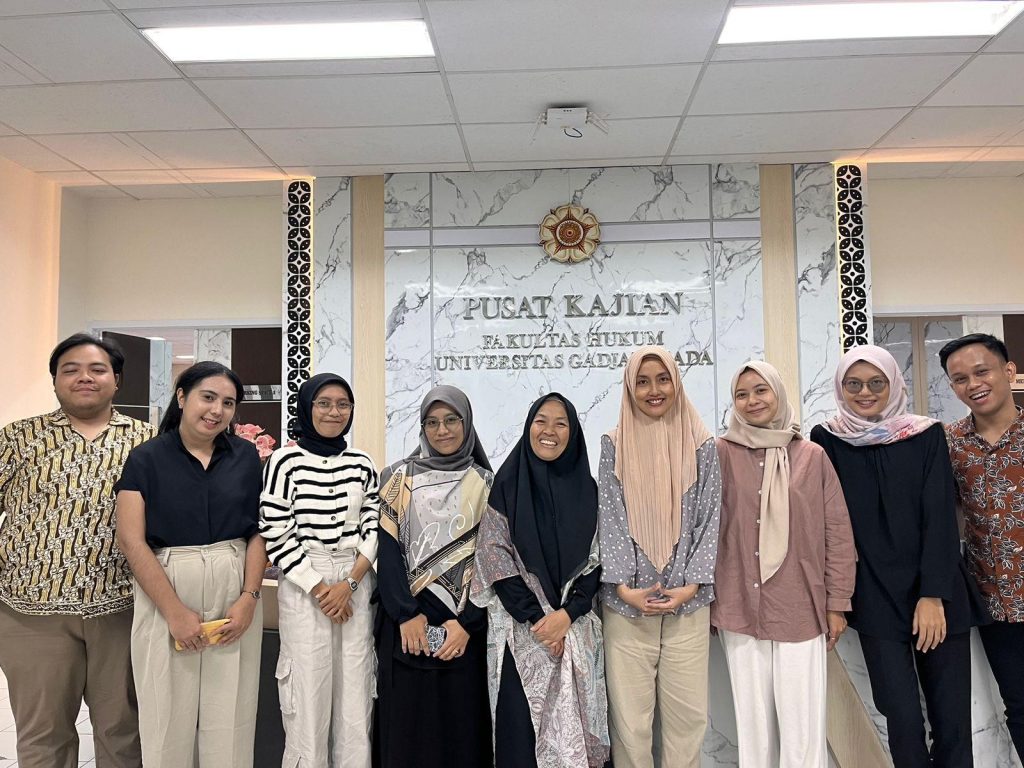
Friday (23/01/2023), Law, Gender, and Society Study Centre FH UGM (LGS FH UGM) just held sharing session with an Inspirational Woman Leader, Nyai Nissa Wargadipura, founder of the Ath-Thaariq Ecological Islamic Boarding School. This event was intended to inspire advocacy and service among LGS members while deepening knowledge through reflective practice. Moreover, the insights shared by this figure—who has contributed to the empowerment and protection of women and vulnerable communities—added significant value. Additionally, this activity aligns with the UN Sustainable Development Goals specifically Goal 4 on Quality Education.
Sharing sesion began with general questions about Nyai Nissa Wargadipura’s background and her involvement in advocating for the issues she has encountered. Nyai Nissa explained that the establishment of the Ath-Thaariq Ecological Islamic Boarding School stemmed from her involvement in agrarian conflicts, particularly those faced by farmers. Nyai Nissa immersed herself in farmers’ lives to understand the existing agrarian conflicts, even going so far as to meet with farmer groups in remote areas. Since there was no transportation available, Nyai Nissa forced herself to find a highway and hitchhike on any vehicle she encountered to reach her destination. Nyai Nissa advised, “Trust me, if you go out into the field, your wisdom will grow rapidly and will foster empathy.” Nyai Nissa stated that empathy and a sense of calling are what drive her to always engage in advocacy
Once empathy and a sense of purpose have taken root, Nyai Nissa emphasizes the importance of organizing the group. Organization is key to advocacy because a group’s voice carries more weight and is more likely to be heard by stakeholders. This can strengthen the group’s position. In Nyai Nissa’s experience, she organized a group of farmers in Garut to address agrarian conflicts. There are many challenges in organizing groups and conducting advocacy. However, Nyai Nissa believes that every problem has a solution. When organizing a group, several things must be clear, such as what issues need to be addressed, who should be encouraged to resolve the issues, and what the group expects. Adhering to these principles, Nyai Nissa works to defend farmers’ rights to a decent life through land management that ensures farmers’ well-being and is sustainable.
The experience described above represents the spiritual journey undertaken by Nyai Nissa. Through these struggles and her spiritual journey, Nyai Nissa came to realize that natural resources are the key to well-being and play a role in resolving social issues, including those faced by women. This realization prompted Nyai Nissa and her husband to establish the Ath-Thaariq Ecological Islamic Boarding School. The Ath-Thaariq Ecological Islamic Boarding School is an institution intended to enhance the capacity of the surrounding community while fostering leadership and entrepreneurial character that prioritizes religious, gender, environmental conservation, and local wisdom perspectives. Nyai Nissa states that these perspectives are the pillars of development that promotes well-being and sustainability. This approach is reflected in the motto of the Ath-Thaariq Ecological Islamic Boarding School: “Care for the Earth, Care for Others, Care for the Future.”
Nyai Nissa’s work through the Ath-Thariq Ecological Islamic Boarding School has had a significant impact on the community, ranging from the development of good and sustainable agricultural production practices for farmers, to conducting da’wah with an environmental conservation perspective, and educating students with leadership qualities. At the national level, the Coordinating Ministry for Human Development and Culture recognizes Nyai Nissa as an inspirational figure in women’s empowerment. Nyai Nissa’s contributions are also recognized internationally, as UN Indonesia acknowledges her role in agricultural transformation in Indonesia—a concrete realization of the UN Sustainable Development Goals, particularly the eradication of poverty (SDG 1), gender equality (SDG 5), sustainable cities and communities (SDG 11), and climate action (SDG 13).
Mengakiri sharing session, Nyai Nissa memberikan tips untuk berpartisipasi dalam konservasi alam, yaitu menggunakan produk-produk yang ramah lingkungan. Salah satu contoh adalah penggunaan produk-produk alami, seperti menggunakan garam dengan perasan jeruk nipis untuk membersihkan diri atau “luluran” sebagai pengganti bahan kimiawi yang tidak ramah lingkungan.
To wrap up the sharing sessionNyai Nissa offered tips on how to contribute to nature conservation, namely by using eco-friendly products. One example is using natural products, such as salt mixed with lime juice for cleansing or as a body scrub, as an alternative to chemical products that are harmful to the environment.
Penulis: LGS