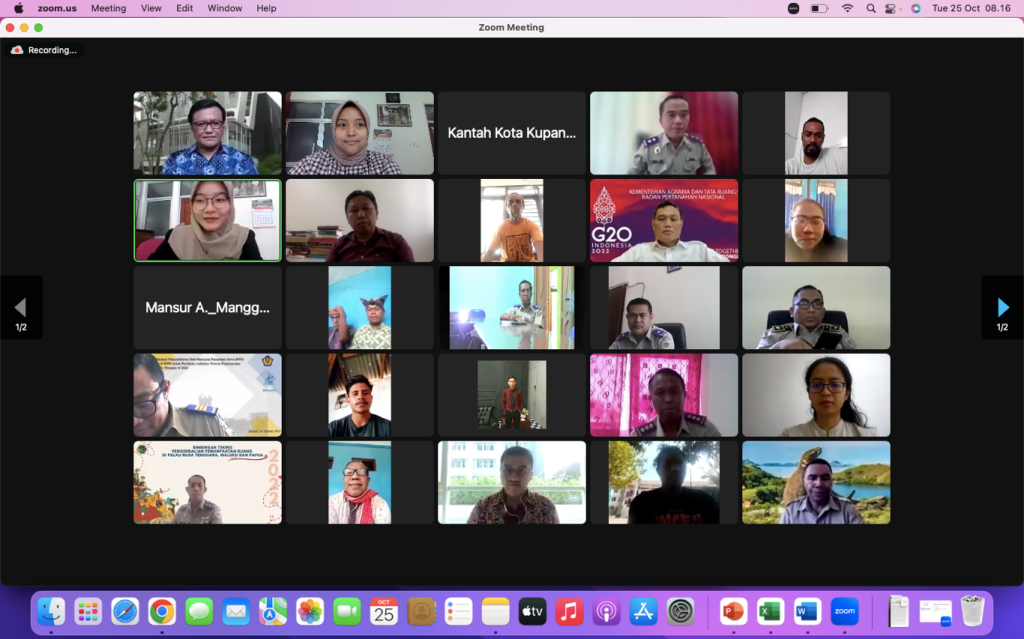
On Tuesday, October 25, 2022, the Djojodigoeno Center for Customary Law Studies held an online registration process. on the theme "Options for Administering Customary (Ulayat) Land in East Nusa Tenggara." This session followed up on the Customary Land Inventory and Identification activity conducted in Bali and East Nusa Tenggara Provinces by Puskaha Djojodigoeno in partnership with the Ministry of Agrarian Affairs and Spatial Planning/National Land Agency (ATR/BPN) in 2021. The event opened with remarks from the Vice Dean for Research, Community Service, and Information Systems, Dr. Heribertus Jaka Triyana, S.H., LL.M., M.A.
Attendees included representatives from city and regency Land Offices in East Nusa Tenggara (NTT), as well as civil society organizations and customary (adat) communities in the province. Speakers included not only academics but also relevant government agencies and representatives from customary communities. Dr. Rikardo Simarmata, S.H., Head of the Center, presented on "Findings and Administration Options from the Inventory and Identification of Customary Land in East Nusa Tenggara Province." He explained that the parties controlling customary land in NTT are highly complex — the diversity of local terminology and the existence of multiple, layered communal groups holding authority over customary land show that customary law communities are not a single unified entity, as classical theory suggests. A second finding was that Puskaha divided customary land into two broad categories: 432 parcels with a strong public/communal character (land under the control of a communal group) and 188 parcels under individual control, which can be understood as former customary land.
There was also a presentation on the "Plan for Administering Customary Land Based on the Inventory and Identification Results in East Nusa Tenggara," delivered by Tri Wibisono, S.T., M.T., Director of Cadastral Surveying and Mapping at the Ministry of Agrarian Affairs and Spatial Planning/National Land Agency. He explained that the Ministry has a strategic goal of registering all land parcels in Indonesia, with a target of registering roughly 126 million parcels nationwide by 2025. However, obstacles remain — chief among them budget availability — requiring the Ministry to review and prioritize which customary land parcels need to be registered in the years ahead.
Jaconias Walalayo, S.H., M.H., Head of the Regional Office of the National Land Agency for East Nusa Tenggara Province, responded regarding the follow-up plan for administering customary land in NTT. He explained that under Ministerial Regulation ATR/BPN No. 18/2019, formal recognition from local government is required before a land parcel can be registered — and that this recognition has not yet been granted in NTT, meaning local government needs to pay closer attention so that customary land can be registered. Daud P. Tambo, S.H., an advocate supporting customary communities in Ende Regency, added that Ende already has a regional regulation (Perda Kab. Ende No. 2/2017) governing the mechanism for recognizing and protecting customary law communities (MHA) there.
In closing, Puskaha Djojodigoeno, through Rikardo Simarmata, reiterated that under Ministerial Regulation ATR/BPN No. 18/2019 and Circular Letter No. 139 from the Director General of Spatial Planning and Land Use Control at the Ministry, Land Offices can proceed with delineating customary land — issuing a Temporary Identification Number along with its attributes — even while awaiting formal recognition of customary law communities from local government. This mechanism is meant to prevent a stalemate caused by the absence of that recognition, while also helping the Ministry stay on track to meet its 2025 target. He noted that successful administration of customary land nationwide requires intensive collaboration between the Ministry and its regional offices, local governments, relevant customary communities, and civil society organizations, along with breakthrough regulations to speed up the process.
The full Inventory and Identification Report on Customary Land in Bali and East Nusa Tenggara Provinces is available for download via the link: http://ugm.id/LaporanUlayatBaliNTT .
Source: Puskaha Djojodigoeno FH UGM.