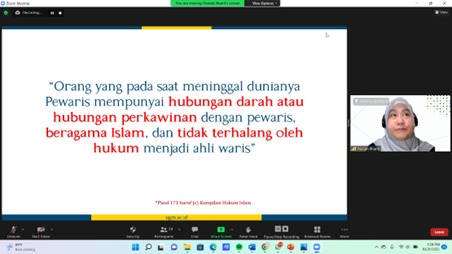
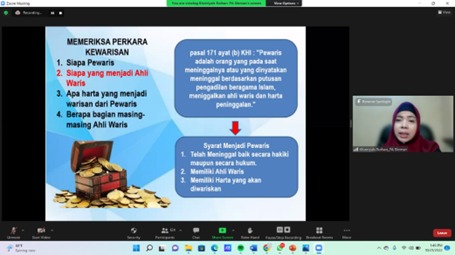
On Friday, October 21, 2022, the Department of Islamic Law held its 10th Legal Outreach session, on the theme "Heirs under Islamic Law and Issues in the Practice of Distributing Inheritance." The speakers were Haniah Ilhami, S.H., LL.M. (lecturer, Department of Islamic Law, FH UGM) and Khoiriyah Ilhami, S.Ag., M.H. (Judge, Sleman Religious Court).
Following the previous month's session on estate property and its related issues, this session went deeper into one specific element of inheritance: heirs. Haniah noted that the public still commonly assumes inheritance applies to anyone with a blood relationship to the deceased, when the more accurate framing is "an heir with a legal right" to inherit. Under Article 171 point c of the Compilation of Islamic Law (KHI), an heir is defined as someone who, at the time of the testator's death, has a blood or marital relationship with the testator, is Muslim, and is not legally barred from inheriting. In other words, a family relationship alone is not sufficient to make someone an heir.
As a legal practitioner, Khoiriyah then discussed real-world problems that can arise involving heirs, such as an heir predeceasing the testator, an heir dying before the estate is distributed, an heir who is missing or whose whereabouts are unknown (mafqud), stepchildren as potential heirs, and several other scenarios. Participants and speakers also engaged in further discussion during a Q&A session. Turnout was especially strong for this session, with nearly 200 attendees from a range of backgrounds, including students, lecturers, lawyers, civil servants, and even prospective civil servants (CPNS) from various institutions. Toward the end of the year, the Department of Islamic Law planned to hold another legal outreach session, continuing its collaborative Legal Outreach series with the Sleman Religious Court.
Writer: Fadhila Ardianti
Editor: Public Relations