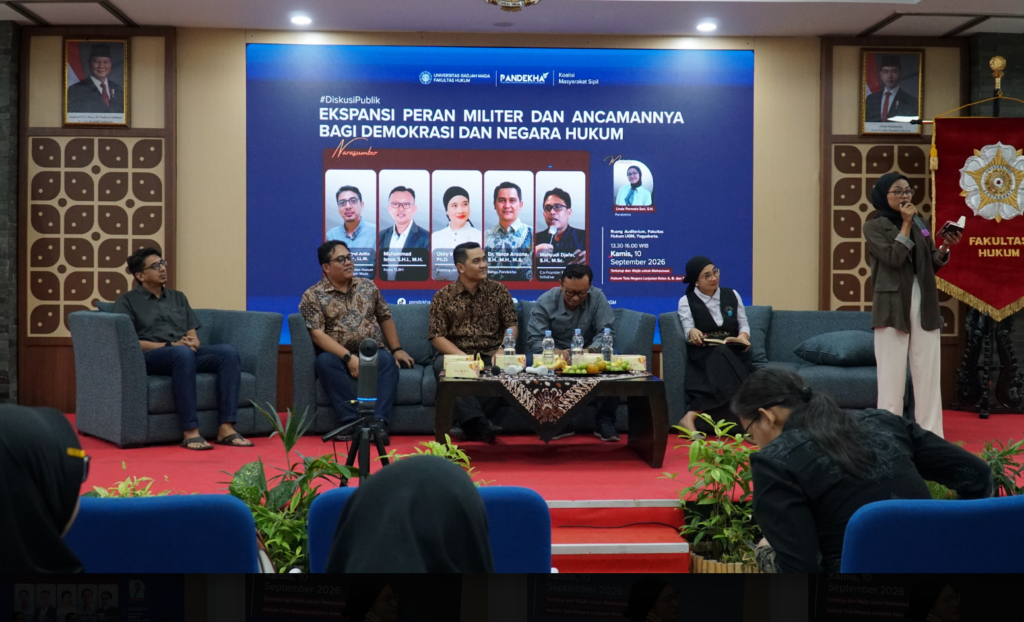
The Centre for Democracy, Constitutional Law, and Human Rights (PANDEKHA) at the Faculty of Law, Universitas Gadjah Mada, in collaboration with the Civil Society Coalition, organized a Public Discussion titled "The Militarization of Civilian Space", on Thursday, September 10, 2026. The forum was convened as an expression of academic disquiet and as an advocacy effort in response to the expanding role and functions of the military, originally mandated solely as an instrument of the state for the defense of sovereignty which is now seen as increasingly encroaching upon and threatening the democratic order and the rule of law in Indonesia. Facilitated by Linda Permata Sari, S.H. as moderator, the dialectical forum featured five prominent cross-disciplinary speakers: Mochamad Isnur, S.H., M.H. (Chair of the Indonesian Legal Aid Foundation/YLBHI), Okky Madasari, Ph.D. (Sociologist and Author), Wahyudi Djafar, S.H., M.Si. (Co-Founder of the Raksha Initiative), Prof. Dr. Zainal Arifin Mochtar, S.H., LL.M. (Professor of Constitutional Law, FH UGM), and Dr. Yance Arizona, S.H., M.H., M.A. (Chair of PANDEKHA FH UGM).
The discussion underscored that the dynamics of military presence in civilian spheres are deeply intertwined with Indonesia's constitutional history. In the post-Reform era, national legal politics had in principle abolished the Dual Function of the Armed Forces (Dwifungsi ABRI) through MPR Decree No. VI/MPR/2000 and MPR Decree No. VII/MPR/2000. However, the commitment to this separation of roles has since been distorted by a wave of expansion in military personnel involvement in government programs. The deployment of tens of thousands of TNI personnel in the food security program, plans for new regional military command (Kodam) establishments, and the formation of border battalions all reveal a shift in the direction of defense politics one that no longer merely reinstates a dual function, but has transformed into a practice of military multi-functionality.
This development is cause for growing concern, as the influence of the military has not merely manifested in the filling of civilian structural positions, it has penetrated the cultural domain. The dominance of a militaristic culture in public space builds a narrative of an all-capable protector or savior figure capable of resolving every social problem. The normalization of military personnel in everyday civilian life is seen as dangerous because it cultivates public dependency on command institutions while eroding the critical reasoning and independence of democratic civilian institutions.
The entry of military instruments into the domestic sphere also has a direct impact on the weakening of democratic pillars marked by a deficit of legal accountability and a shift in the pattern of policymaking. Cases of violence such as that experienced by Andrie Yunus serve as a grim reflection of the limited justice mechanisms available when arbitrary acts by security personnel occur, given the tendency toward lenient sentences in military trials and the absence of transparent military administrative justice mechanisms. On the other hand, a culture of command centralization is beginning to displace a tradition of policymaking oriented toward meaningful public participation, as reflected in the hasty deliberation of defense regulations with minimal broad public involvement.
Closing the discourse, the forum reaffirmed the constitutional mandate that civilian and military spheres carry a rigid demarcation. The position of the military must be restored to its fundamental function that of defending the state through the maintenance of objective civilian control. The assumption that an expanded military presence will minimize friction on the ground was firmly rejected; on the contrary, an excessive military presence reduces citizens' safe spaces and increases the risk of horizontal conflict escalation. Democracy and the rule of law can only be preserved when civilian authority firmly enforces accountability and ensures that state power remains at all times subject to the mandate of the people's voice.
The organization of this public discussion reflects the commitment of FH UGM's academic community to supporting the Sustainable Development Goals (SDGs) particularly SDG 16 (Peace, Justice, and Strong Institutions) through the strengthening of accountability of state instruments, law enforcement, and the defense of civil rights; and SDG 17 (Partnerships for the Goals) through the strategic collaboration between the university and the civil society coalition network.
Author : Wisanggeni Kertya Adi