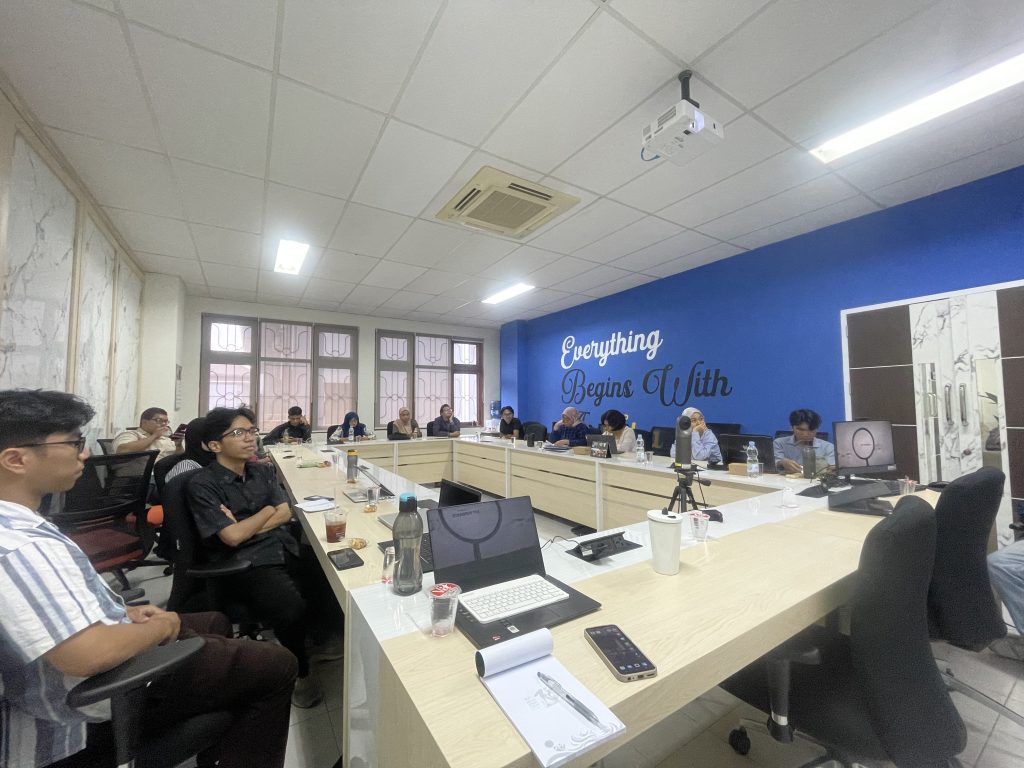
The Environmental Law Society (ELS), through its Spatial Planning Division, in collaboration with the Center for Law and Social Justice Studies (LSJ), organized a Screening and Discussion event on Thursday (16/05/2024). The event took place in the Study Center Room, Building IV, Faculty of Law, Universitas Gadjah Mada (UGM). Attended by 25 students from the Faculty of Law as well as neighboring faculties such as FISIPOL and the Faculty of Cultural Sciences (FIB), the event fostered interdisciplinary engagement.
Titled “Human Rights-Based Agrarian Conflict: Shared Understanding and Action,” the event aimed to provide deeper insight into issues surrounding agrarian conflict, environmental justice, and human rights. It also served as a platform for knowledge and experience exchange between students and experts/practitioners. The discussion further sought to spark student involvement in raising awareness and fostering collective participation in seeking sustainable solutions to agrarian conflicts.
The event began with a screening of the documentary “Tanah Moyangku” produced by WatchDoc Indonesia, followed by an open discussion led by two speakers: Dr. Laksmi Adriani Savitri, M.Si., from the Research Centre of Democratic Economy at UGM and former lecturer in Agrarian Anthropology at FIB UGM, and Albert Suprayogi Ginting, a student from the Department of Agrarian Law.
During the discussion, the speakers reflected on the agrarian conflicts depicted in the film. Albert Suprayogi emphasized that agrarian conflict in Indonesia is deeply rooted and intergenerational, dating back to the Dutch East Indies period and continuing post-Reformasi. He noted that the situation has worsened with the enactment of the Omnibus Law (UU Cipta Kerja), which is often used to legitimize government-backed projects under the guise of public interest. This has been evident in conflicts in areas such as Air Bengis and Rempang.
Laksmi Savitri presented a talk titled “The State, Agrarian Conflict, and Human Rights: A Portrait of Neoliberal Legality,” offering a critique of the state’s role in perpetuating agrarian conflict. Her presentation covered topics such as the recognition of Indigenous peoples, customary territories, structural violence, and the impact of neoliberal legality in enablingcapital violence. She stressed that solutions to agrarian conflict must address the root causes, not just the surface-level symptoms.
The open discussion session provided participants with the opportunity to ask questions, share opinions, and relate personal experiences connected to the topic. The dialogue was highly active, enthusiastic, and substantive, fulfilling the forum’s goal of educating, advocating, and collaboratively seeking solutions to the issues raised through the film and speakers' reflections.
Author : Ramadani S. D. Nicholas (Environmental Law Society)