
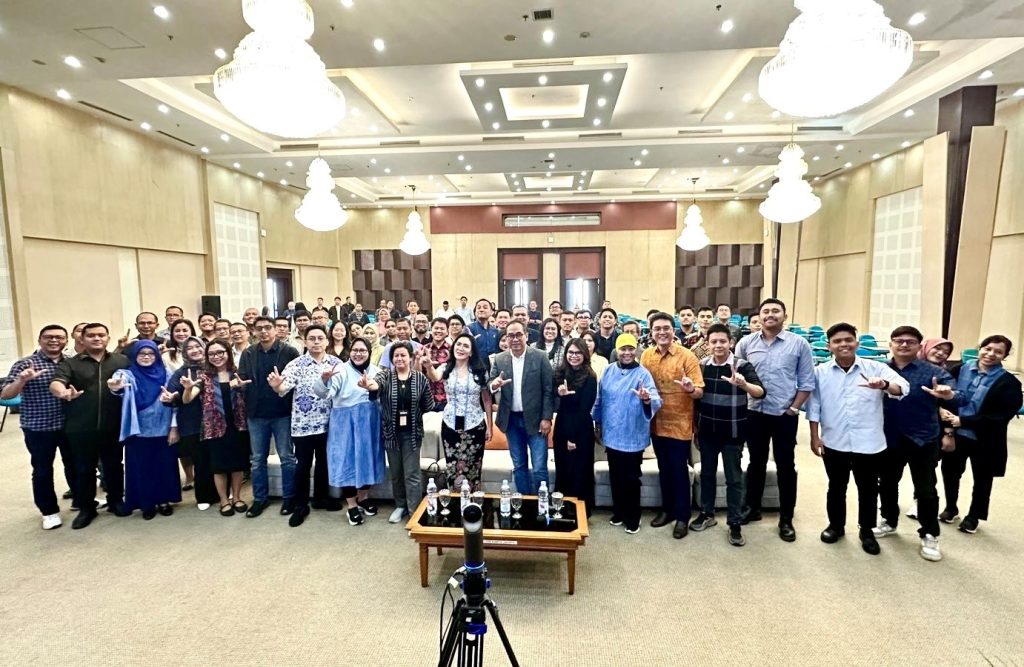
The MIH Program at UGM (Jakarta Campus) is once again playing an active role in advancing the agenda for sustainable public sector governance reform. On Saturday (October 11, 2025), the MIH UGM (Jakarta Campus) hosted a National Seminar titled “State-Owned Enterprise (SOE) Governance: The Ideal Composition and Compensation Model for SOE Commissioners” at the 9th-floor Auditorium of the Jakarta Campus. The event brought together a diverse range of stakeholders, including members of the Indonesian House of Representatives (DPR RI), ministry officials, economists, academics, industry representatives, and members of civil society. This inclusive participant composition reflects the spirit of the Sustainable Development Goals (SDGs), particularly Goal 16: Peace, Justice, and Strong Institutions, which emphasizes the importance of transparent and accountable public institutions.
The seminar was opened by Prof. Dr. Heribertus Jaka Triyana, S.H., LL.M., M.A., Vice Dean for Research, Community Service, and Information Systems at the UGM Faculty of Law. In his opening remarks, he emphasized that the discourse on SOE governance must not be limited solely to technocratic aspects but must also be grounded in public ethics and accountability. Universities, he argued, bear an epistemic responsibility to serve as catalysts for knowledge-based policy reform.
The first discussion was opened by Prof. Dr. Paripurna, S.H., M.Hum., LL.M., a Full Professor at the Faculty of Law, UGM, who outlined the three main paradigms of remuneration: Pay for Person, Pay for Position, and Pay for Performance. He emphasized that ideal compensation is not measured by the size of the figure, but by fairness and its focus on long-term value. Commissioners’ honoraria should be viewed as an investment in the effectiveness of oversight, not merely a financial burden on the state. Meanwhile, Nawal Nely, S.Ak., EMBA., CFA., CA. (Deputy for Finance and Risk Management at the Ministry of State-Owned Enterprises, 2020–2024) explained that the effectiveness of corporate governance is largely determined by the state’s ownership model. She highlighted the global trend toward a centralized ownership model, which allows for stronger government control without compromising professionalism.
Public opinion was represented by Dr. Rieke Diah Pitaloka, S.S., M.Hum., a member of the Indonesian House of Representatives (DPR RI), who voiced the public’s concerns regarding the image of state-owned enterprises (SOEs), which are perceived as elitist and out of touch with the people’s interests. She called for a strict ban on holding multiple positions, as conflicts of interest are the root cause of injustice in the management of state assets. Compensation, she argued, must be linked to integrity and actual contributions. Meanwhile, Dr. Zainal Arifin Mochtar, S.H., LL.M., a constitutional law expert at UGM, citing Constitutional Court decisions No. 80/PUU-XVII/2019 and 128/PUU-XXIII/2025, emphasized that public officials must not straddle two roles: governing the state while simultaneously overseeing SOEs. He urged the implementation of an open, merit-based selection process to ensure that commissioner positions do not become instruments of political patronage.
In the subsequent session, Yunaedi, Ak., M.M., CA., CRMP., CHRMP., CGCAE., CIAE., Askom (Deputy for State Accountants at BPKP) emphasized that compensation in state-owned enterprises should be viewed not as a perk, but as a tool to control the behavior of decision-makers. A proportional and transparent compensation structure is believed to foster independent oversight. Rendy Ardiansyah, M.B.A. (President Director of PT WIKA Tirta Jaya Jatiluhur), shared the industry’s perspective. He emphasized that board composition and compensation are two fundamental pillars of corporate governance. The board of commissioners must possess a diverse range of competencies and strong independence, while fair remuneration is necessary to maintain integrity and attract strategic talent.
To conclude the seminar, Albertus Pratama, S.H., LL.M. (Principal Consultant at PT Robert Walters Indonesia) outlined executive selection practices at global companies. He cited the 360° reference check process and multi-layered interviews as standards that ensure board positions are filled by individuals who are not only competent but also of high character.
Reforming the governance of state-owned enterprises cannot be done piecemeal. Prohibitions on holding multiple positions, limits on bonuses, or administrative regulations are insufficient without institutional reform and an accountability-based selection system. The speakers agreed that the position of commissioner is not a ceremonial or political one, but rather a strategic oversight function regarding state assets. A new paradigm needs to be established: that compensation is an instrument to maintain integrity, attract top talent, and ensure effective public oversight.
In the context of the Sustainable Development Goals (SDGs), this seminar directly contributes to SDG 16 (Peace, Justice, and Strong Institutions) through efforts to strengthen the governance of public institutions so they are transparent, accountable, and free from conflicts of interest. In addition, this event also supports SDG 8 (Decent Work and Economic Growth) by promoting a fair and productive performance-based compensation system, as well as SDG 17 (Partnerships for the Goals) by fostering synergy among academics, the government, the legislature, and the private sector. Thus, this seminar represents a concrete step by MIH UGM Jakarta Campus in promoting SOE reform that is characterized by integrity, inclusivity, and sustainability, with the aim of realizing strong and equitable national economic governance.
Author: Ramzy Oansa Ilham (MIH Jakarta Campus)