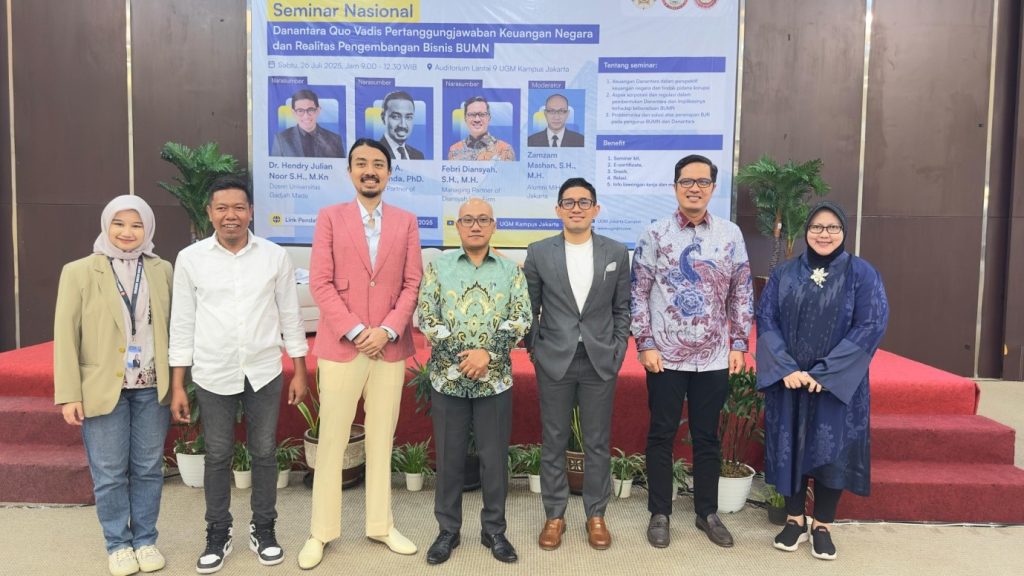
The Master of Law Student Association (KMMIH) at Gadjah Mada University (Jakarta Campus) held a national seminar titled “Danantara: Quo Vadis—State Financial Accountability and the Reality of SOE Business Development” on Saturday (July 26, 2025). This seminar served as a vital intellectual forum for bringing together legal, corporate, and state policy perspectives in the context of the establishment of Danantara as a state-owned enterprise management entity. Held in the 9th-floor Auditorium of UGM’s Jakarta Campus, the event—which ran from 9:00 AM to 1:00 PM WIB—was attended by academics, students, legal practitioners, and public officials interested in the future of SOE governance in Indonesia under the latest legal framework. In his opening remarks, KMMIH Chair Razikin, S.H., stated that this seminar serves as a concrete manifestation of students’ role in addressing national issues and provides a platform to voice aspirations and recommendations toward improved SOE governance.
This seminar featured speakers with strong academic and professional backgrounds: Dr. Hendry Julian Noor, S.H., M.Kn. (Lecturer at the Faculty of Law, UGM), Pramudya A. Oktavinanda, Ph.D. (Managing Partner at UMBRA Strategic Legal Solutions), and Febri Diansyah, S.H., M.H. (Managing Partner at Diansyah Law Firm). The three speakers discussed various dimensions of the relationship between state financial accountability and the reality of business management by state-owned enterprises following the enactment of Law No. 1 of 2025. The seminar was moderated by Zamzam Mashan, S.H., M.H., an alumnus of the UGM Master of International Law (MIH) program (Jakarta Campus), who is also active in public policy research.
The first presentation was delivered by Dr. Hendry Julian Noor, who guided participants in re-examining the conceptual foundations of what is referred to as “state finances.” Hendry explained that within the discourse of public finance law, two approaches have emerged: a narrow approach that limits state finances solely to the State Budget (APBN), and a broad approach that also includes SOE assets within the scope of state finances. However, according to Hendry, in the context of criminal legal accountability, an overly broad approach carries a high risk of criminalizing legitimate business policies. He emphasized that the assets of SOEs are the assets of entities that have been separated from the state as the owner of capital; therefore, any business loss cannot automatically be treated as a loss to the state.
More specifically, Hendry criticized the application of Article 2(1) and Article 3 of the Anti-Corruption Law, which are highly abstract and broad in scope. In his view, these provisions tend to arbitrarily ensnare SOE directors, even when business decisions have been made in a reasonable and rational manner. He underscored the importance of the Business Judgment Rule (BJR) doctrine in economic criminal law, so that SOE executives who act in good faith, free from conflicts of interest, and based on the principle of prudence, are not automatically held criminally liable. Through an analysis of various court rulings, Hendry demonstrated how the BJR is increasingly recognized as a key principle in evaluating the elements of “unlawfulness” or “wrongdoing” in SOE corruption cases.
The second presentation was delivered by Pramudya A. Oktavinanda, Ph.D., who systematically outlined the restructuring of SOE governance under Law No. 1 of 2025. According to him, the establishment of BPI Danantara as an investment and operational holding entity for SOEs is a strategic reformist step aimed at fostering efficiency, professionalism, and economic value in the management of state assets. Pramudya emphasized that although Danantara will indirectly hold a majority stake in SOEs, the legal status of these entities will remain as SOEs as long as the state retains the Dwiwarna Series A shares, which grant special rights.
Pramudya provided an in-depth analysis of the provisions of Articles 4A and 4B of Law No. 1 of 2025, which stipulate that the profits and losses incurred by state-owned enterprises are a matter for the corporation itself and are no longer classified as part of the state’s finances. In his view, this paves the way for a more corporate-oriented governance approach and reduces the risk of jurisdictional overlap between law enforcement agencies and corporate decision-makers. Pramudya also emphasized that the protection afforded to SOE executives through the BJR principle—which requires good faith, due diligence, and the absence of conflicts of interest—constitutes an essential form of legal protection for the investment climate and legal certainty.
Meanwhile, in his presentation, Febri Diansyah highlighted the challenges of implementing the BJR principle within the realm of criminal corruption law. Drawing on his experience as a legal practitioner frequently involved in high-profile corruption cases, Febri noted that there is currently no standardized application of the BJR principle within Indonesia’s judicial system. He provided concrete examples from major cases such as those of Karen Agustiawan (Pertamina), Hendrisman Rahim (Jiwasraya), and Hotasi Nababan (Merpati), which demonstrate inconsistencies in determining whether BJR can negate the elements of fault or illegality.
Febri emphasized that the application of BJR in corruption cases must meet strict criteria, namely proof that business decisions were made based on rational analysis, the absence of personal interests, and the existence of adequate risk mitigation measures. He also expressed concern that, as long as there are no binding judicial guidelines, the BJR remains susceptible to subjective interpretation by law enforcement officials. Therefore, he urged the standardization of BJR indicators and their explicit application in proving criminal elements, so as to provide legal certainty and protection for strategic decision-makers in state-owned enterprises.
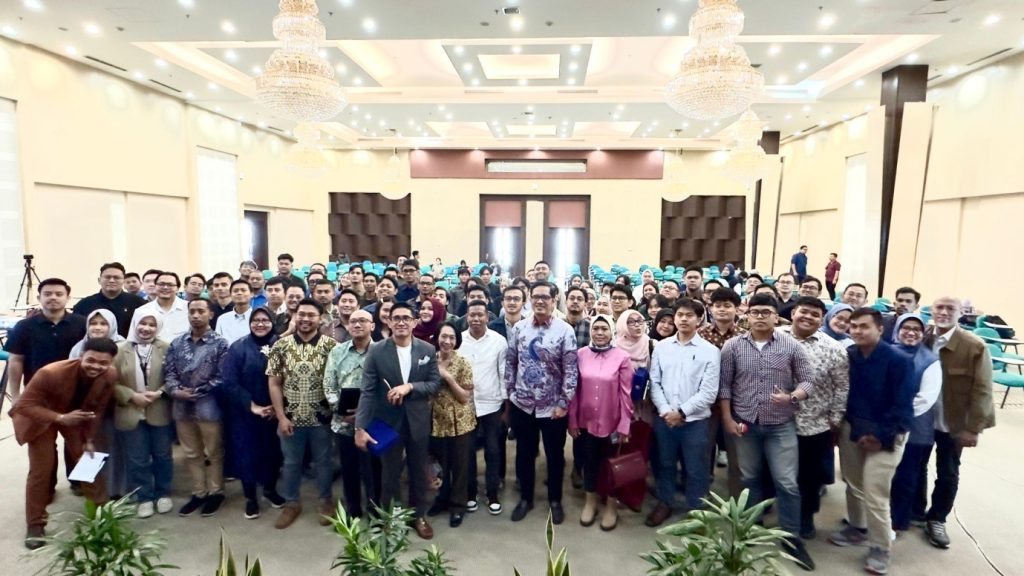
This seminar served as a reflective and constructive forum for gaining a deeper understanding of the future challenges of SOE governance, as well as the limits of criminal liability within a public policy framework based on business risk. The narratives from the speakers emphasized the importance of legal reform not only at the normative level but also in terms of mindset and interpretive approaches to state business law. The presence of over 150 participants from academic circles, students, and legal practitioners underscored the significant attention this issue has garnered.
This seminar was also designed not only as an academic forum but also as a space for professional interaction. Participants received additional benefits in the form of a seminar kit, an e-certificate, light refreshments, and exclusive information on internship and job opportunities from corporate partners collaborating with MIH UGM Jakarta Campus. This event underscores MIH UGM Jakarta Campus’s commitment to continuously providing legal analyses responsive to policy changes, as well as supporting a fair and progressive legal transformation process in the management of state resources.
As part of its contribution to sustainable development, this initiative also reflects support for the Sustainable Development Goals (SDGs), particularly SDG 4 on quality education, by providing an intellectual forum that fosters academic and professional capacity building. This seminar also addresses SDG 16 on peace, justice, and strong institutions, through discussions on legal reforms that support transparency and accountability in the management of state-owned enterprises (SOEs). Furthermore, by addressing the legal and policy implications for investment and national economic development, this seminar contributes to the achievement of SDG 8 on decent work and inclusive and sustainable economic growth.
Details about this event can be viewed on Youtube: https://www.youtube.com/watch?v=oUsey-_m6qk
Author: MIH UGM (Jakarta Campus)