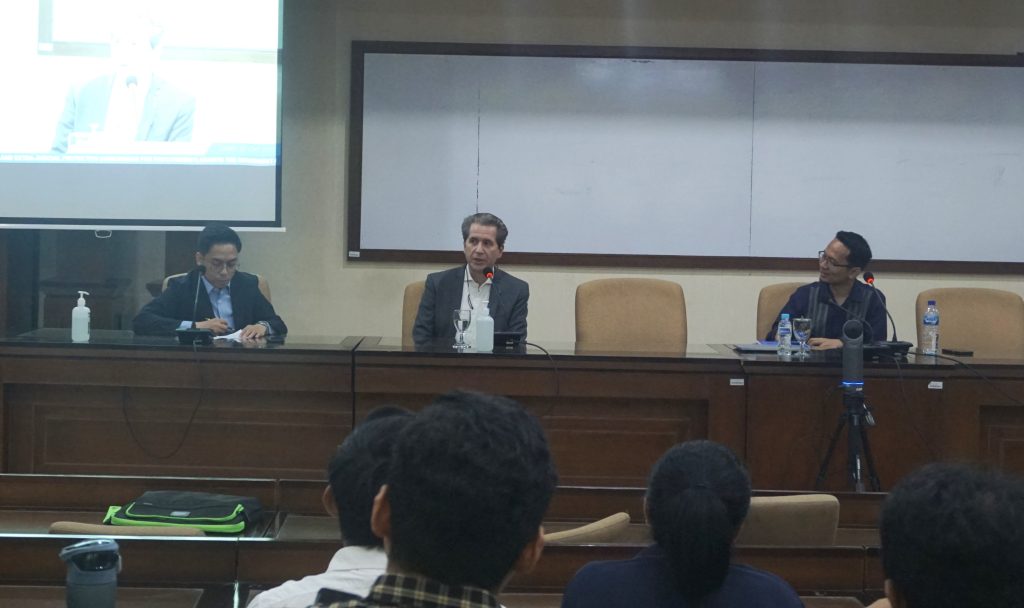
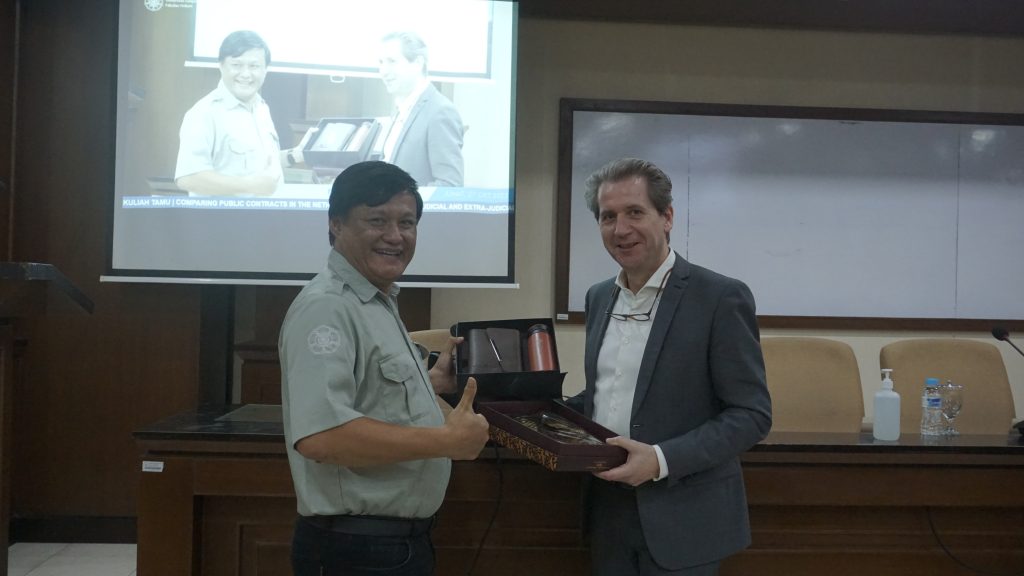
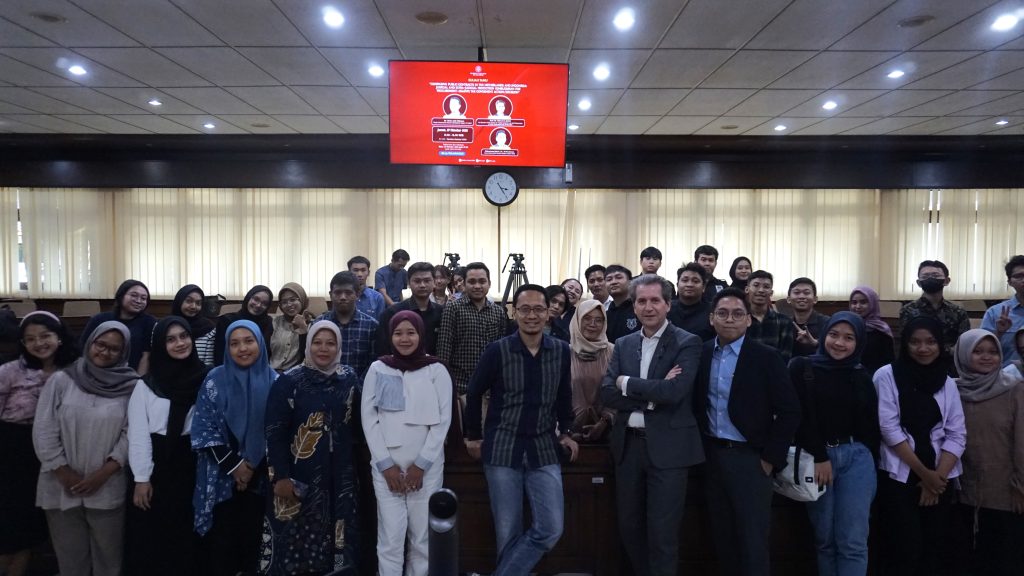
The Department of State Administrative Law hosted Prof. Dr. Chris Jansen, Co-Director of the Centre for Public Contract Law and Governance at Vrije Universiteit Amsterdam, for a guest lecture on Friday, October 27, 2023. This edition's guest lecture carried the theme "Comparing Public Contracts in the Netherlands and Indonesia: Judicial and Extra-Judicial Protection (Ombudsman for Procurement) Against the Government Action/Decision."
Held in Room 3.1.3, the guest lecture was moderated by Muhammad Jibril, S.H., M.PrivateLaw. The lecture consisted of three main sessions. The first session was a presentation by Richo Andi W., S.H., LL.M., Ph.D., titled "Public Contracts Law in Indonesia: Some Unclarities and the Need to Address the Accountability Issue." The second session was led by Prof. Dr. Chris Jansen, who presented on "Procurement Contracts in the Netherlands: Judicial and Extra-Judicial Review." The final session was an interactive Q&A, moderated by Muhammad Jibril.
In his presentation, "Public Contracts Law in Indonesia: Some Unclarities and the Need to Address the Accountability Issue," Richo Andi explained that Indonesia recognizes two types of public contracts: tender (procurement) and auction (sale by auction). A tender refers to a government contract activity that places a burden on the state budget, as a consequence of acquiring particular goods or services. An auction, by contrast, refers to a government contract activity that results in state revenue -- because the state grants a particular concession to a legal entity (such as 5G management concessions, natural resource concessions, and the like), because it sells off (disposes of) state property no longer needed, or because a public body has idle assets that it partners with the private sector to put to productive use and generate revenue.
In practice, these two terms are often used interchangeably within the public discourse, owing to regulatory inconsistency and the sheer volume of overlapping and accumulated regulations. Legislation addressing government contracts ranges from Government Regulations, Presidential Regulations, and Ministerial Regulations from relevant ministries, to Non-Ministerial Agency Regulations, down to the supporting policies issued by individual officials. Meanwhile, the substance of the latest Draft Law on Public Goods/Services Procurement (RUU PBJ Publik) does not yet appear to reflect any concerted effort to design a harmonization of the existing legislative framework. This raises a further question as to whether the government has fully recognized the complexity of this regulatory landscape as a problem requiring resolution -- even though the drafters of the bill have begun working toward a better review mechanism for this issue.
Prof. Jansen then delivered his presentation, "Procurement Contracts in the Netherlands: Judicial and Extra-Judicial Review." In this presentation, Prof. Jansen discussed public contract procurement in the Netherlands, encompassing both judicial and extra-judicial review. Procurement contracts in the Netherlands (and the European Union more broadly) encompass not only the procurement of goods and services in the sense of government spending, but also concession contracts.
The aim of his presentation was to explain the concept of public contracts, the role of legal rules in public procurement, and the legal procedures available in cases involving breaches of public procurement rules. Prof. Jansen also underscored the importance of creating a single market within the European Union -- typically achieved through competitive tender mechanisms in public contract procurement. He further explained the mechanisms of administrative review and judicial review in the context of accountability in the Netherlands. With regard to the latter, beyond the complaint mechanism available within the public body conducting the tender, an aggrieved provider can also lodge a complaint with the expert procurement committee (the Ombudsman for Procurement Affairs) to address grievances relating to public procurement -- as an alternative to the courts. This is what he referred to as extra-judicial review. He argued that transparency, integrity, and accountability in public procurement are of critical importance -- particularly as a means of ensuring the efficient use of public budgets, encouraging innovation, and ensuring that government acts in accordance with the applicable law.
Following both resource persons' presentations, the third session - the Q&A segment - began. At least five questions were put to the resource persons. These five questions came not only from members of the UGM Faculty of Law academic community, but also from participants of varied backgrounds, including from the UGM Faculty of Engineering, Universitas Negeri Sebelas Maret, and Universitas Mulawarman.
For those unable to join this guest lecture, the materials can be downloaded via the following link,https://bit.ly/MateriGuestLectureDeptHANor viewed on YouTube via the UGM Faculty of Law's Knowledge Channel (Kanal Ilmu Pengetahuan) at the link below.https://www.youtube.com/live/Xfd8fBdyqSM?si=GjTySFb6UfKV42SF).
Penulis: Stevanus Hizkhia Gunawan
Editor: Public Relations