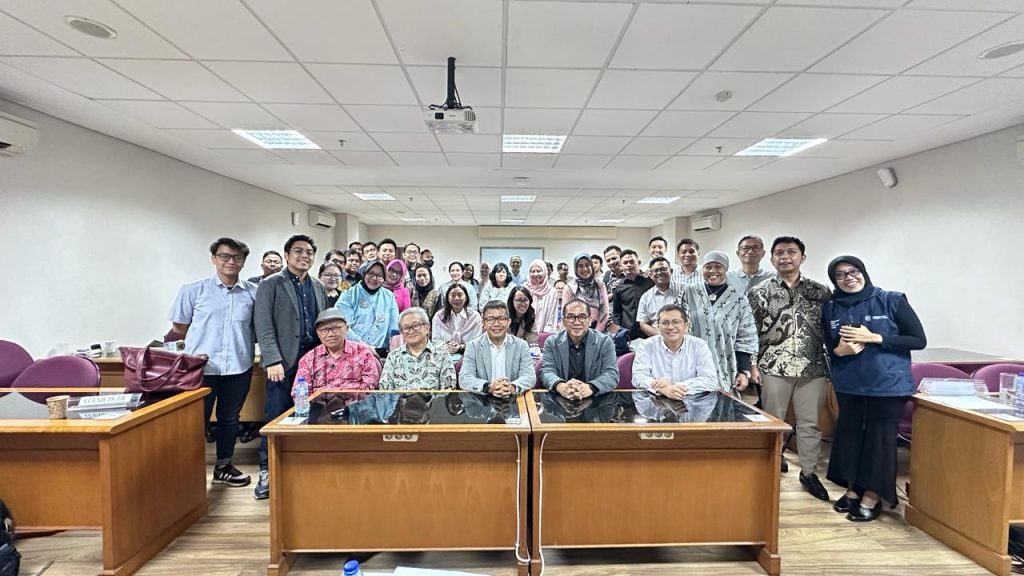
The UGM Master’s Program in Law (Jakarta Campus) held a hybrid National Seminar titled “Legal Issues in the Application of the Business Judgment Rule in State-Owned Enterprises in Criminal Cases” on Saturday (February 15, 2025). This national seminar was attended by 96 in-person participants and 27 online participants, including academics, practitioners, civil servants, and professionals from both the government and private sectors.
The event was organized to provide a comprehensive understanding of the Business Judgment Rule (BJR) principle in the context of business decision-making at State-Owned Enterprises (SOEs). The event also aimed to identify the legal challenges faced by SOE boards of directors in making strategic decisions, as well as to analyze the application of this rule based on applicable laws and regulations, particularly the Limited Liability Companies Act and the State-Owned Enterprises Act.
Through this seminar, it is hoped that a constructive forum for discussion will be created among practitioners, academics, and students to formulate solutions to the legal uncertainties frequently faced by corporate boards. Additionally, this event aims to broaden the perspectives of UGM Master of Law students (Jakarta Campus) regarding the dynamics of corporate law and the importance of the principle of prudence in business, so that they can contribute professionally and with integrity to the future development of national law and the economy.
This seminar also represents the UGM Faculty of Law’s effort to realize Sustainable Development Goal (SDG) No. 4—Quality Education—by supporting the strengthening of higher education, the dissemination of knowledge, and the enhancement of academic capacity and skills in the field of law; as well as SDG Goal 17—Partnerships for the Goals—by strengthening partnerships between law schools and various key stakeholders to achieve sustainable development goals.
In the first session, Prof. Dr. Nindyo Pramono, S.H., M.S., explained that state-owned enterprises (SOEs) are business entities with separate state capital, consisting of Persero and Perum. The lecturer at the UGM MIH (Jakarta Campus) explained that the board of directors is responsible for managing SOEs in accordance with the principles of good corporate governance (GCG). However, they face legal risks due to the disharmony between public and private law, as well as potential losses resulting from ultra vires actions. The Business Judgment Rule (BJR) protects directors acting in good faith; however, its implementation is still hindered by a lack of understanding among law enforcement officials and requires legal system reform.
Furthermore, Bobby R. Manalu, S.H., M.H., stated that the BJR provides legal protection for directors in making business decisions in good faith, without conflicts of interest, and with due diligence. In Indonesia, its application still leans more toward the criminal sphere than the civil sphere, unlike in the United States. The uncertainty surrounding the application of the BJR and disparities in court rulings affect professionals’ willingness to serve as directors. Legal reform is needed to promote the consistent and fair application of the BJR.
In the second session, Prof. Dr. Drs. Paripurna P. Sugarda, S.H., M.Hum, L.L.M., noted that there are regulatory overlaps in the State Finance Law, the State Treasury Law, and the BPK Law, which result in SOE assets being treated as part of the state’s finances—a situation that contradicts the Business Judgment Rule. This inconsistency hinders business decision-making and innovation by the board of directors due to concerns about legal risks. The Constitutional Court’s ruling affirmed that SOE assets are corporate assets, not state assets, thereby providing legal certainty and room for professionalism in the management of SOEs.
Deputy Assistant for Legal Affairs at the Ministry of State-Owned Enterprises, Dr. Anas Puji Istanto, stated that the BJR within state-owned enterprises still faces implementation challenges, with 96% of rulings concerning problematic assets involving either the state or state-owned enterprises. Although the BJR aims to protect business decisions based on professionalism, only three rulings specifically addressed this issue. Judicial review highlights the need for legal certainty so that boards of directors are not hindered in making strategic decisions. SOEs continue to play a vital role in maintaining national economic stability during times of crisis.
Yunan Novaris Arifidianto, S.H., MBA., Executive Vice President of Corporate Secretary & Communications at PT Penjaminan Infrastruktur Indonesia (Persero), explained that BJR refers to the exercise of authority by the board of directors and board of commissioners in accordance with the law and the company’s Articles of Association, in good faith, with due diligence, and without conflicts of interest. In business, it is necessary to consider political, economic, social, environmental, technological, and legal factors. Business risks—such as market, operational, and legal risks—must be mitigated through regulation, mediation, and financial strategies. Effective mitigation provides SOEs with a competitive advantage as well as economic and financial benefits.
Furthermore, Dr. H. Maqdir Ismail, S.H., LL.M., noted that the application of the Business Judgment Rule (BJR) in Indonesia has not yet been consistently recognized, as evidenced by the Jiwasraya case, which caused a loss of 40 trillion to the state-owned enterprise. The debate arose due to regulatory inconsistencies, particularly Article 2(g) of the State Finance Law. The 2025 revision of the SOE Law clarifies that SOE assets are not state assets, and that directors are protected if they act in good faith. Amendments to the State Finance Law and the Corruption Eradication Law are necessary to ensure legal certainty for SOE business operations.
The seminar was closed by Dr. Sigid Riyanto, S.H., M.Si. It is hoped that this seminar will serve as a valuable platform for all participants to gain a deeper understanding of the application of the Business Judgment Rule in SOE business practices. By involving academics, practitioners, and students, this seminar not only broadens perspectives but also makes a tangible contribution to the development of business law in Indonesia. It is hoped that, through the discussions and insights gained, participants can take an active role in supporting the creation of a healthy, accountable, and ethical business climate for the future advancement of the national economy.
Author : Debby Citra Dewi (MIH UGM Kampus Jakarta)