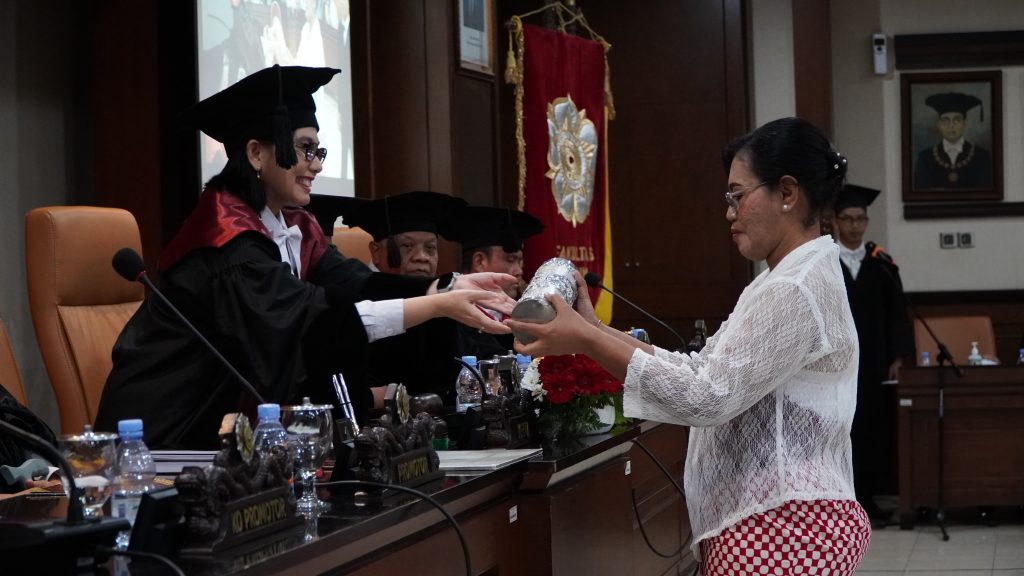
Lilian G.F. Apituley, a doctoral student in the Doctoral Program in Legal Studies at the Faculty of Law, Gadjah Mada University, successfully defended her dissertation titled “Revitalizing Tobelo Customary Law Values in Resolving Domestic Violence: A Study of Women’s Legal Options Based on Restorative Justice in North Halmahera Regency.” Lilian defended her dissertation in an open examination held on Monday (November 3, 2025). This achievement adds to the academic accomplishments of the Doctoral Program in Legal Studies at the Faculty of Law, UGM, in conferring doctoral degrees in the field of law.
The dissertation examines how Tobelo customary law is applied in resolving cases of domestic violence, which in this context is still addressed through a village-level resolution process known as makadatoro (consultation) by the customary council. If an agreement leading to legal proceedings cannot be reached, the customary council tends to prioritize peaceful resolution and the provision of compensation. In such cases, the female victims are not directly involved, as they are represented by their families. The tendency to rely on customary institutions often disregards the provisions of Law No. 23 of 2004 on the Elimination of Domestic Violence and the principles of CEDAW General Recommendation No. 35/2017, which affirm the state’s obligation to ensure direct protection for victims—not merely through peaceful resolutions at the community level. This phenomenon illustrates a form of strong legal pluralism, in which non-state law is more dominant than state law, leading to a clash of norms. As a result, victims often experience double victimization.
The dissertation concluded that the application of Tobelo customary law reflects “living law,” yet remains patriarchal in nature. Furthermore, the choice of legal recourse demonstrates legal pluralism (customary, religious, and state law). Most victims opt for customary law or religious channels due to cultural factors, shame, and social pressure, while the criminal justice system (state law) is perceived as complicated. Furthermore, the revitalization of customary law based on Restorative Justice is crucial because it provides an opportunity to place victims at the center, hold perpetrators accountable, and foster healthy reconciliation. This revitalization is directed toward gender-sensitive customary norms, inclusive customary institutions, and a legal culture that respects women’s rights.
The doctoral defense was attended by Dahliana Hasan, S.H., M.Tax., Ph.D., as chair of the examining committee, with committee members consisting of Prof. Dr. Marcus Priyo Gunarto, S.H., M.Hum., Dr. Sulastriyono, S.H., M.Si., Dr. Supriyadi, S.H., M.Hum., and Prof. Dr. Dra. Sulistyowati Irianto, M.A. (FH UI) as the external examiner, as well as Dr. Djoko Sukisno, S.H., C.N., and Sri Wiyanti Eddyono, S.H., LL.M., Ph.D. (HR) as the doctoral committee. Lilian G.F. Apituley was officially recognized as the 277th doctoral graduate of the Faculty of Law, Gadjah Mada University, and the 7,081st doctoral graduate of Gadjah Mada University. Lilian G.F. Apituley’s achievement reflects the Faculty of Law at UGM’s commitment to supporting the realization of the Sustainable Development Goals (SDGs), particularly Goal 4 on Quality Education and Goal 16 on Strong and Just Institutions. Lilian G.F. Apituley’s dissertation not only expands the body of knowledge regarding the legal options available to women as victims in the resolution of domestic violence cases but also promotes justice and protects women’s rights to lead more dignified lives.
Author : Alexandra Lisa Wijaya (PDIH)