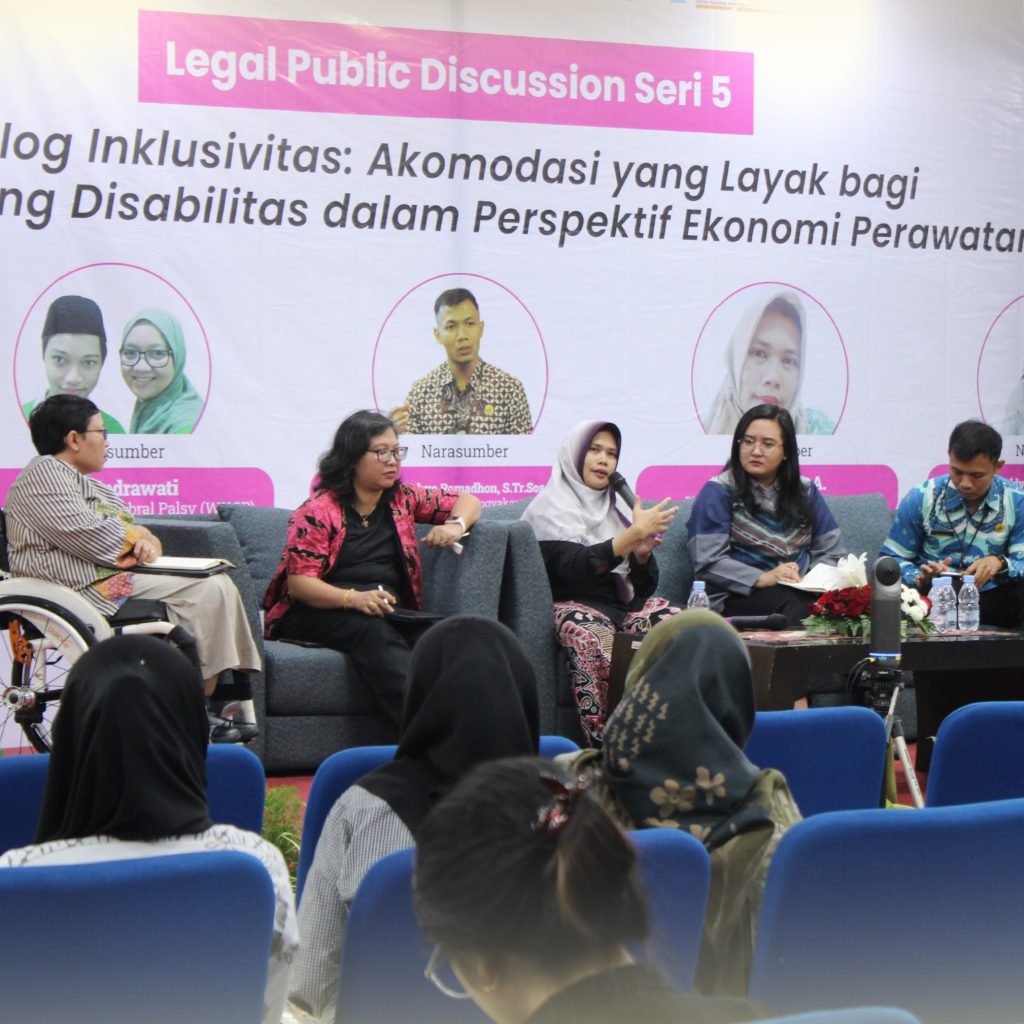
The Center for Law, Gender, & Society (LGS) at the UGM Faculty of Law successfully held the 5th Legal Public Discussion Series on the theme “Dialogue on Inclusivity: Appropriate Accommodations for People with Disabilities from a Care Economy Perspective” on Friday (November 15, 2024). The event was attended by 54 participants from the academic community and the general public, 5 speakers, 1 moderator, and 17 invited guests from the GERKATIN Sleman, GERKATIN Bantul, PERTUNI DIY, KDK Trimulyo, LBH Jogja, LBH APIK Jogja, LBH Jogja, Rifka Annisa, Rekso Dyah Utami, Bethesda Hospital, Panti Rapih Hospital, GERKATIN DIY, GERKATIN Gunung Kidul, GERKATIN Kulon Progo, and PERTUNI Gunung Kidul. ]
The organization of this Legal Public Discussion is a priority program for LGS. This program contributes to critical, discursive, and emancipatory thinking regarding the law and evolving situations within the country and society by addressing issues related to gender and vulnerable groups, whether concerning specific cases or the policy-making process. This Legal Public Discussion also aims to identify recommendations as a form of response and concern regarding the occurrence of a phenomenon or the policy-making process related to vulnerable groups, particularly people with disabilities. The objective is to examine legal developments in Indonesia regarding gender and disability issues, evaluate the implementation of reasonable accommodations from an inclusivity perspective, and map out policy prospects and the implementation of policies related to reasonable accommodations for people with disabilities.
Diskusi dipimpin oleh Nailul Amany, S.H., M.H. dengan beberapa pembicara perwakilan penyandang disabilitas, caregiver disabilitas, NGO, Dinas Sosial, dan Akademisi.
The first presentation was delivered by Wuri Handayani, S.E., Ak., M.Si., M.A., Ph.D., on the topic of the aspirations of people with disabilities regarding appropriate accommodations from the perspective of the economics of care. Wuri emphasized that people with disabilities face various limitations, whether stemming from stigma, the law, cultural factors, or structural barriers. For example, existing laws do not fully support people with disabilities, as certain regulations regarding physical and mental health criteria, in practice, hinder them. It is important to note that reasonable accommodations must address three key aspects: processes, facilities, and appropriate media and tools tailored to each individual’s needs. Institutions are expected to identify and facilitate these needs. Wuri also noted that providing reasonable accommodations is the responsibility of the state, employers, public and private service providers, and the broader community.
The second presentation was delivered by Reny Indrawati on the topic of “Reflections on My Experience as a caregiver and companion to a person with a disability.” As the caregiver for her child who has cerebral palsy, Reny explained that after the diagnosis, she needed time to prepare and had to learn a great deal about the treatment required to care for her child. Having a child with a disability inevitably leads to extra costs for daily life—for example, needing to use a car instead of a motorcycle when traveling—as well as costs required for therapy, such as physical therapy, writing therapy, sensory therapy, learning support, and others. Another issue is the age limit for BPJS coverage, which is only available up to age 7. Consequently, once the child turns 8, all costs must be covered out-of-pocket. At the end of the session, Reny shared that as a caregiver for a person with a disability, one must continue to learn, remain optimistic, and rely on support from the entire community.
Kedua materi tersebut ditanggapi oleh Nurul Saadah A yang menyampaikan topik advokasi terkait akomodasi yang layak bagi disabilitas dan tantangannya. Nurul menyampaikan bahwa penyandang disabilitas dan pendamping memerlukan dukungan seperti asupan gizi, terapi, jaminan sosial, terapi, dan biaya lainnya serta dukungan perhatian, perlindungan sosial, dan psikologis. Nurul menyampaikan bahwa penyandang disabilitas membutuhkan extra cost sebesar 4.6% kenaikan berdasarkan data dari Prospera. Selain itu, perempuan cenderung dibebankan beban pengasuhan berlebih. Padahal seharusnya beban pengasuhan itu dilakukan bersama antara suami dan istri. Masing-masing harus berkontribusi dalam pengasuhan langsung bagi penyandang disabilitas.
The DIY Social Affairs Agency was represented by Heru Cahyo Romadhon, S.Tr.Sos. Heru stated that the disability paradigm must be shifted to one grounded in a human rights perspective. This paradigm requires cross-organizational and interdisciplinary collaboration aimed at providing appropriate accommodations to enhance the productivity of people with disabilities, thereby fostering inclusive development. Specifically in DIY, there is a regional regulation guaranteeing social security coverage for people with disabilities through Regional Regulation No. 5 of 2022. This regulation needs to be widely disseminated so that it reaches all people with disabilities in DIY.
In addition, there is a central policy comprising the 7 Objectives of the RAN-PD, which include: 1) the objective of inclusive data collection and planning; 2) the objective of providing a barrier-free environment; 3) the objective of protecting rights, political access, and justice; 4) the objective of empowerment and independence; 5) the objective of realizing an inclusive economy; 6) education and skills; and 7) access to and equitable distribution of health services. In practice, there are several centers accessible to people with disabilities in DIY, namely: Social Rehabilitation in Institutions, the Integrated Rehabilitation Center for People with Disabilities, the Bina Karya and Laras Social Rehabilitation Centers, LKS-PD Social Assistance, Disaster Preparedness for People with Disabilities, Special Education Boarding Schools and Educational Scholarships, BLKPP, and BAPELJAMKESOS.
The final presentation was delivered by Sri Wiyandi Eddyono, S.H., LL.M. (HR), Ph.D., an academic addressing this topic. He began by noting that there are more than 22.9 million people with disabilities in Indonesia, highlighting the urgent need for appropriate accommodations for people with disabilities in the country. From the perspective of education, the number of people with disabilities is disproportionate to the availability of special education schools (SLB). Therefore, the rights of people with disabilities, as stipulated by the Constitution within the framework of “every person,” constitute an obligation that must be fulfilled by the State.
In addition, caregivers for people with disabilities also need attention by changing existing social constructs. Under patriarchal culture, women are burdened with domestic responsibilities. As a result, this central role of women is not recognized as work and is not considered to require any specific skills. Consequently, women are forced to abandon their careers and are not counted as part of the labor force. Therefore, key aspects of the care economy that require attention include distributing responsibilities among the government, communities, families, individuals, and society at large, so that the burdens mentioned above can be shared collectively. The session concluded with a question-and-answer session between participants and the presenters.
LGS would like to thank the speakers and participants for their active participation. LGS remains committed to organizing dialogues to foster understanding, sensitivity, and solidarity among communities. In this context, LGS contributes to the realization of UN Sustainable Development Goals 5 (Gender Equality), 10 (Reduced Inequalities), and 16 (Peace, Justice, and Strong Institutions).
Author: Arimbi Fajari Furqon (LGS)