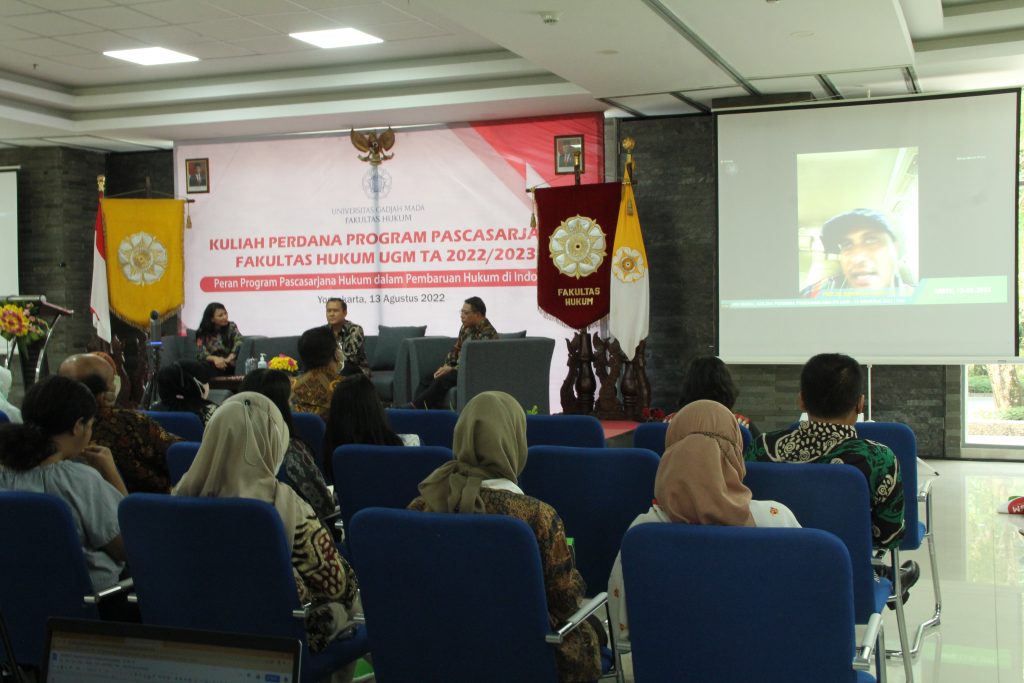
Faculty of Law of UGM opened its graduate program's semester lecture series with an inaugural lecture titled "The Role of Graduate Legal Education in Legal Reform in Indonesia," held on Saturday, August 13. Held in the Auditorium of Building B, the lecture was opened by Adrianto Dwi Nugroho, S.H., Adv.LL.M., LL.D., Vice Dean for Academic Affairs, Student Affairs, and Cooperation.
The lecture was moderated by Dr. Supriyadi, S.H., M.Hum., and featured three FH UGM alumni as speakers.
The first session featured Prof. Dr. Edward Omar Sharif Hiariej, S.H., M.Hum., Deputy Minister of Law and Human Rights and Professor of Criminal Law at UGM. Unable to attend in person, Prof. Eddy joined via Zoom, presenting on the challenges and issues in reforming Indonesia's national criminal.
This first session drew strong engagement from graduate students, reflected in the large number wanting to ask questions — though due to time constraints, only three questioners were given the chance to speak.
Before ending the zoom call, Prof. Eddy advised, "I hope graduate students do not just pursue degrees. My message is to learn, learn, and learn. Then, the knowledge gained can be implemented and applied in daily life."
The second session featured Dr. Inosentius Samsul, S.H., M.Hum., Head of the Expert Body of Indonesia's House of Representatives (DPR RI). Unlike Prof. Eddy's presentation, Dr. Sensi — speaking as a legislative representative — focused on the legislator's perspective on the challenges of national legal reform in Indonesia.
According to Dr. Sensi, there are several things that graduate education can do to strengthen the substance of legislative drafting. "The role of academics or students is to think about how we design legislation responsively, compiled on a case by case, basis, so that the Draft Criminal Code (RKUHP) can address issues in society. Academics and students can question how this draft can get onto the legislative agenda list. Academic papers can also contribute to it."
The third session featured Dr. Yurisa Martanti, S.H., M.H., Head of Training and Education at the Central Board of the Indonesian Notary Association. She discussed the challenges facing graduates of the Master of Notarial Law program in particular.
"It is homework for all of us, both the Ministry of Higher Education and graduate students, that this notary profession is different from notaries abroad. Public notaries in civil law (countries) are different. Public notaries cannot create authentic evidence; they can only record documents. Meanwhile, in Indonesia, (notaries) must create authentic instruments of evidence," said Dr. Yurisa in her presentation.
Following Dr. Sensi and Dr. Yurisa's presentations, the lecture continued with a Q&A session, with six participants in total raising questions to both speakers about issues that could arise, or already have arisen, in society.
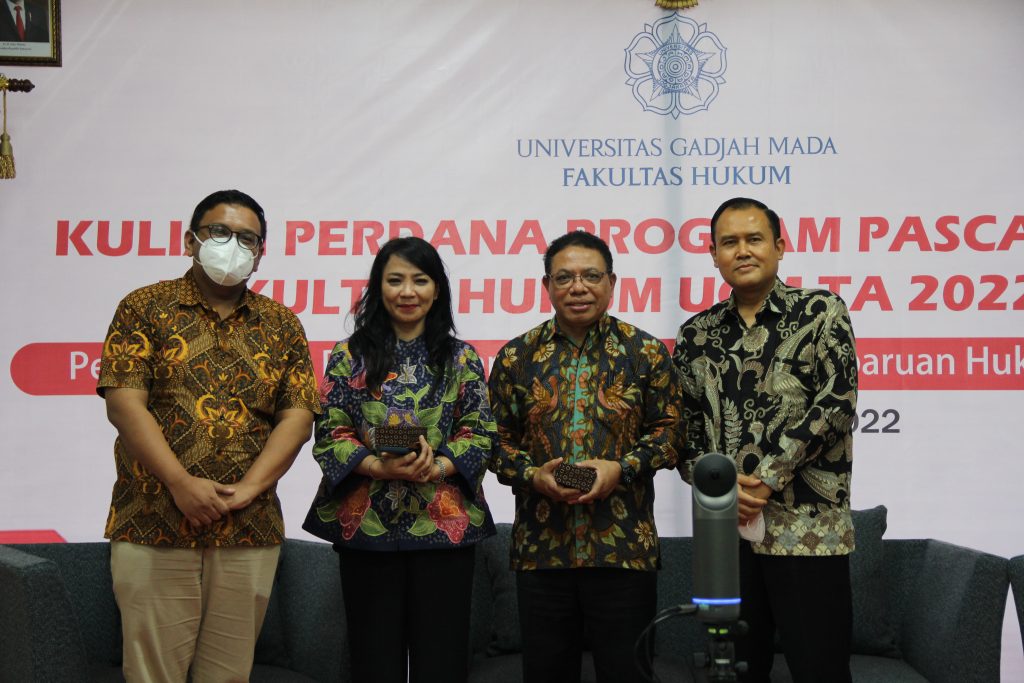
The inaugural lecture closed with the presentation of commemorative plaques from FH UGM to the speakers.