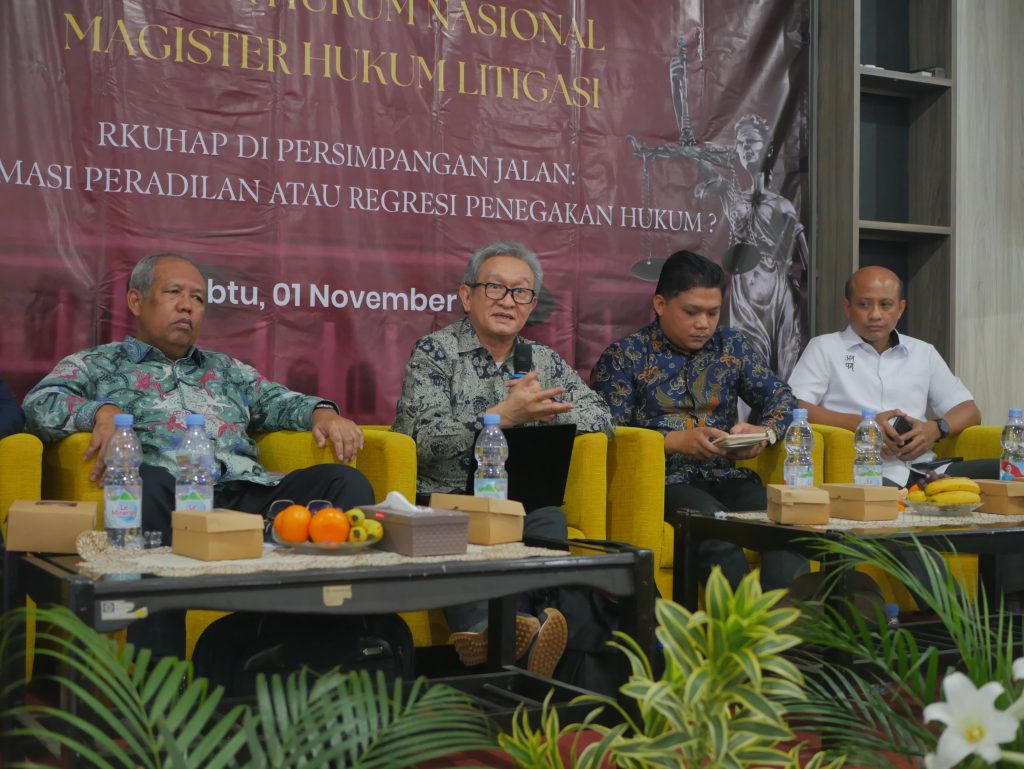
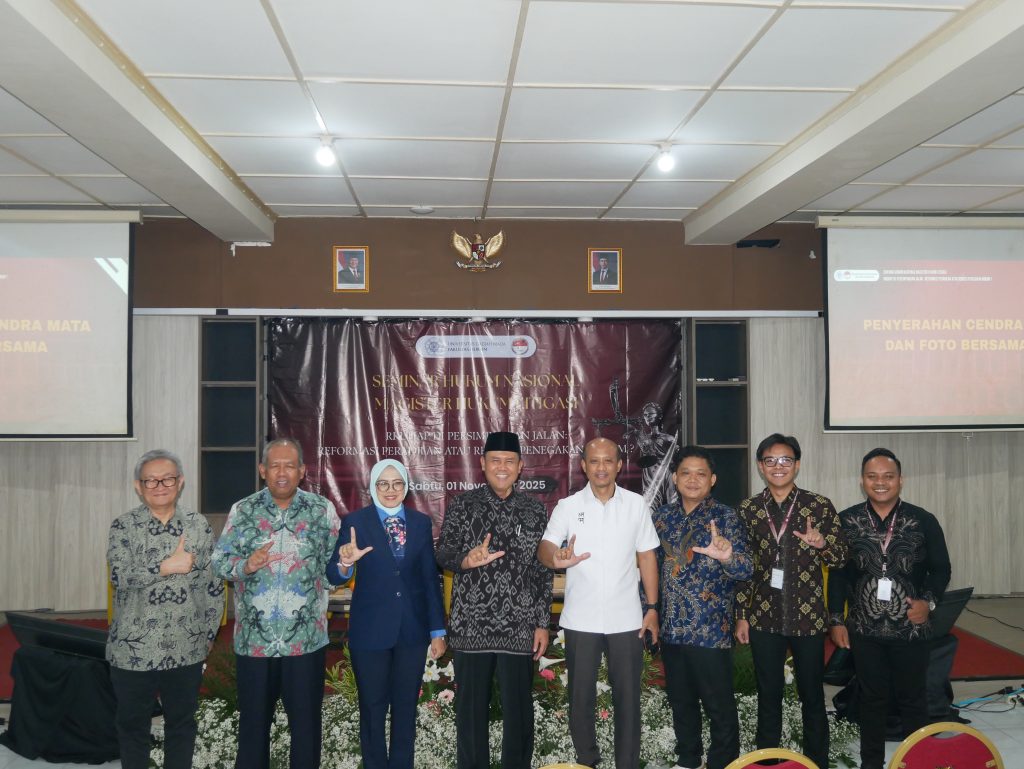
The Gadjah Mada University Master of Law in Litigation Program (KMHLi FH UGM) once again reaffirmed its role as a forum for the production of critical discourse on national law enforcement by hosting a National Seminar titled “The Draft Criminal Procedure Code at a Crossroads: Judicial Reform or a Regression in Law Enforcement?” This National Seminar was held on Saturday (November 1, 2025), in Building A 5.1.1 of the UGM Faculty of Law. The forum brought together key figures from the government, the Supreme Court, the Attorney General’s Office, the National Police, lawyers, and legal aid organizations—creating a dialogue that brought together the state, the legal profession, and civil society to analyze the direction of Indonesia’s criminal justice system transformation ahead of the enactment of the RKUHAP. The seminar session was dynamically moderated by Hauzan Zaky Rizqullah, S.Tr.K., who ensured the discussion remained incisive, focused, and inclusive for all participants.
In his keynote speech, the Deputy Minister of Law and Human Rights of the Republic of Indonesia, Prof. Dr. Edward Omar Sharif Hiariej, emphasized that the Draft Criminal Procedure Code (RKUHAP) is not at a crossroads, but is instead charting a course of firm and measured criminal law reform to strengthen the protection of human rights while ensuring the effectiveness of the criminal justice system. Through an emphasis on the concept of an integrated criminal justice system, the differentiation of functions among law enforcement agencies, the role of defense attorneys as a mechanism to check authority starting from the investigation stage, and restrictions on the use of coercive measures and pretrial detention by prosecutors, the RKUHAP is designed as a progressive legal framework that balances state instruments with the protection of individual rights. The integration of information technology in case monitoring, the strengthening of pretrial procedures, and innovations such as plea bargaining for corporations demonstrate a commitment to reform that is responsive to modern legal challenges. Thus, the overarching vision offered is not merely a normative change, but a restructuring of the culture of law enforcement toward a judiciary that is accountable, transparent, and substantively just.
A similar progressive tone emerged from the Yogyakarta Regional Police through a presentation by Senior Commissioner Rudy Yulianto, who emphasized the urgency of revising the Criminal Procedure Code to address the complexity of modern crime and the dynamics of Constitutional Court rulings. He highlighted the importance of more precise procedural reforms—from witness summonses to seizures—so that law enforcement prioritizes legal certainty and no longer relies on sector-specific regulations for critical details. Additionally, the implementation of restorative justice mechanisms was cited as a key tool for preventing prison overcrowding while providing resolutions that are more humane and responsive to the public’s sense of justice.
From the prosecution’s perspective, Rini Triningsih, S.H., M.Hum., explained that without the involvement of prosecutors from the investigation stage onward, the criminal justice system will continue to be plagued by the back-and-forth of case files (P-19) and inter-agency coordination issues. According to her, the RKUHAP offers a path toward a more integrated and transparent case-handling model that ensures legal certainty all the way through the execution phase. In this context, the Attorney General’s Office does not merely act as the dominus litis but also serves as the guardian of the quality of evidence and the accountability of the process.
Meanwhile, Dr. Maqdir Ismail, S.H., LL.M., highlighted the urgency of strengthening the role of defense attorneys as a bulwark of fair trials. He criticized historical practices that have reduced defense attorneys to a mere formality and emphasized that the Draft Criminal Procedure Code must guarantee legal representation starting from the investigation phase to prevent the erosion of the principle of due process of law. Attorneys, he argued, are not merely procedural window dressing but an essential component of a legal democracy that ensures the state does not transform into an unchecked Leviathan.
From the pinnacle of the judicial hierarchy, Chief Justice Jupriyadi, S.H., M.Hum, emphasized the need to reorganize the ever-increasing caseload of appeals. According to him, limiting legal remedies and strengthening the role of preliminary review judges are strategies to enhance the quality of rulings while upholding the principle of proportionality in the application of legal instruments. Preliminary hearings, he stressed, must remain a space for procedural oversight without devolving into a forum that delays or duplicates the examination of the merits of a case.
From the perspective of civil society, Julian Duwi Prasetya, S.H., M.H., offered a critical perspective on the risk of impunity and the importance of ensuring that the legal system is not subject to the logic of viral trends. He cited the case of the alleged torture and death of Oki in Banyumas as a reminder that human rights violations arise not only from active actions but also from institutional negligence. The state, he argued, must not hide behind administrative terms such as “taken into custody,” because every action—including negligence—carries legal and moral consequences.
Throughout the presentation, this seminar not only reflected on the direction of criminal procedure policy but also situated it within the framework of the Sustainable Development Goals (SDGs) agenda, particularly SDG 16 on peace, justice, and strong institutions, as well as SDG 10 on reducing inequalities in access to justice. The revision of the Criminal Procedure Code is articulated not as a sterile technocratic endeavor, but as part of the national development agenda that demands a transparent, humane, and human rights-based judicial system. Criminal procedure reform, in the vision of the speakers, is a long-term investment in the legitimacy of the rule of law and public trust—the two main pillars of the sustainability of democratic institutions.
The seminar concluded with an interactive discussion session and the presentation of appreciation to the speakers. Through this space for critical dialogue, KMHLi UGM reaffirmed its commitment as an intellectual laboratory guiding Indonesia’s legal transition toward a more just, transparent, and civilized future.
Authors: Wika Desta Qatrunada, Hilmi Miftahzen Reza, and Jihan Magina (Master’s Program in Litigation Law Student Association)