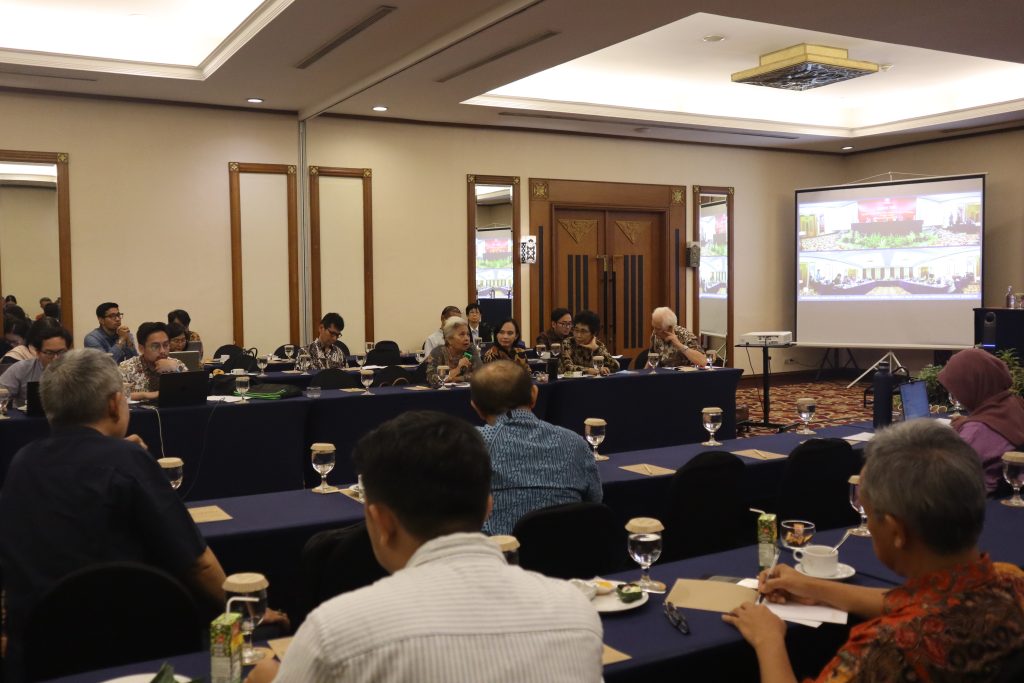
Yogyakarta, 14 June 2024 – Faculty of Law UGM once again held another Focus Group Discussion (FGD) on Friday (14/6/2024) regarding the Lecturer’s role as the Expert in Court Proceeding. This FGD was conducted as the follow-up from the previous FGD on March. This discussion was attended by the Faculty of Law lecturers with the speaker from the ethics scholar, R. P. Prof. Dr Franz Magnis Suseno and Judge Albertina Ho and currently serves as the KPK Supervisory Board.
This discussion was organized by the Task Force Team of the Vice Dean for Research, Community Service, and Information System and assisted by the Consultation Center and Legal Aid Unit (PKBH). This forum was conducted in Lulilo Ballroom, Loman Park Hotel, Yogyakarta. This forum was attended with more than 40 participants that contributed their thoughts on the current issues. Aside from implementing the Three Pillars of Higher Education, which is Education and Community Service, this event is also align with the Sustainable Development Goals (SDGs) on the 4th point on Quality Education and the 17th goal on the Partnership for the Goals.
On the opening session, Vice Dean for Research, Community Service, Dr. Heribertus Jaka Triyana, S.H., M.A., LL.M. as the moderator for this discussion, opened the meeting with directly asking the speakers with their opinion and perspective when a lecturer appeared as the Expert in Court Proceeding, especially on the ethics and moral side. On the first session, Prof. Dr. Franz Magnis Suseno argued that Ethics is a thought on morality, and every individual have a basic knowledge on right and wrong. Personal conscience is always right and must be the primary point of reference. Law regulates the people’s norm in resolving a conflict fairly. Obeying Law itself is not enough, integrity and ethics is important as well, even though it’s often debated by the public.
In the court proceeding, law experts are not only seeing facts from the perspective of existing law. It is important for law experts to be free from personal interest and owning a high integrity. Such a honorarium payment issue should not affect the experts testimonies. Academic institution such as Faculty of Law UGM should not forbid their lecturers to be an expert witness, but instead, they should maintain their integrity and independence.
On the second session, Albertina Ho, S.H., M.H. argued that the term “expert” is more precise than “witness” to avoid ambiguity. Lecturer holds important role in bridging the gap between theory and practice in the field of law. Conflict can be appear during the practice on giving expert testimonies. Objectivity in giving the expert testimonies is important and should not be intervene by personal relationship or any other personal interests. Honorarium, even though is not mandatory, could affect the perspective of the expert testimonies.
Expert testimonies can affect to the result of the court proceeding, both positive and negative. Transparency and ethic code implementation is important to maintain the lecturer’s integrity as an expert. Further discussion needs to be conducted within the internal scope of the institution, which also includes the need for regulations and ethics in providing expert testimony, as well as the university’s role in properly regulating and supervising this practice.
The discussion continued with the discussion session by the participants and the speakers. Both Lecturer and Professor as the participants were giving their insights on this issue. As what Prof. Dr. Nurhasan Ismail, S.H., M.Si has agreed on the ethic code in gibing the expert testimonies. Other than that, orientation in giving the legal testimonies itself is justice. On the end of the discussion, the Dean of Faculty of Law UGM, Dahliana Hasan, S.H., M.Tax, Ph.D. concluded that she eventually knows the happening reality in giving the expert witness. The Deanery themselves started considering for preparing and issuing the special assignment letters addressed to lecturers for providing testimony in corruption cases, primarily from the defendant’s perspective. Additionally, a mechanism for accountability will be developed, in which lecturers will be asked to provide an overview of the testimony they have given to uphold the dignity of the Faculty of Law, UGM.
Writer: Fadhila Ardianti