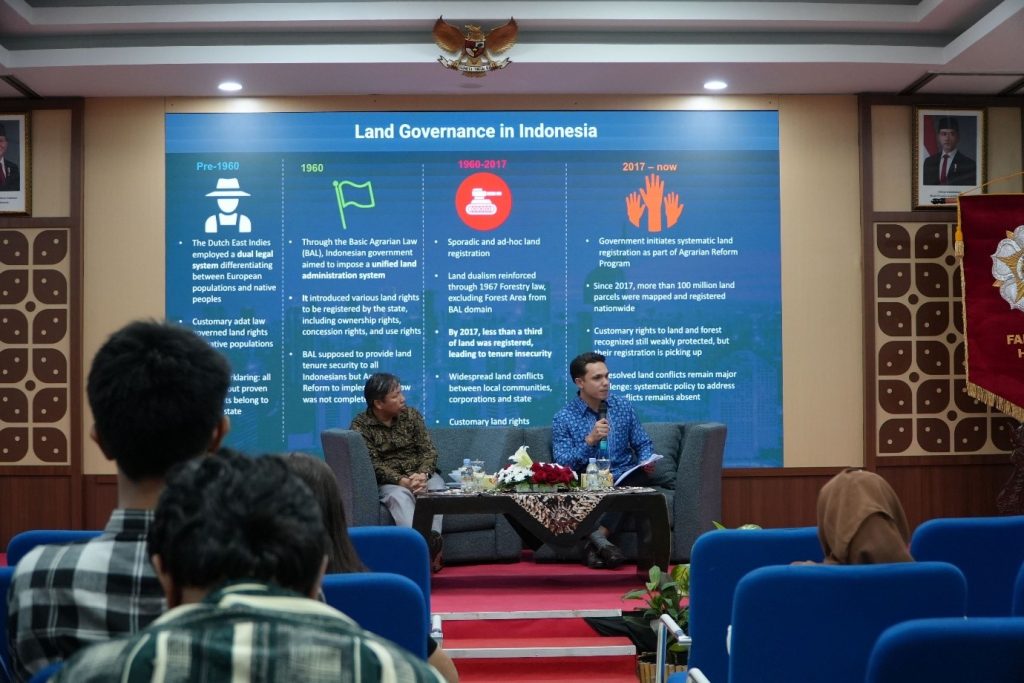
The Department of Agrarian Law at the Faculty of Law, Universitas Gadjah Mada (UGM), organized a public lecture entitled “Multi-Dimensional Perspective in Understanding Land Registration Issues in Indonesia” on Tuesday, 26 May 2026, at the Auditorium of Building B, Faculty of Law UGM. The event featured Dr. Willem van der Muur, M.A., a Land Tenure Specialist and Team Leader of the Integrated Land Administration and Spatial Planning Project (ILASPP) from the World Bank.
Land registration in Indonesia has been one of the sectors supported by the World Bank through a series of projects implemented since the mid-1990s. These initiatives have not only sought to accelerate land registration processes but have also addressed complex challenges related to public administration, development approaches, and social dynamics at the community level. The public lecture was therefore organized as a forum to discuss and examine the challenges and emerging issues surrounding land registration in Indonesia.
The event was moderated by Dr. Rikardo Simarmata, S.H., Head of the Department of Agrarian Law at UGM Faculty of Law. In his opening remarks, he emphasized that land registration in Indonesia is a complex and multidimensional issue. Within this context, the World Bank, as a development agency, has been supporting the Indonesian government in its efforts to complete land registration nationwide.
In his presentation, Dr. Willem van der Muur explained that the World Bank’s interest in the land sector stems from its mission to reduce poverty and promote shared prosperity in a sustainable manner. Within this framework, secure land rights are regarded as a crucial foundation for economic development, broader access to resources, and stronger protection for vulnerable groups.
He further emphasized that the recognition of land rights should not be understood solely as an administrative or legal process. Rather, it is also shaped by power relations, negotiation processes, and political dynamics at the local level. Therefore, a more inclusive approach to recognizing land rights—particularly customary and communal land rights—is needed to ensure that policies reflect social realities and the practices that exist within communities.
During the lecture, Dr. Willem also introduced the Integrated Land Administration and Spatial Planning Project (ILASPP), a program currently being implemented in Indonesia under his leadership. The project focuses on strengthening land administration systems, improving tenure security, and integrating spatial planning to support sustainable development.
Following the presentation, the event continued with three rounds of discussion and question-and-answer sessions. Participants demonstrated strong enthusiasm by raising various issues related to land registration, ranging from the registration of customary lands to the use of technology in improving the accuracy and effectiveness of land registration systems in Indonesia.
The public lecture concluded with the presentation of a token of appreciation to Dr. Willem van der Muur by Dr. Rikardo Simarmata on behalf of the Department of Agrarian Law, Faculty of Law UGM, followed by a group photo session.
The organization of this public lecture reflects the Faculty of Law UGM’s commitment to fostering knowledge development and critical dialogue on land registration through a multidisciplinary lens. The event also contributed to the achievement of several Sustainable Development Goals (SDGs), particularly SDG 1 (No Poverty) by highlighting the role of secure land rights in poverty reduction and community welfare improvement. Discussions on the recognition of customary land rights and the protection of vulnerable groups also aligned with SDG 10 (Reduced Inequalities) by promoting equitable access to resources and legal protection.
Furthermore, conversations on strengthening land administration and spatial planning support SDG 11 (Sustainable Cities and Communities) through more effective and sustainable land governance. The involvement of academics, practitioners, international organizations, and students in this forum also reflected the spirit of collaboration promoted by SDG 17 (Partnerships for the Goals) in advancing a fair, inclusive, and sustainable land administration system.
Writer: Eka Putri Endriana