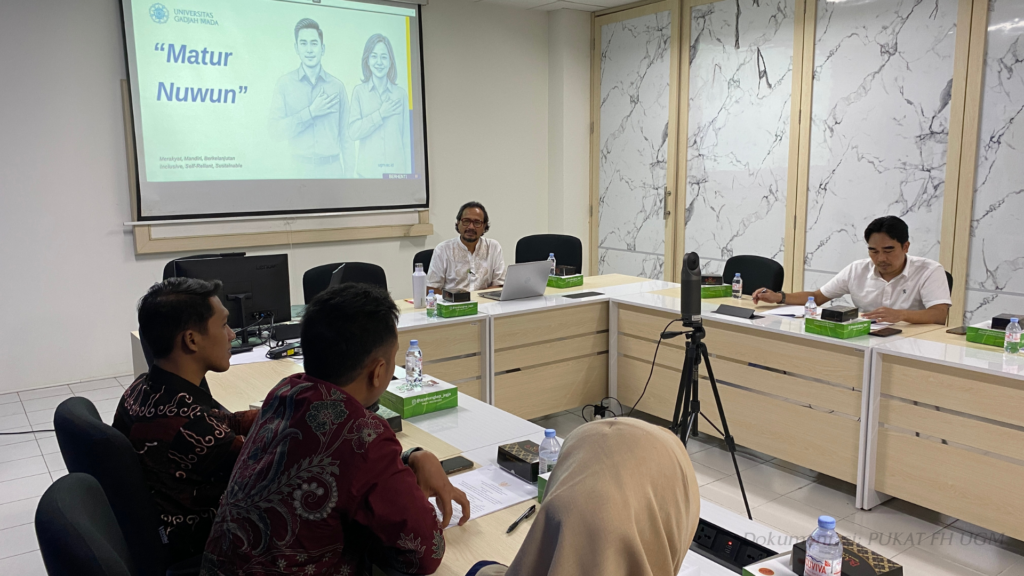
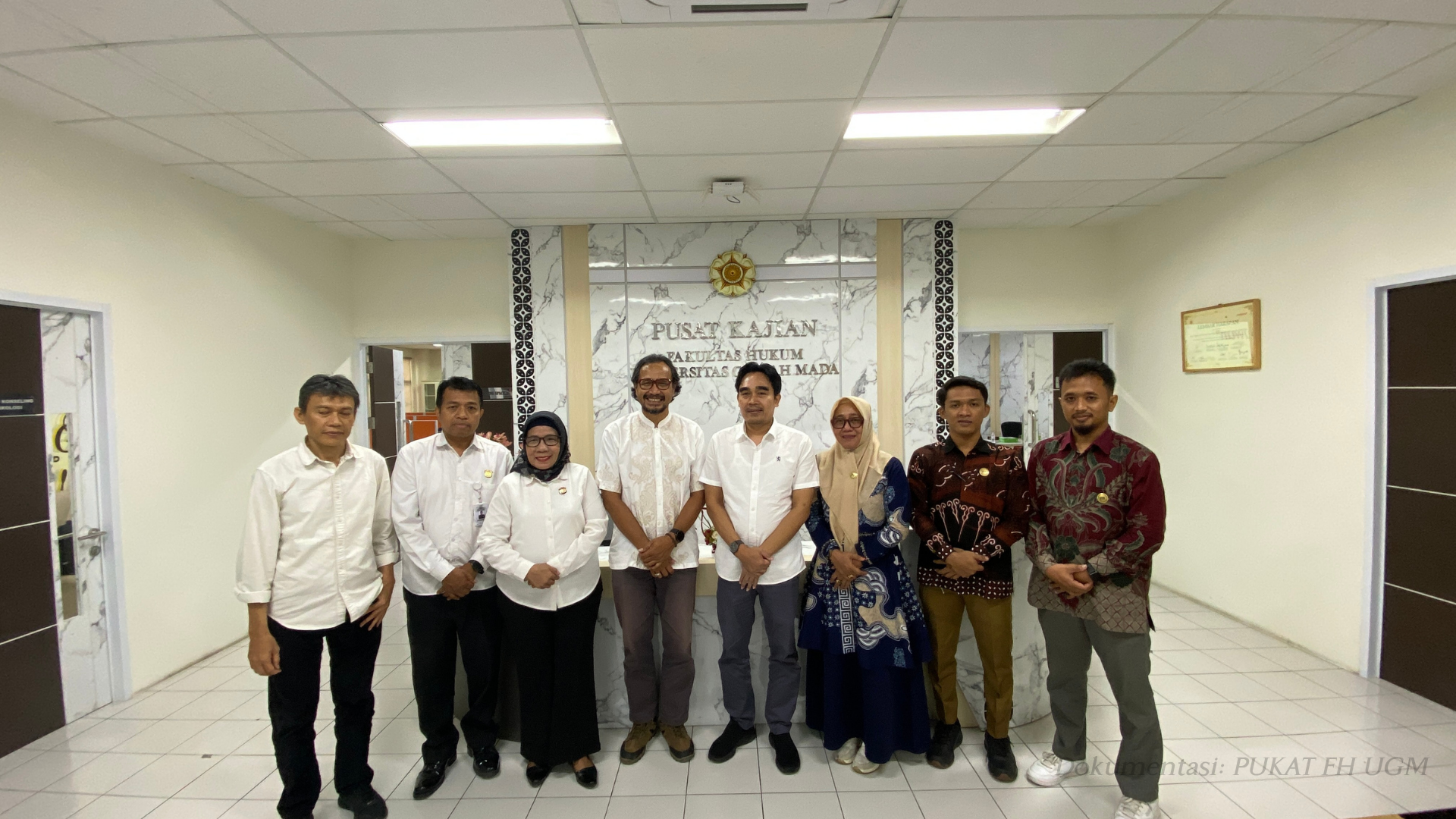
The Legal Consultation and Assistance Centre of the Faculty of Law, Universitas Gadjah Mada (PKBH FH UGM), in collaboration with the Civil and State Administrative Affairs Division (Bidang Perdata dan Tata Usaha Negara/Datun) of the Yogyakarta Special Region High Prosecutor's Office (Kejati DIY), held a legal outreach activity to assist in drafting the Draft Wirokerten Kalurahan Regulation of 2026 on the Amendment to Kalurahan Regulation No. 5 of 2024 on the Income of the Lurah, Kalurahan Officials, Kalurahan Staff, Honorary Kalurahan Staff, and the Kalurahan Consultative Body, on Wednesday, October 21, 2026. The activity ran from 9:00 to 11:00 a.m. WIB in Meeting Room 2 of the Research Centre, Building 3, FH UGM. It was attended by 19 participants, with Dr. Totok Dwi Diantoro, S.H., M.A., LL.M. as the resource person. The discussion focused on regulating the income of the Lurah (village head), Kalurahan Officials (Pamong Kalurahan), Kalurahan Staff, Honorary Kalurahan Staff, and the Kalurahan Consultative Body (Badan Permusyawaratan Kalurahan) in Wirokerten Kalurahan, Bantul Regency.
The activity aims to support the kalurahan government in drafting regulations that have a clear and consistent legal basis and that can be applied in line with local governance conditions. Legal assistance matters because a Kalurahan Regulation (Peraturan Kalurahan/Perkal) must not only satisfy technical drafting requirements, but must also have the right substance and be consistent with higher regulations.
In the presentation and discussion, a number of technical aspects of drafting a Perkal were the main points of discussion, including refining the recitals (konsiderans), the choice of font type and size, and the completeness of the legal bases in the "Having Regard To" (Mengingat) section. The FH UGM Outreach Team also raised the importance of re-checking references to Bantul Regent's Regulations, including whether the right articles are cited and whether the regulations listed are still in force.
One of the main topics was the interpretation of Bantul Regent's Regulation No. 129 of 2021, as amended by Bantul Regent's Regulation No. 33 of 2026. The discussion highlighted the regulation of monthly income and allowances, as well as problems that can arise when a Lurah is replaced. The provisions on applying regulations retroactively also drew attention, especially where doing so would impose burdens on the community or lacks an adequate legal basis.
Participants from the kalurahan said that differing interpretations between the regency government and the kalurahan government remain an obstacle to drafting a Perkal. Another challenge concerns aligning a Perkal with the Kalurahan Revenue and Expenditure Budget (Anggaran Pendapatan dan Belanja Kalurahan/APBKal), given that the APBKal was amended in July 2026, after the Regent's Regulation was issued in March 2026. This situation shows the importance of coordination so that regulation-drafting and budgeting proceed in step.
The discussion brought out a need for the regional government to provide written explanations or guidance in order to reduce uncertainty in interpretation and minimize the risk of problems arising in audits. Assistance from relevant parties, including academics and law enforcement officials, was also seen as important in helping kalurahan understand the legal basis, draft the right provisions, and align them with the applicable budgeting mechanisms.
The activity is expected to deliver benefits in the form of a better understanding of regulation-drafting techniques, greater care in formulating the substance of regulations, and improved coordination between the regency government and the kalurahan government. In this way, the Perkal being drafted is expected not only to meet formal requirements, but also to provide legal certainty and be implementable in an accountable manner.
The activity is relevant to the UN Sustainable Development Goals (SDGs), particularly SDG 16: Peace, Justice, and Strong Institutions, through efforts to strengthen legal certainty, accountable governance, and effective institutions. The collaboration among the kalurahan government, the regional government, academics, and law enforcement officials is also in line with SDG 17: Partnerships for the Goals, as it shows the importance of cross-party partnership in supporting better governance.
Author: Fateh Radik Al Ghifari (Student, Faculty of Law, Universitas Gadjah Mada)