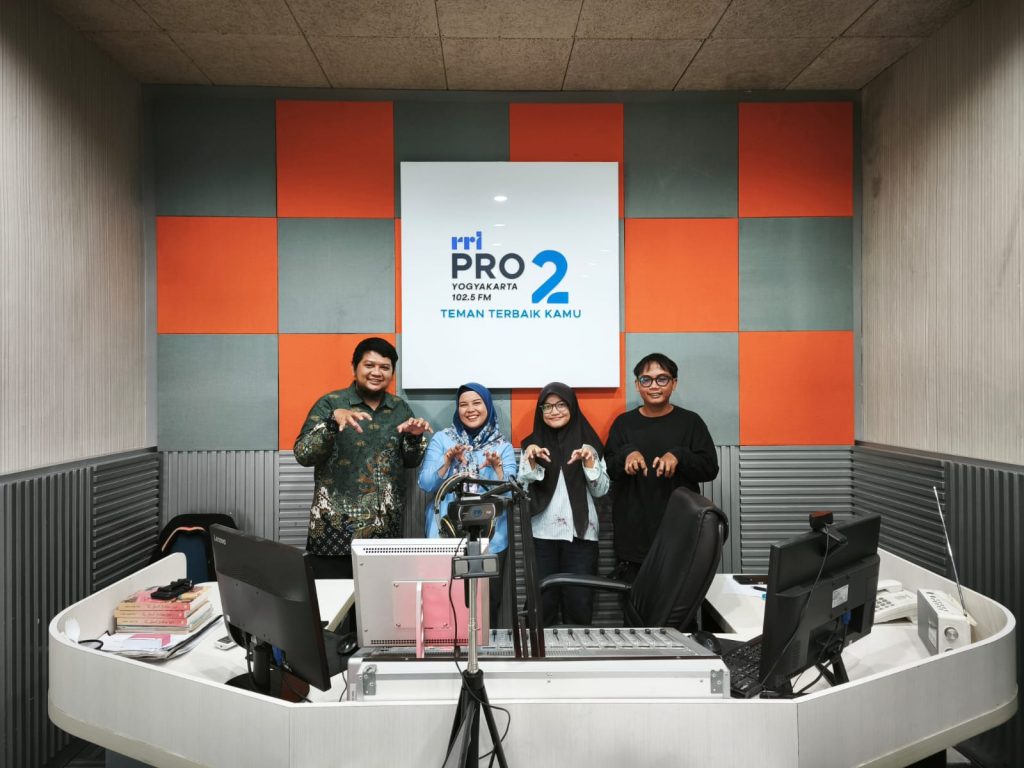
The Gadjah Mada University Legal Consultation and Assistance Center (PKBH UGM), which is part of the UGM Faculty of Law (FH), in collaboration with Radio Republik Indonesia (RRI) Pro2 102.5 FM, hosted a legal awareness broadcast titled “Trash in Tourist Areas: Who Is Responsible and What Can Be Done?” This radio program aired on Wednesday, December 17, 2025, on RRI Pro2 102.5 FM. The event aimed to raise legal awareness and encourage active participation from various stakeholders—particularly the people of Yogyakarta—in supporting public policies related to waste management.
This broadcast features several guests, including Fajri Mulya Iresha, S.T., M.T., Ph.D., a lecturer in Environmental Engineering at the Faculty of Civil Engineering and Planning, Universitas Islam Indonesia (UII), who is also an active researcher focusing on waste management and its impact on the environment; and Elki Setyo Hadi, Head of the Advocacy and Campaign Division at WALHI Yogyakarta, a non-governmental organization that, since 1986, has focused on advocating for environmental issues at both the local and national levels. This event was also supported by female students from the Faculty of Law at UGM—Afita Safanisa, Krisnina Meilani Wardhani, and Rasya Assegaf—who are members of the Environmental Law Society (ELS) at the Faculty of Law, UGM.
The main topic of this broadcast is the state of waste management in Yogyakarta and the various challenges it faces. Fajri Mulya Iresha explained the on-the-ground situation of waste management in Yogyakarta, particularly regarding the closure of the Piyungan Final Disposal Site (TPA). Meanwhile, Elki Setyo Hadi highlights the efforts undertaken by the Special Region of Yogyakarta government in waste management, including through the use of technology. However, the implementation of this technology is deemed not yet fully capable of resolving the issues, and has even led to a reduction in the waste capacity that the Piyungan Landfill can accommodate. Elki Setyo Hadi also emphasized that the current waste management system has not fully integrated the role of the community. This was reinforced by Afita Safanisa, who added that in drafting waste management regulations, the role of the informal sector must also be seriously considered.
This broadcast concluded that there is no single actor who bears the greatest responsibility in the waste management system. Fajri Mulya Iresha and Elki Setyo Hadi agreed that waste management is a shared responsibility. Fajri linked the value of mutual cooperation—which is deeply rooted in Indonesian society—to the concept of shared responsibility in the waste management system. He emphasized that this does not mean placing an excessive burden of responsibility on the public, but public participation must still be taken into account—particularly in household-level waste sorting, in addition to residual waste. Elki Setyo Hadi added that the public also needs to get into the habit of rethinking their purchases before buying an item. Furthermore, Afita Safanisa highlighted the importance of the media’s role in advocating for proper waste management practices. This shared responsibility involves the participation of all stakeholders—including the government, the public, the media, academia, and the private sector—to work together to address structural waste problems.
This initiative is one of the efforts to promote the achievement of the Sustainable Development Goals (SDGs), specifically SDG 11 (Sustainable Cities and Communities) through sustainable waste management, SDG 12 (Responsible Consumption and Production) through raising awareness among consumers and producers regarding the waste they generate, SDG 13 (Climate Action) through reducing the carbon footprint via improved waste management, SDG 15 (Life on Land) through the sustainable protection of terrestrial ecosystems, and SDG 17 (Partnerships for the Goals) through strengthening shared responsibility in waste management. This strategic collaboration between PKBH UGM and RRI embodies a shared commitment to expanding access to adequate information for the public and serves as an effort to promote better waste management, which ultimately contributes to environmental sustainability and the realization of ecological justice in Indonesia.
Author: Afita Safanisa