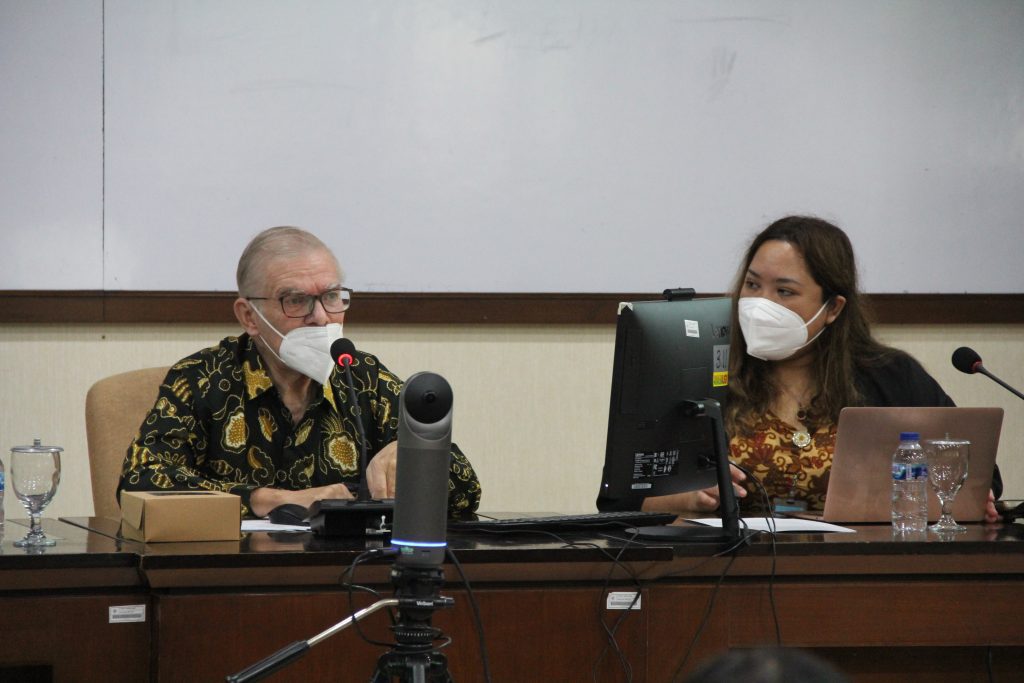
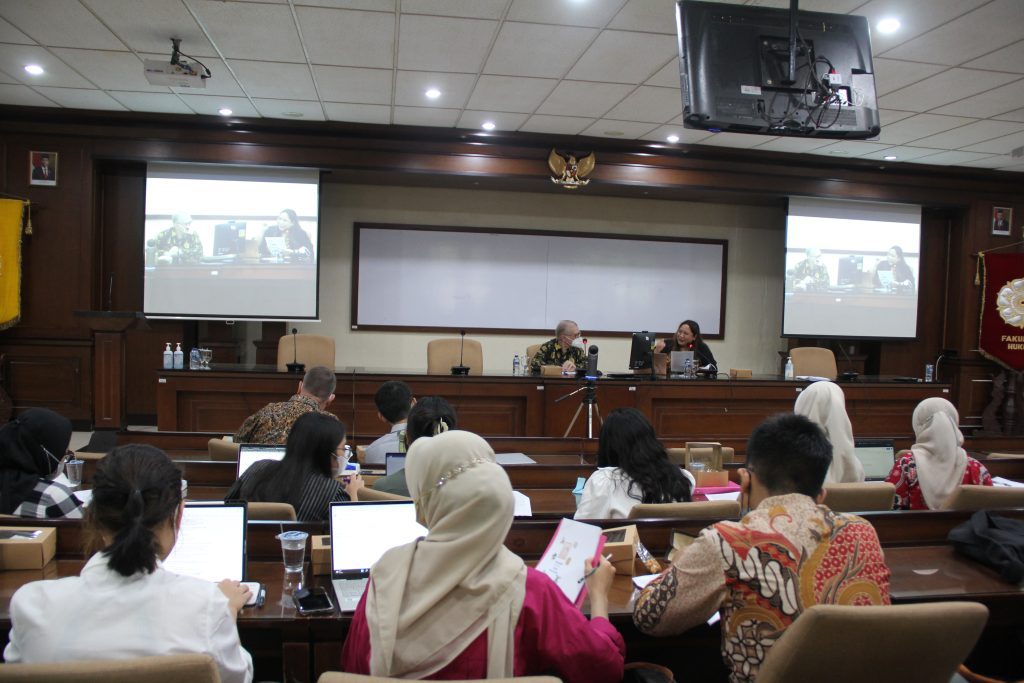
FH UGM held another guest lecture on Friday, September 9, in Room 3.1.1 at the Faculty of Law. Attended by 55 students from UGM's International Undergraduate Program (IUP) in Law, the lecture's theme was "Pancasila as the Foundation and Driving Force for Indonesian Democracy and Religious Tolerance."
The lecture was moderated by Dr. Mahaarum Kusuma P., S.H., LL.M., featuring Wolfgang Brehm as speaker. Brehm previously served as a legal consultant at the Center for Societal and Cultural Studies under Indonesia's National Research and Innovation Agency (formerly LIPI's PMB-LIPI), as well as at Universitas Veteran and Universitas Negeri Jakarta, from 1998 to 2013. Since retiring, he has occasionally taught at the graduate school of UIN Jakarta.
Brehm divided the lecture into two parts: the Formation of the First Principle (Sila Pertama) of Pancasila, and its Application throughout Indonesian History. He drew a linguistic distinction between the word "God" (Tuhan) and the concept of "godliness/divinity" (ketuhanan) — explaining that under linguistic convention, "ketuhanan" refers to everything connected to God as a concept, rather than an individual's personal attitude toward God — while discussing Soekarno's original formulation of Pancasila's first principle.
Toward the end of the lecture, Brehm expressed hope that Indonesians would someday interpret Pancasila's first principle more openly, rather than limiting religious identity strictly to the six officially recognized religions. He pointed out that some Indonesians still hold ancestral/traditional beliefs, yet the state requires them to formally affiliate with a recognized religion — something he suggested reduces this requirement to a mere formality. He argued that the spirit of "ketuhanan" in Soekarno's Pancasila was never meant to impose a burden, but rather to support freedom of religion.
Brehm closed by expressing hope that the guest lecture would help students develop a more open-minded understanding of Pancasila, particularly its first principle.