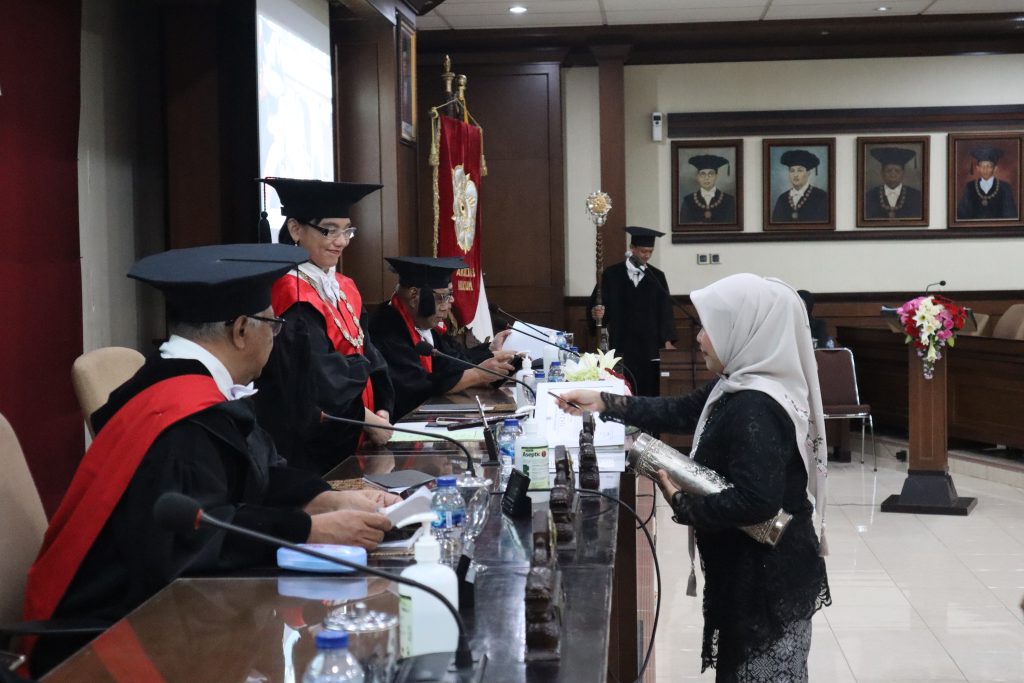
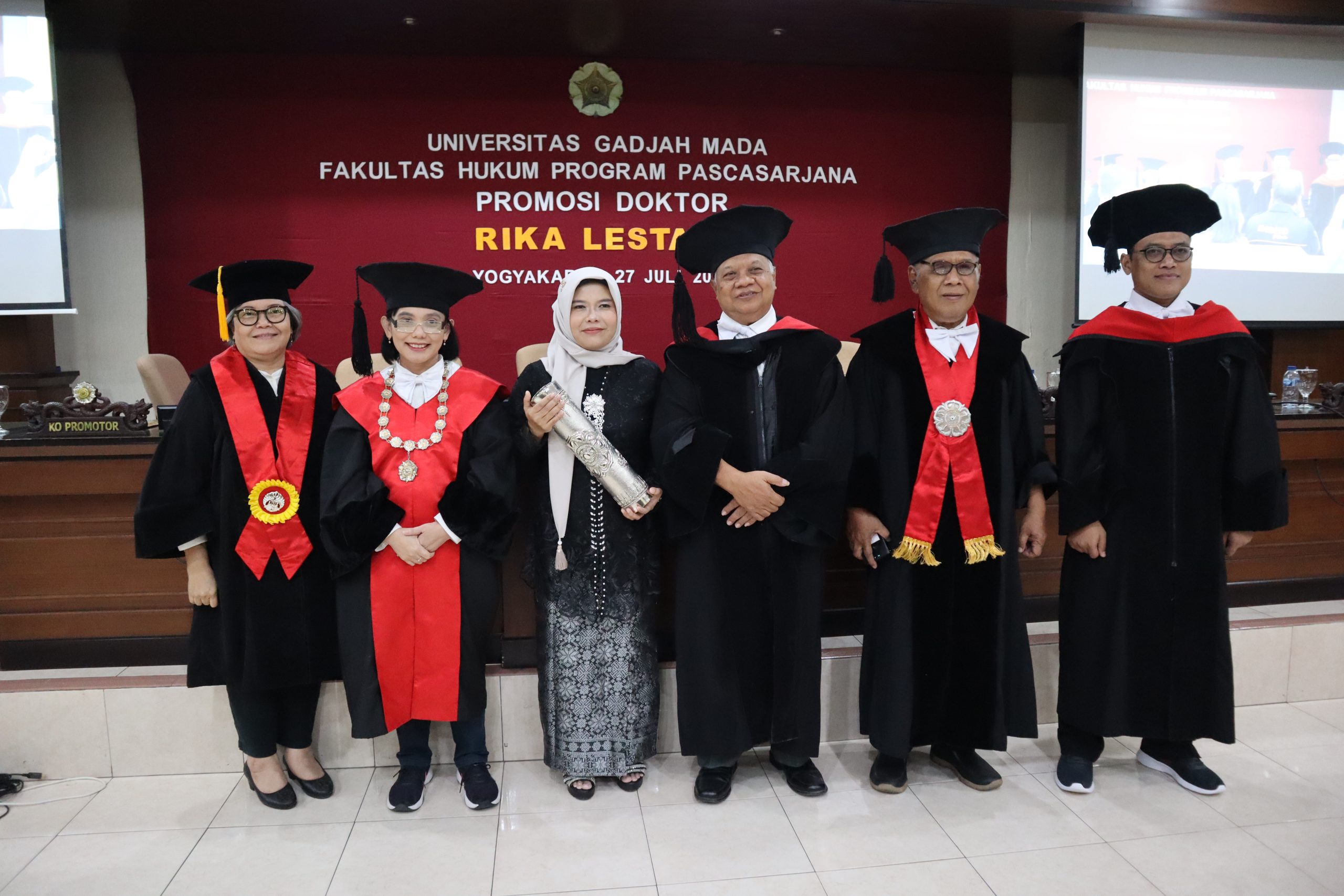
Rika Lestari, S.H., M.Hum., recently took her open doctoral defense at the Faculty of Law, Gadjah Mada University, with a dissertation titled “Changes in Customary Law Governing the Use of Customary Forests in Kampar Regency as Living Law in Society” on Thursday (February 27). For this defense, Dr. Djoko Sukisno, S.H., C.N., served as the supervisor, and Dr. Sulastriyono, S.H., M.Si., served as the co-supervisor. Meanwhile, the examination committee consisted of Prof. Dr. Sudjito, S.H., M.Si., Prof. Dr. Dra. Sulistyowati Irianto, M.A., Dr. Wahyu Yun Santoso, S.H., M.Hum., LL.M., and Dahliana Hasan, S.H., M.Tax., Ph.D., who served as chair of the committee.
In her dissertation, the doctoral candidate explains that the customary forests in Kampar Regency, as communal forests, are well-preserved. This demonstrates that customary law communities, through their local wisdom, are capable of regulating the use and management of customary forests despite significant changes occurring alongside societal development. The success of customary law communities in preserving customary forests amid the dynamics of development demonstrates that these communities are capable of fulfilling the functions of adaptation, goal achievement, integration, and the preservation of values or patterns in the utilization of customary forests.
Based on the doctoral candidate’s research, there has been a shift in customary legal norms regarding customary prohibitions. In the past, logging in customary forests was permitted only for the construction of public facilities such as mosques, bridges, customary community halls, and community homes. Today, this norm has changed to “logging is strictly prohibited within customary forests.” This change was prompted by the actions of certain members of the customary law community who cut down trees without permission for commercial purposes.
Another aspect that has changed relates to the division of forest areas. Previously, the customary forests in Kampar Regency consisted of the Pusako Tinggi Customary Forest, the Soko Forest, the Larangan Forest, and the Reserve Forest. Currently, only the Larangan Forest and the Soko Forest remain. The status of the Pusako Tinggi Customary Forest and the Reserve Forest, which were originally customary forests, has changed to “part of the state forest.”
The doctoral candidate also outlined changes in the institutional aspects of oversight. “Typically, authority over customary forests is granted to the Penghulu Pucuk Godang Ka Dalam within the village, who then delegates it to the Dubalang. Currently, oversight of customary forests is carried out by the Forest Farmers’ Group (KTH), the Customary Forest Management Agency (LPHA), tribal chiefs, and the village government,” explained the doctoral candidate.
The doctoral candidate’s dissertation examines three main areas: research on changes in customary law governing the use of customary forests in Kampar Regency; factors influencing changes in customary law governing the use of customary forests in Kampar Regency as a living legal system within the community; and an investigation into the role of customary law in regulating the use of customary forests in relation to applicable statutory laws.
During this open defense, Rika Lestari, S.H., M.Hum., successfully defended her research findings and was declared to have passed with a grade of A- and the distinction of “highly satisfactory.” It is hereby announced that Rika Lestari, S.H., M.Hum., is the 257th doctoral candidate to pass the examination at the UGM Faculty of Law and the 5,919th doctoral graduate of Gadjah Mada University.
Author: PDIH
Editor: Public Relations