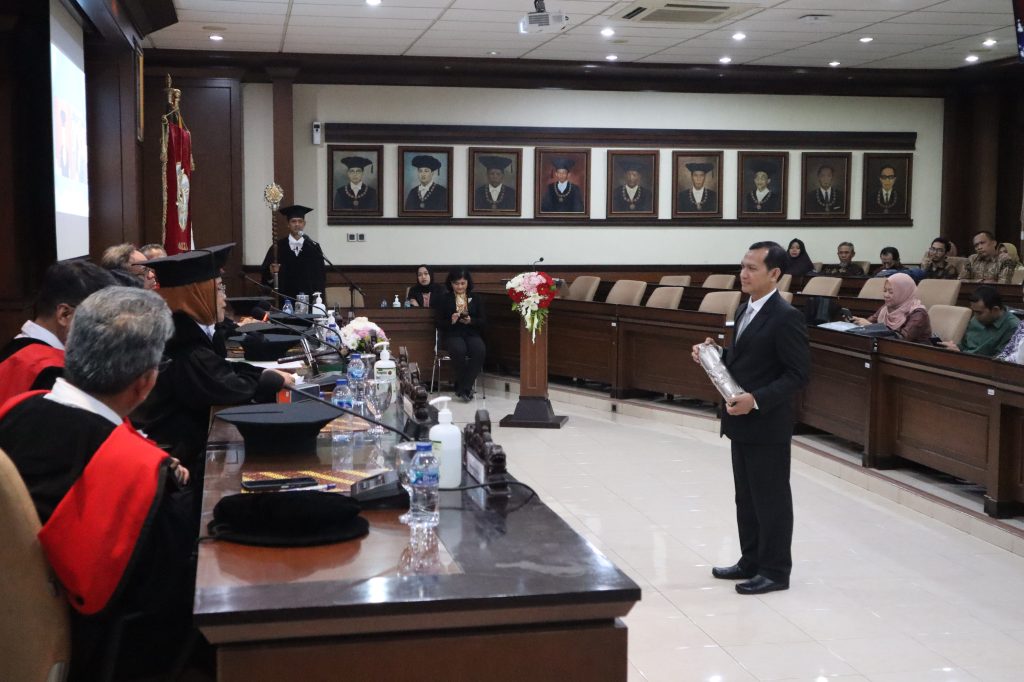
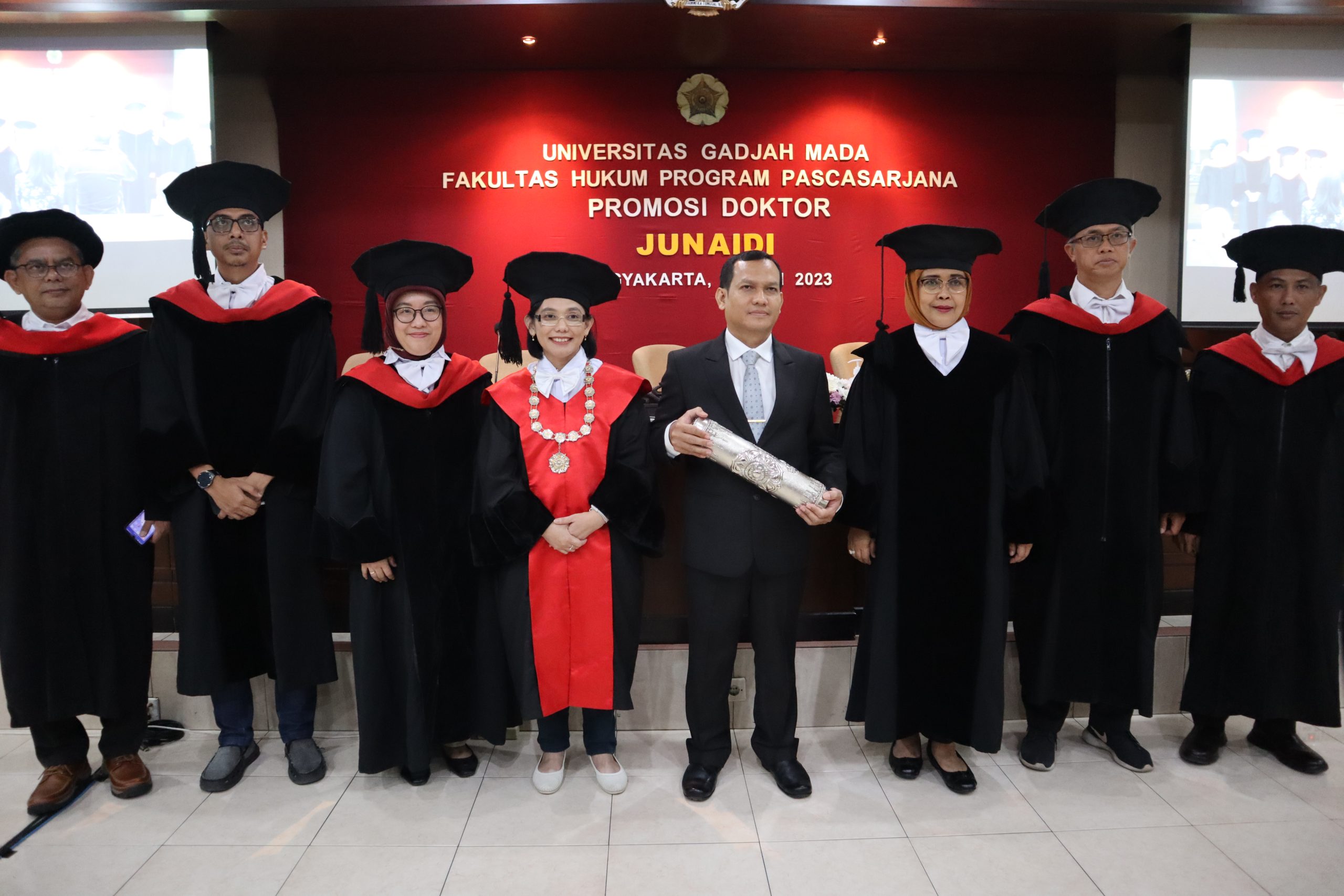
Junaidi, S.H., M.H., recently took his open doctoral defense at the Faculty of Law, Gadjah Mada University, presenting a dissertation titled “The Phenomenon of a Sole Candidate Supported by a Majority of Political Parties and Its Implications for Oversight by the Regional People’s Representative Council” on Friday (February 28).
For this doctoral defense, the supervisor was Prof. Dr. Enny Nurbaningsih, S.H., M.Hum., and the co-supervisor was Dr. Zainal Arifin Mochtar, S.H., LL.M. Meanwhile, the examination committee consisted of Andy Omara, S.H., M.Pub&Int. Law., Ph.D., Dr. Mailinda Eka Yuniza, S.H., LL.M., Dr. Andi Sandi Antonius TT, S.H., LL.M., Iwan Satriawan, S.H., MCL., Ph.D., and Dahliana Hasan, S.H., M.Tax., Ph.D., who served as the chair of the examination committee.
In his dissertation, the doctoral candidate explains that since the implementation of the regional head election (Pilkada) policy in 2015, a new phenomenon has emerged: a number of regions with only one candidate pair (a single candidate). Over time, from one election cycle to the next, the number of regions holding Pilkada elections with a single candidate has continued to increase significantly. Political party support for single candidates has also risen dramatically. In the 2018 Pilkada, the coalition of political parties backing a single candidate exceeded 80%. If political party support for a single candidate across all regions exceeds 80%, it is certain that no other candidate pairs will emerge in the relevant regions through the political party channel.
The doctoral candidate explained that, based on the above reality, the number of regions holding regional elections with a single candidate pair is directly proportional to the increase in political party support for that single candidate pair. This raises questions regarding the effectiveness of checks and balances in the relationship between regional heads and the Regional People’s Representative Council (DPRD). Although the regional government law grants equal standing to regional heads and the DPRD as components of the regional government, the DPRD has a distinct function: to oversee the administration of government. Translated with DeepL.com (free version)
“Logically, the Regional People’s Representative Council (DPRD) is separated from the local government with the aim of further empowering the DPRD and enhancing the local government’s accountability to the people. The DPRD’s oversight function is correlated with the size of the political party coalition supporting a regional head candidate and the effectiveness of the DPRD’s oversight function,” explained the doctoral candidate.
The doctoral candidate also quoted Muchammad Ali Safa’at, who stated that a single candidate supported by all political parties in the Regional People’s Representative Council would undermine the democratic structure of local government. The doctoral candidate acknowledged that while such concerns may not necessarily materialize, if the Regional People’s Representative Council’s oversight function does not operate effectively, the regional head faces a high risk of abusing their authority.
In this open defense, Junaidi S.H., M.H. successfully defended his research and was declared to have passed with a grade of A- and the rating “highly satisfactory.” It is hereby announced that Junaidi, S.H., M.H. is the 259th doctoral candidate to pass the examination at the Faculty of Law and the 5,921st doctoral candidate to graduate from Gadjah Mada University.
Author: PDIH
Editor: Public Relations