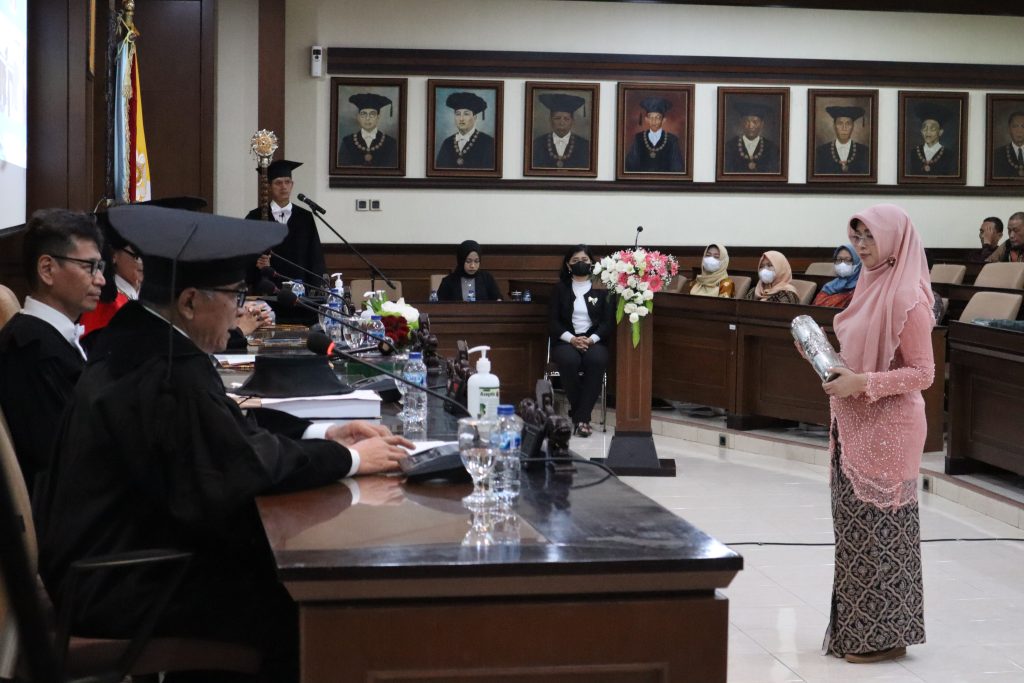
A lecturer at the Faculty of Law, Universitas Muhammadiyah Yogyakarta (UMY), Reni Budi Setianingrum, S.H., M.Kn., recently sat her open doctoral defense at the UGM Faculty of Law, presenting research titled "ASEAN Competition Law as Ius Constituendum in the Enforcement of Cross-Border Competition Law in the ASEAN Region." Prof. M. Hawin, S.H., LL.M., Ph.D. served as Promotor, with Prof. Dr. Marsudi Triatmodjo, S.H., LL.M. as Co-Promotor. The examining panel comprised Irna Nurhayati, S.H., M.Hum., LL.M., Ph.D., Dr. Heribertus Jaka Triyana, S.H., LL.M., M.A., Dr. Siti Anisah, S.H., M.Hum., Prof. Dr. Mukti Fajar ND., S.H., M.Hum., and Dahliana Hasan, S.H., M.Tax., Ph.D. as Head of the Examining Panel.
In her dissertation, Reni explained that ASEAN, as an association of Southeast Asian nations, has established a single market reinforced through the ASEAN Economic Community (AEC). This freedom and openness of the market has given rise to new forms of competition among ASEAN member states. Realizing healthy cross-border competition within the ASEAN region, however, presents a number of challenges -- including jurisdictional issues stemming from the distinct legal characteristics of each ASEAN member state, despite the existence of a regional guideline on competition policy that serves as a general framework. Reni explained the need for further study of ASEAN Competition Law as a body of law intended to apply in the future (ius constituendum) within the ASEAN single market, in order to govern cross-border business competition among ASEAN member states.
The underlying rationale for positioning ASEAN Competition Law as ius constituendum in the enforcement of competition law across the ASEAN region rests on three grounds. First, the existence of an integrated and competitive market under the AEC will give rise to a need for a shared regulatory framework in competition law enforcement across the region. Second, any market requires competition law aimed at supervising market behavior to prevent market players from engaging in conduct that could lead to "market failure" or the unlawful acquisition of market dominance. Third, the differing parameters across the competition laws of ASEAN member states mean that the same conduct by a business actor may be deemed lawful or unlawful depending on the competition authority of the relevant state -- giving rise to legal uncertainty.
"The benefit for Indonesia is that, with an ASEAN Competition Law in place, there would be uniformity in cross-border competition regulation, which in turn would create legal certainty in the field of competition." This was Reni's explanation of the benefits that ASEAN Competition Law would bring to Indonesia.
In this open defense, Reni Budi Setianingrum successfully defended her dissertation research and was awarded a final grade of A. With this result, Dr. Reni Budi Setianingrum, S.H., M.Kn. is announced as the 252nd doctoral graduate of the UGM Faculty of Law and the 5,771st doctoral graduate of Universitas Gadjah Mada.