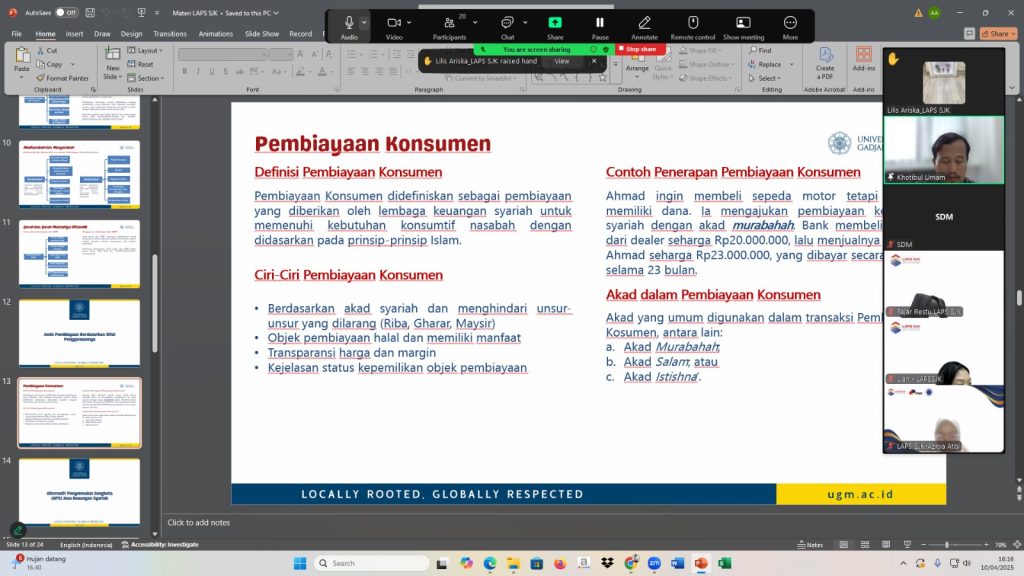
The Alternative Dispute Resolution Institute for the Financial Services Sector (LAPS SJK) held basic training on Islamic Financial Institutions for its employees and administrators. The training featured Dr. Khotibul Umam, S.H., LL.M., a lecturer from the Department of Islamic Law, Faculty of Law, Universitas Gadjah Mada, who is known for his active involvement in the development of Islamic economic and financial law.
This activity is part of an internal education and training program to improve the capacity of LAPS SJK's human resources, particularly in understanding the legal and operational aspects of Islamic financial institutions. This training is expected to strengthen employee professionalism in resolving disputes in the financial services sector based on Sharia principles.
The material presented was titled "Sharia Financing in Practice: Operational Systems, Law, and Dispute Resolution"covering six main topics: Operational Systems of Sharia Financial Services Institutions Sharia Financing Law Sharia Financing Contracts and Composition Types of Financing Based on the Nature of Their Use Alternatives for Sharia Financial Dispute Resolution Case Study of Sharia Financing in Practice Case Study.
The learning approach used a combination ofconceptual approach,statute approach, andcase approach, aiming to provide participants with both theoretical understanding and practical skills.
The training was also attended by members of the LAPS FSS management, including Mr. Fajar Restu Sonjaya (Secretary) and Mr. Erdianto Sigit Cahyono (Treasurer). The discussion session was lively, with participants raising questions and offering critical insights regarding the implementation of Sharia financing in the context of resolving disputes they encounter in the field.
More broadly, this activity supports the achievement of the UN Sustainable Development Goals (SDGs), particularly Goal 4 (Quality Education) and Goal 8 (Decent Work and Economic Growth).This training demonstrates LAPS SJK's commitment to improving the quality of education and training for its employees and creating a professional, competitive work environment oriented toward inclusive and equitable financial sector growth.
Writer: Dr. Khotibul Umam, S.H., LL.M. (Lecturer from the Department of Islamic Law, Faculty of Law)
Editor: Public Relations