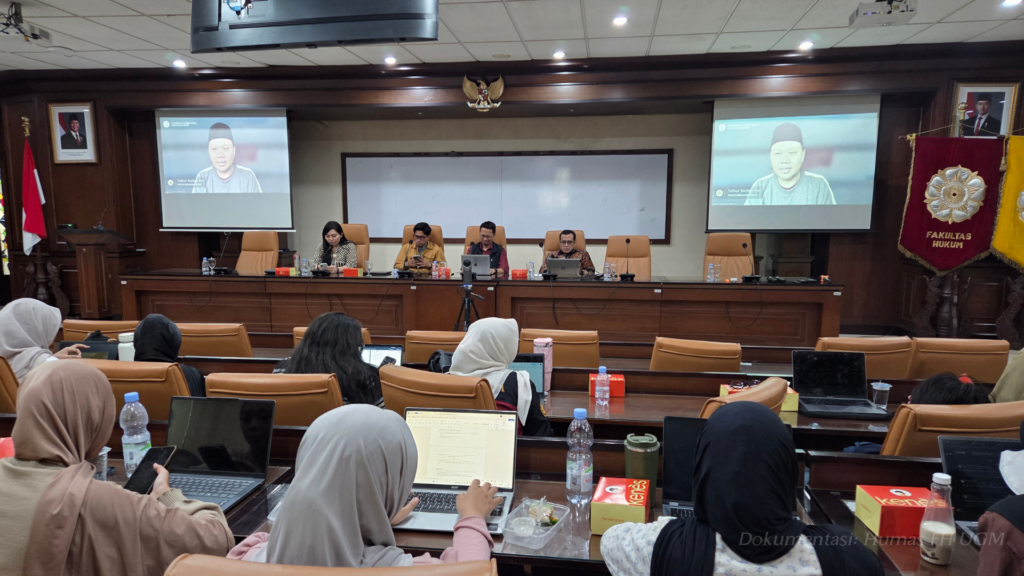
The Department of State Administrative Law (Hukum Administrasi Negara/HAN) in collaboration with the Department of Environmental Law at the Faculty of Law, Universitas Gadjah Mada (FH UGM), organized a Public Dialogue titled "Why Do Forest and Land Fires Keep Recurring?" The dialogue was held in a hybrid format at Room 3.1.1, FH UGM, and broadcast live through the FH UGM Knowledge Channel on Friday, September 4, 2026. The event was attended not only by academics and students, but also by representatives of civil society organizations and members of the media.
The academic forum featured five cross-disciplinary resource persons: Budi Baskoro, an environmental journalist at Mongabay Indonesia; Dr. Hendry Julian Noor, S.H., M.Kn., a Lecturer in the Department of State Administrative Law at FH UGM; Fathur Roziqin Fen, Executive Director of WALHI East Kalimantan; Karina Dwi Nugrahati Putri, S.H., LL.M., a Lecturer in the Department of Business Law at FH UGM; and Dr. Wahyu Yun Santoso, S.H., M.Hum., LL.M., a Lecturer in the Department of Environmental Law at FH UGM. The session was moderated by Dr. Richo Andi Wibowo, S.H., LL.M., Chair of the Department of State Administrative Law at FH UGM. The in-depth discussion examined the root causes of the perennial forest and land fire (karhutla) crisis in Indonesia and formulated proposals for ecologically just legal reform.
The event was formally opened with remarks from Dr. Totok Dwi Diantoro, S.H., M.A., LL.M., Chair of the Department of Environmental Law at FH UGM. In his opening address, Totok underscored the importance of examining the karhutla crisis with clarity and critical rigour given that its impacts extend well beyond ecological damage to encompass social, public health, and economic dimensions. He expressed his hope that the forum would give rise to comprehensive ideas from the resource persons in addressing an ecological disaster that recurs with growing alarm every dry season.
Facilitated by Dr. Richo Andi Wibowo as moderator, the presentations opened with Budi Baskoro, who shared direct empirical testimony from Palangkaraya, Central Kalimantan, on the air quality crisis and the shower of fire ash falling on residential areas since the onset of the dry season in July. He highlighted the destruction of the landscape and the drying out of peat ecosystems stemming from the failure to maintain the minimum water table level of 40 centimetres, compounded by the absence of canal block maintenance leaving the area extremely vulnerable to fire.
The second presentation was delivered by Dr. Hendry Julian Noor from the perspective of State Administrative Law. Hendry outlined the crucial role of administrative instruments which function not only at the enforcement stage when a disaster occurs, but also in prevention, through permit supervision, feasibility auditing, and periodic concession evaluation. He emphasized that administrative sanctions such as the revocation of business licences and government compulsion (bestuursdwang) carry direct executorial force without the need to await lengthy court proceedings. He also questioned the consistency of public officials in exercising this authority without engaging in passive acceptance of violations.
Next, Fathur Roziqin Fen presented the environmental crisis from the perspective of civil society organizations. Fathur criticized the state's weak oversight of private concessions and its tolerance of violations of the no-burning land-clearing obligation (zero burning policy), which has fuelled the proliferation of hotspots in plantation and mining areas. He also highlighted the disproportionate application of law enforcement against indigenous communities despite the fact that these communities possess traditional wisdom in managing fire and maintaining forest sustainability.
The fourth session was delivered by Karina D.N. Putri from the Department of Business Law at FH UGM, who examined loopholes in corporate criminal prosecution that frequently result in a misidentification of the legal subject (error in persona) with only field-level workers being charged. Karina proposed the use of business law doctrines, such as piercing the corporate veil and beneficial ownership tracing, to penetrate the opacity of corporate group structures — so that parent entities that enjoy economic benefits from the efficiency of land burning can be held legally accountable.
As the final resource person, Dr. Wahyu Yun Santoso affirmed that the El Nino climate phenomenon is merely an accelerator — the primary trigger remains human land-clearing activity. Wahyu highlighted governance weaknesses in the Peat Hydrological Unit (Kesatuan Hidrologis Gambut/KHG) and called for the optimization of strict liability enforcement under Article 88 of the Environmental Protection and Management Law (UU PPLH) in environmental civil suits. He also criticized the stalled execution of environmental compensation awarded in court decisions which are not being promptly collected for land restoration and proposed a blacklist mechanism for beneficial owners of corporations that repeatedly cause environmental damage.
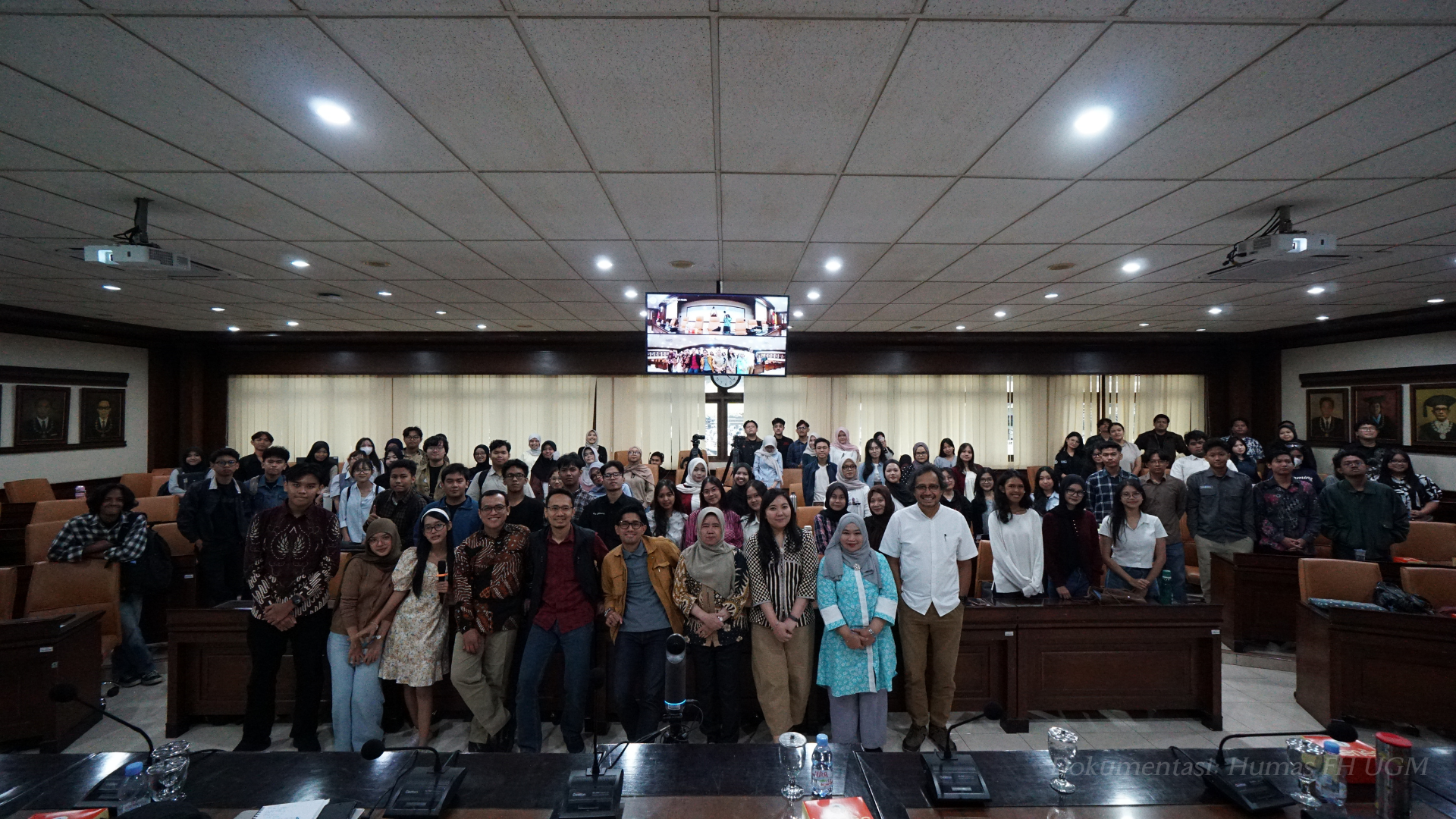
After all resource persons had shared their views, Dr. Richo Andi Wibowo synthesized the ideas that had emerged into a policy improvement roadmap encompassing: ecology-based permit evaluation, prompt application of administrative sanctions, the strengthening of corporate criminal evidence up to the parent company level, genuine execution of environmental compensation, and the opening of concession spatial data to public transparency.
The public dialogue was formally closed by Dr. Totok Dwi Diantoro, who delivered the concluding remarks. In his closing statement, Totok underscored that karhutla is an ecological disaster rooted in governance problems and power relations necessitating that valuable lessons be drawn for the improvement of the licensing system through to law enforcement. He also called for an end to the misdirected blaming of indigenous communities, and urged the creation of affirmative policies to protect the management spaces of local communities, which have proven more resilient and sustainable in preserving ecosystems.
Through this agenda, the Departments of State Administrative Law and Environmental Law at FH UGM reaffirm their commitment to continuing to oversee legal policy on licensing, oversight, and environmental law enforcement in Indonesia in a sustained manner. This is in line with support for the achievement of the Sustainable Development Goals (SDGs) particularly SDG 13 (Climate Action) through the strengthening of policies and governance to address the risks of forest and land fires; SDG 15 (Life on Land) through the promotion of the protection of forests, peatlands, biodiversity, and sustainable ecosystem management; SDG 16 (Peace, Justice, and Strong Institutions) through the strengthening of permit oversight, corporate accountability, environmental law enforcement, and public information transparency; and SDG 3 (Good Health and Well-Being) through the discussion of the impacts of karhutla on public health and livelihoods. In doing so, this forum positions the resolution of the karhutla problem not merely as a disaster response, but as an agenda for environmental governance reform and sustainable development requiring collaboration among government, universities, civil society, media, the business sector, and the public. Resource person materials are accessible via the link provided.
Materi narasumber dapat diakses di sini.
Penulis: Muhammad Fadhlan Surya Nugroho