The Centre for Democracy, Constitutional Law, and Human Rights at the UGM Faculty of Law (PANDEKHA) held one of its regular discussion forums — titled "#IndonesiaGelap: The Fate of Education and the Academic World" — on Friday, March 14, 2025. The discussion brought together academics and researchers to examine the serious challenges currently facing higher education in Indonesia. Three main speakers participated: I Gusti Agung Made Wardana, Dhia Al Uyun, and Herlambang P. Wiratraman. The event drew 91 participants via Zoom and is directly relevant to SDG 4 (Quality Education) and SDG 16 (Peace, Justice and Strong Institutions).
I Gusti Agung Made Wardana raised the issue of power dominance within academic institutions. He argued that universities are no longer purely educational spaces — they have become arenas of contestation between three major forces: the market, with its neoliberal agenda; the state, with its logic of control and exploitation; and society, which is struggling to preserve academic idealism.
Wardana highlighted how neoliberalism has transformed higher education into a commodity subject to market mechanisms. He cited the "Kampus Merdeka" (Freedom Campus) program as an example of an initiative oriented toward preparing students as a compliant workforce within a capitalist economic system. The state, for its part, plays its own role in controlling universities through policies that constrain academic freedom and discipline lecturers and students who are deemed to be at odds with the government.
Dhia Al Uyun highlighted a crisis in the quality, accessibility, and funding of education. She revealed that 76% of lecturers in Indonesia must take on additional work to make ends meet — a stark indicator of the low welfare levels among academics. She also drew attention to heavy administrative burdens and discriminatory human resource management systems that compound the difficulties faced by academics.
According to Dhia, lecturer loyalty is often coerced in three dimensions: to the state, to the institution, and to its leadership. She highlighted how private universities have carried out unilateral dismissals of academics deemed to conflict with institutional interests, and how multi-tiered pay structures complicate academic welfare. She called on the government to take a more active role in improving lecturer welfare through more supportive policies.
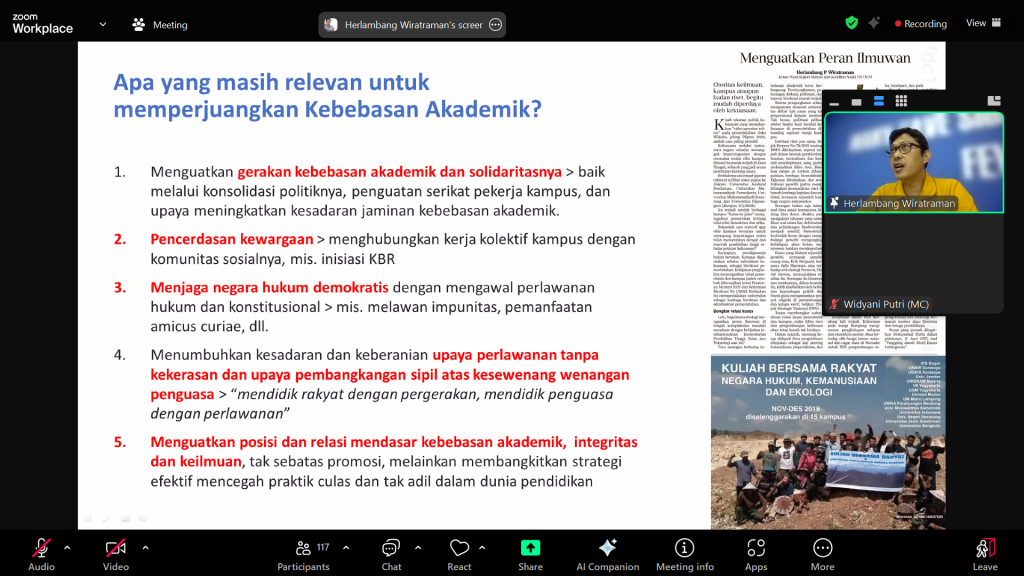
Herlambang P. Wiratraman addressed strategies of resistance among academics confronting threats to their freedom. He highlighted how the government, through various legal policies, continues to narrow the space for academic freedom. One example he raised was the potential of the new Penal Code (KUHP), which enters into force in 2026 to silence critical expression in the academic world.
He also drew attention to state co-optation strategies targeting universities — including the awarding of mining concessions to universities — which ultimately risk compromising academic independence. This, he argued, represents a subtle effort to bring academic institutions to heel so that they no longer serve as spaces of resistance against authoritarian government policy.
As a practical response, Herlambang proposed five strategies for defending academic freedom: strengthening academic solidarity, cultivating civic consciousness, protecting democracy through legal advocacy, building the courage for civil resistance, and developing effective strategies to shield academic freedom from political and economic interference.
The discussion painted a frank picture of how higher education in Indonesia is under serious threat from political intervention, economic pressure, and the weak protection of academic freedom. As repression of the academic world intensifies, concrete steps are urgently needed to preserve the integrity and independence of higher education institutions in Indonesia.
Reporter: Poppy Hairunnisa (PANDEKHA)