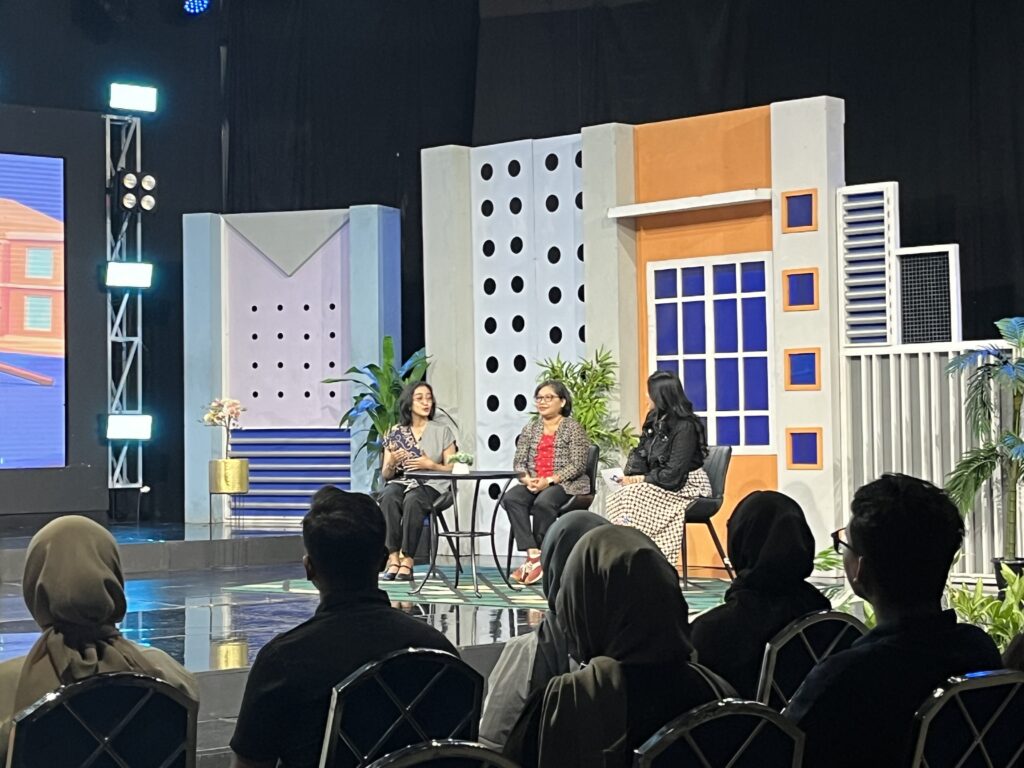
The Center for Legal Consultation and Assistance (PKBH) at the Faculty of Law, Universitas Gadjah Mada (UGM), once again held a legal outreach program via a broadcast on Televisi Republik Indonesia (TVRI) Yogyakarta. This activity is part of the UGM Faculty of Law's community service grant program, which aims to expand legal literacy among the public. This broadcast was initiated by two UGM Faculty of Law students: Azzahra Dewi Santika, an undergraduate (S-1) student serving as the proposal team leader, and Raden Rara Natasya Nurputri Adiyana, a graduate (S-2) student serving as a proposal team member. Both are members of the UGM Faculty of Law's PKBH legal outreach grant recipient team.
The legal outreach session focused on the theme "Children's Digital Safety: Recognize and Combat Electronic-Based Sexual Violence." This theme was chosen because electronic-based sexual violence (KSBE), also known as online gender-based violence (KBGO), has become a real threat to children amid rapid advances in digital technology. The outreach event featured two speakers: Sri Wiyanti Eddyono, S.H., LL.M., Ph.D., a lecturer in the Department of Criminal Law and Chair of the Master's Program in Litigation Law at the UGM Faculty of Law, and Raden Rara Natasya Nurputri Adiyana, a member of the proposal team who also served as a speaker.
In their presentations, the two speakers explained that Article 14(1) of Law No. 12 of 2022 on Sexual Violence Crimes classifies KSBE as a form of sexual violence committed via digital means. Children are considered vulnerable to becoming victims because they are biologically classified as a vulnerable group, compounded by unequal and disguised social relationships in the virtual world. As a form of protection, Article 14(3) of the law stipulates that this criminal offense is classified as a public offense, not a complaint-based offense, if the victim is a child. This provision is reinforced by Law No. 35 of 2014 on Child Protection and Law No. 11 of 2012 on the Juvenile Criminal Justice System.
Data from the Ministry of Communication and Digital Affairs (KOMDIGI) shows that there were at least 1,450,403 reports of online child sexual exploitation cases throughout 2024, with numbers continuing to rise each year. The forms of online sexual exploitation of children discussed in this workshop include internet abuse, risky interactions in online games, the distribution of photos or videos without the victim's consent, the gradual manipulation of children for the purpose of sexual exploitation, and the distribution of intimate content as a form of revenge porn. Both speakers also highlighted external factors that increase the risk, including a lack of sex education within families, the normalization of KSBE in social circles, and low levels of digital literacy among the public.
This workshop also emphasized the impact of KSBE on children, ranging from psychological trauma and emotional developmental disorders to social stigma, as well as disruptions to the victims' education and social lives. The public's limited understanding of the signs of KSBE has the potential to lead to delays in intervention and may even result in victim-blaming attitudes that further exacerbate the victim's condition.
During the Q&A session with viewers, several current issues were highlighted, including how to handle child perpetrators manipulated by adults, along with the applicable legal provisions for such cases; how to handle cases of KSBE involving family members without giving the impression of judging or pressuring the victim; and the initial steps for assisting victims and identifying the responsible parties, from the prevention stage through post-incident response.
This outreach program is also linked to the Sustainable Development Goals (SDGs): Goal 3 on health and well-being; Goal 16 on peace, justice, and strong institutions; Goal 4 on quality education; Goal 5 on gender equality; and Goal 10 on reducing inequalities.
Through this legal outreach program, the proposing team aims to provide comprehensive education to the public regarding electronic sexual violence against children, while also fostering collective awareness among parents, educators, and the broader community in recognizing, preventing, and addressing these threats.
Author: Azzahra Dewi Santika (Chair of the Student Legal Education Grant Recipient Team)