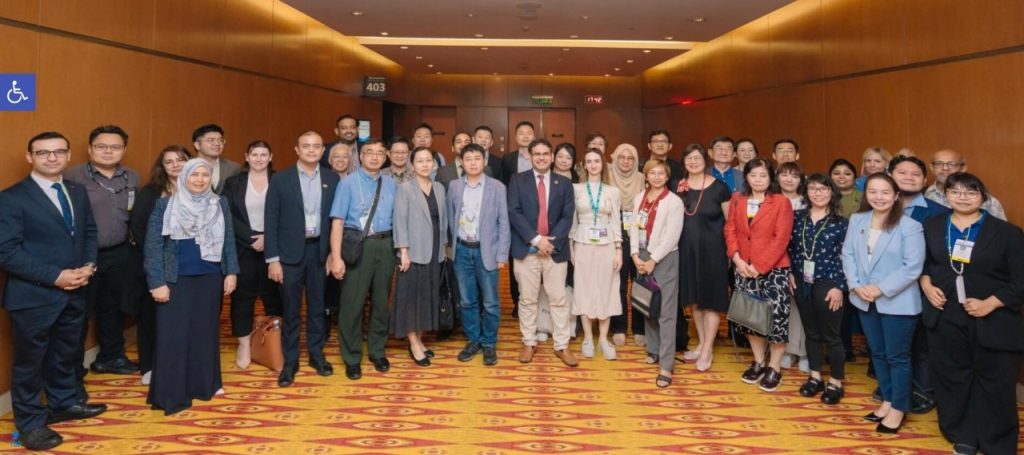
The Global Knowledge Dialogue (GKD) 2023 was recently held at the Kuala Lumpur Convention Center in Malaysia from Wednesday, October 4, 2023, through Friday, October 6, 2023. GKD serves as a platform that brings together leading experts, researchers, and policymakers to exchange ideas, insights, and experiences regarding pressing global challenges. The GKD for Asia and the Pacific was organized by the International Science Council (ISC), the Academy of Sciences Malaysia (ASM), and the ISC Regional Focal Point for Asia and the Pacific (ISC RFP-AP) at the Australian Academy of Science.
Dr. Herlambang P. Wiratraman, a lecturer at the Faculty of Law, Gadjah Mada University, and Secretary-General of the Indonesian Young Scientists Academy (ALMI), attended the GKD 2023 meeting. During the meeting, Dr. Herlambang delivered a presentation on initiatives and efforts to advance science through the work of Indonesian scientists as a form of public education.
Key Points Presented at the 2023 Global Knowledge Dialogue
First, Indonesia’s highly strategic role in leading the G20 (2022) for one year. This is driven by a political commitment to mastering technology and innovation, which is one of the priorities of the administration of President Joko Widodo and Vice President Ma’ruf Amin for the 2019–2024 term. This period must serve as a unique opportunity to build the influence of science on human civilization at the global level.
Second, the challenges Indonesia faces as a tropical country in its efforts to preserve nature. Large-scale deforestation—such as the destruction of natural resources through the expansion of mining capitalism and the palm oil industry—has a significant impact on efforts to protect biodiversity. This leads to socioeconomic impoverishment and ecological threats that disrupt the balance of nature and its sustainability. At the same time, various technologies such as the Internet of Things (IoT), Artificial Intelligence (AI), and data analytics can be leveraged to create, expand, and monitor the effectiveness of sustainable development and environmental protection, including the development of an advanced healthcare system.
Third, science diplomacy. In this context, this refers to how to pave the way for enhancing multi-, inter-, and trans-disciplinary collaboration with various stakeholders for the benefit of humanity, planet Earth, and the well-being of all parties. ALMI, as a community of young scientists, can continue to strengthen cooperation to enhance the contributions of science and technology so that no one is left behind.
Fourth, at the first Indonesian Young Scientists Congress (KIMI), ALMI declared, “Science is the path of humanity—bold and progressive.” This message signifies that it is time for scientists to build strength, collaboration, and commitment through scientific work to bring about a more humane and ecologically sustainable transformation of civilization for one Earth.
Fifth, ALMI emphasizes the importance of science diplomacy to bridge science, technology, and innovation with national interests and global challenges. Advanced technology has played a crucial role in shaping and regenerating nature as well as transforming the environment. The transformation and regeneration of the Earth, along with shifts in development patterns, will bring immense benefits to future generations.
Rountable Discussion
During the roundtable discussion, inspiring perspectives from fellow scientists were shared on ways to amplify the voices of early- and mid-career researchers (EMCRs) in scientific research, scientific writing, and international programs and awards, as well as on how to foster research collaboration. There are 54 national young academies globally, but only five have been established in ASEAN countries. These five academies are located in Thailand, Vietnam, the Philippines, Indonesia, and Malaysia.
Orakanoke Phanraksa, Senior Advisor for International Affairs, Research, and Scientific Innovation in Thailand and Co-Chair of the ASEAN Young Scientists Network (ASEAN YSN), said during a roundtable discussion that some young scientists’ academies are working more effectively with networks of senior scientists, particularly for knowledge transfer.
At the end of the meeting, Dr. Herlambang, Chair of the Center for the Study of Law and Social Justice (LSJ) at the Faculty of Law, UGM, welcomed the active plans of the ISC Regional Focal Point for Asia and the Pacific, which is committed to supporting young researchers.
“The Australian government is deeply interested in Southeast Asia and the Pacific. We want to ensure that the entire region is involved and heard in this conversation. Engaging young people in the ISC’s plans for science missions, as outlined in the reports *Mission Science for Sustainability* and *Flipping the Science Model*, will be crucial. Young researchers are the future of science; they are the future of the scientific voice, and they must become better communicators. We really need to harness the energy, vitality, and intelligence we have in our young academics,” said Dr. Petra Lundgren, Director of the ISC Regional Focal Point for Asia and the Pacific. The outcomes of the Young Academics and Associations Conference will be incorporated into the work program currently being developed by the ISC and its Regional Focal Point for Asia and the Pacific.
Author: LSJ
Editor: Public Relations