
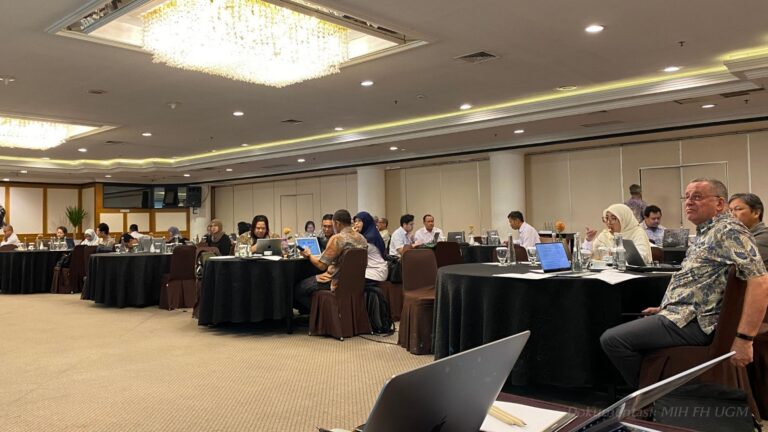
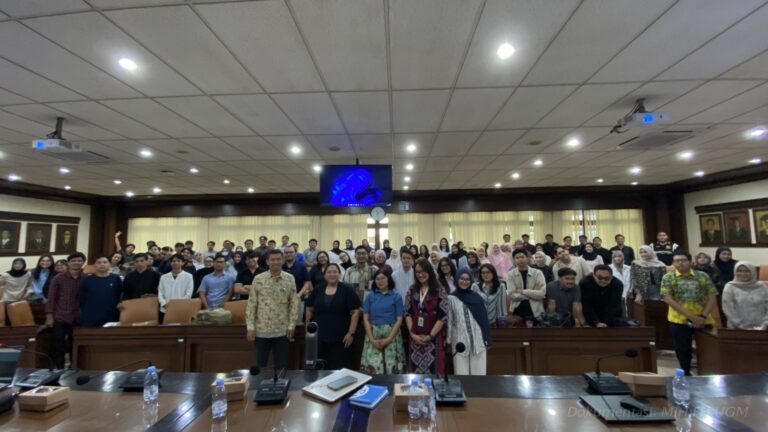
The “White Book” containing seventeen writings by the academic staff of the Faculty of Law, Universitas Gadjah Mada, was officially launched on Monday (15/2). The book maps out various legal issues in Indonesia along with several proposed solutions. As part of the 70th Anniversary celebration of the Faculty of Law UGM, the publication represents one of the Faculty’s contributions to the development of Indonesian law. In his opening remarks, the Dean of the Faculty of Law UGM, M. Hawin, expressed his hope that the book would be widely read by both the public and government policymakers.
Linda Yanti Sulistiawati, S.H., M.Sc., Ph.D., who served as moderator, explained that the idea for producing the book had emerged when Joko Widodo was close to winning the 2014 Presidential Election. Each contributor was asked to formulate ideas based on their respective expertise after examining the Nawacita agenda, with the aim of providing input for the new government.
The keynote speaker, Maria S.W. Sumardjono, emphasized that Indonesia still faces numerous overlapping legal products that create unequal access within society. On this occasion, she encouraged lecturers to become more active in writing and conducting research for the benefit of the people. “UGM is a people-oriented university, not a capitalist university,” she remarked.
According to Paripurna, the book entitled “Just and Prosperous Law: Contributions of Ideas for a New Indonesia” still requires further refinement and updating due to developments that had occurred since the writing process began in 2014. Nevertheless, the book was acknowledged by Gunawan Sumodiningrat, who attended as a discussant, as a strong and comprehensive entry point for presenting Indonesia’s legal problems. The Professor from the Faculty of Economics and Business UGM emphasized that legal drafting should return to the spirit of Bhinneka Tunggal Ika Tan Hana Dharma Mangrwa. “Indonesia is indeed a pluralistic nation, but it must remain united,” he stated.
Meanwhile, Arie Sudjito, who also participated as a discussant, appreciated the white-covered publication for raising readers’ awareness of problems that need to be openly discussed and addressed through practical action. He stressed that academics should continuously generate ideas for solving national problems, accompanied by the formation of an epistemic community. “A place where idealism can develop is far more important,” he asserted. The sociologist and lecturer from the Faculty of Social and Political Sciences UGM further expressed hope that future discussions could specifically address the issue of injustice, arguing that it is impossible to fully understand justice without first understanding injustice itself.
(Fardi/Lita)