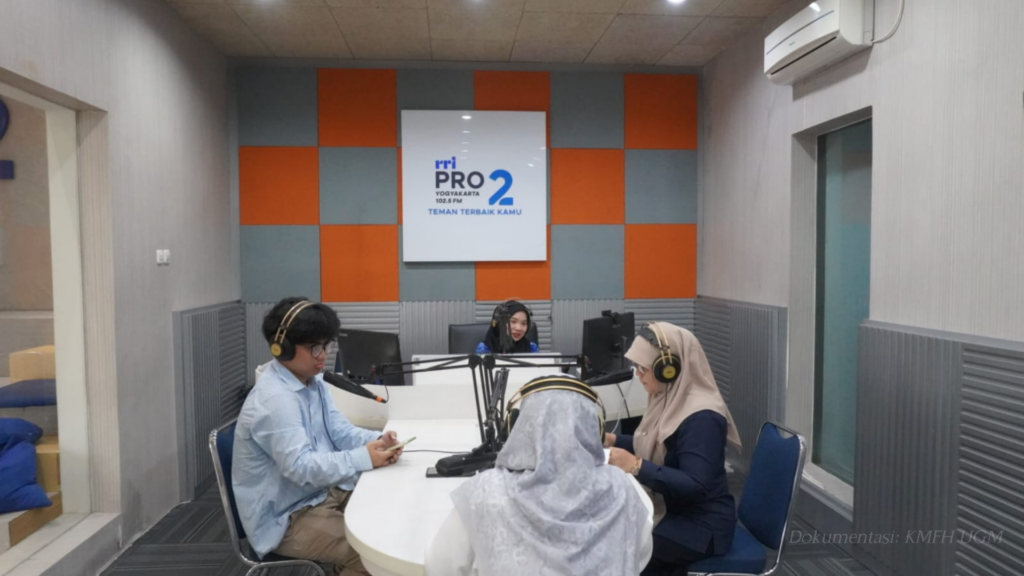
The Muslim Family of the Faculty of Law, Universitas Gadjah Mada (KMFH UGM), held a legal outreach program on RRI Pro 2 Yogyakarta radio on Wednesday (20/05/2026) at 11:45 WIB. The program featured Prof. Dr. Hartini, S.H., M.Si., Professor of Dispute Resolution in Islamic Law at the FH UGM, Rita Puspa, S.K.M., M.P., Lecturer in Civic Education at FTK IAIN Bengkalis, and student Muhammad Asyrof Al-Ghifari. It was carried out under the 2026 Legal Outreach Grant, organized by FH UGM through its Legal Consultation and Aid Center in cooperation with RRI Yogyakarta. The proposal was submitted by the KMFH UGM grant team, Ghifari and Bangkit Putra Prayoga, both law students of the class of 2023.
In the "Santai Siang" broadcast, the discussion focused on the definition of domestic violence (KDRT), its complexity, and its external factors. Rita Puspa explained that KDRT is not only physical but can also be verbal, is rooted in patriarchal culture and gender bias, and is difficult to detect. Contributing factors include one party being dominant, wives being coerced into sexual relations on the grounds of obligation, and one party failing to fulfill their role in the household. Citing Surah An-Nisa verse 34, she said men should act as leaders who protect and care for their wives in order to realize a Sakinah Mawaddah wa Rahmah family, and that Islam is very progressive in regulating this matter. Prof. Hartini explained that KDRT occurs because perpetrators regard such conduct as normal, a phenomenon arising from poor parenting and misinterpretations of Islamic teachings. As a result, victims experience layered dependency, unable to free themselves because of emotional manipulation and fear.
The discussion then turned to Law No. 23 of 2004 on the Elimination of Domestic Violence (the PKDRT Law). The law is considered not yet fully effective, but it has encouraged the public to report such crimes. However, some reports have been withdrawn under pressure from perpetrators or their families, making case handling slow and protracted. Restorative justice, which women's and children's rights activists often oppose, is another option. Victims are frequently pressured to reconcile to preserve the household or for their children's future, without regard for power relations and their own safety. Because KDRT is a crime against human rights that can threaten lives, it cannot be resolved through reconciliation, which fails to deter perpetrators and risks recurrence.
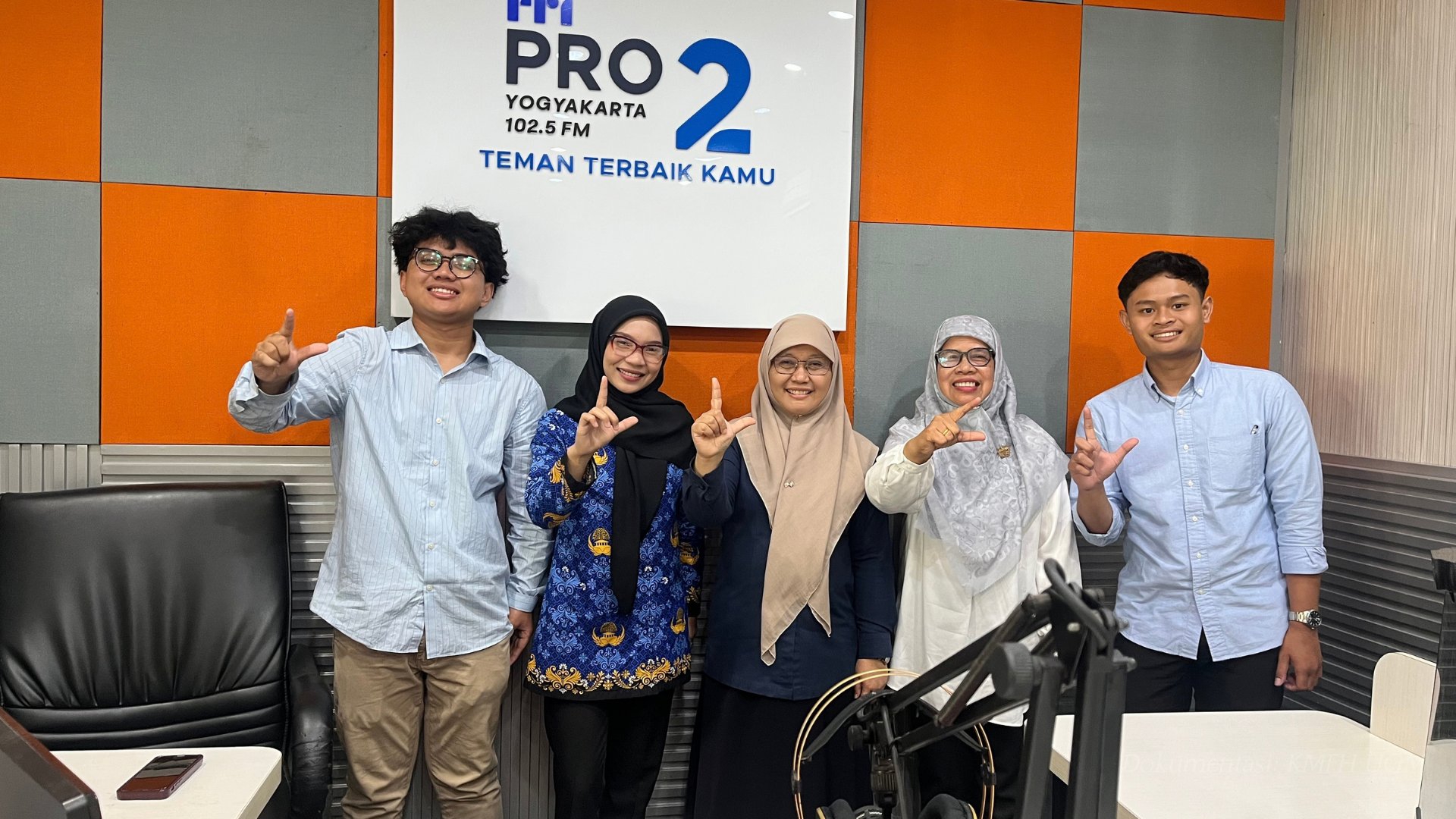
To prevent KDRT, Rita Puspa said the younger generation must develop a positive perspective. Prof. Hartini added that this can be done through character education that cultivates empathy from an early age, in both family and community. Muhammad Asyrof Al-Ghifari stressed that everyone must see others as whole human beings, not objects.
This activity is strongly relevant to the Sustainable Development Goals (SDGs): SDG 3 (Good Health and Well-Being), through outreach on the physical and psychological impacts of KDRT; SDG 4 (Quality Education), through outreach on preventing KDRT; SDG 5 (Gender Equality), through outreach on the fair roles of husband and wife in the household; and SDG 10 (Reduced Inequalities), through outreach on easier access to legal aid for victims.
Author: KMFH UGM Grant Recipient.