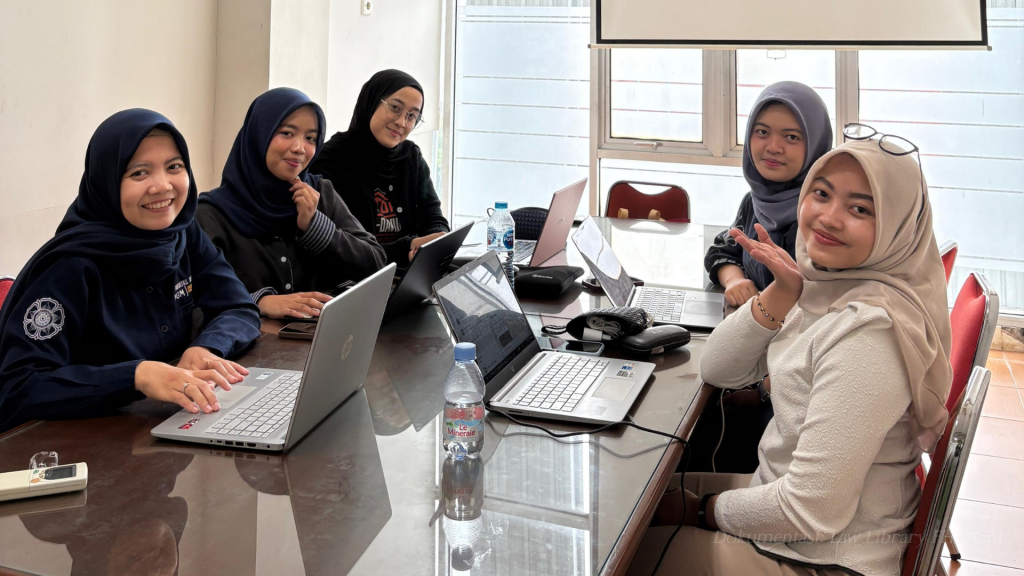
As part of its commitment to strengthening academic literacy and optimizing the use of legal information resources, the Law Library of the Faculty of Law, Universitas Gadjah Mada (FH UGM) organizes the Law Library Literacy Class (LitClass Law Library), a program open to all members of the FH UGM academic community. Conducted regularly every Tuesday and Thursday, the program serves as a learning platform where students can develop the skills needed to access, search, and effectively utilize a wide range of legal information resources.
Through LitClass Law Library, participants are equipped with practical skills in locating credible legal literature, using the library catalog, accessing digital collections and academic journal databases, and applying effective legal research techniques to support coursework, research projects, and scholarly writing. Participants also receive training on the use of Reference Management Tools, the responsible use of reference materials and Artificial Intelligence (AI) technologies, as well as guidance on self-upload procedures and the use of bookmark features within the library’s digital services.
The sessions are held every Tuesday and Thursday from 1:30 p.m. to 2:30 p.m. (WIB) in the Law Library discussion room. Students may participate by registering through the following link: http://ugm.id/PendaftaranLitClass. Throughout the program, participants receive direct assistance from professional librarians through an interactive learning approach that combines conceptual explanations with hands-on practice using the library’s services and facilities.
By offering LitClass Law Library on a regular basis, FH UGM aims to enhance students’ ability to manage scholarly information, improve the quality of their research, and foster an academic culture that is critical, innovative, and grounded in information literacy.
The implementation of LitClass Law Library supports the achievement of the Sustainable Development Goals (SDGs), particularly SDG 4 (Quality Education) by strengthening information literacy, research competencies, and the effective use of information technology in the learning process. The program also contributes to SDG 9 (Industry, Innovation and Infrastructure) by promoting the ethical use of digital innovations, academic databases, and artificial intelligence in academic activities. Furthermore, by expanding access to high-quality knowledge resources, the initiative helps foster an inclusive, adaptive, and capacity-building higher education ecosystem in the field of law.
Author: Afni Isnaini A