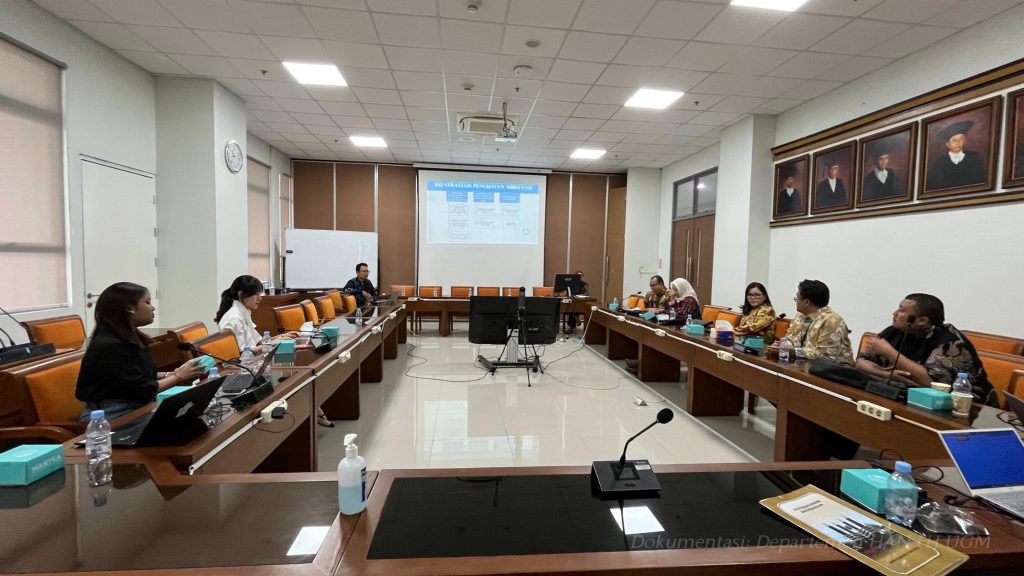
On Tuesday, 19 May 2026, the Department of Administrative Law (HAN), Faculty of Law, Universitas Gadjah Mada (UGM), welcomed a delegation from the Policy and Judicial Strategy Center of the Supreme Court of the Republic of Indonesia (Pustrajak Kumdil MA RI) for an audience and interview session. Held at the Faculty of Law UGM, the meeting served as a collaborative effort to gather data, exchange ideas, and provide evidence-based policy recommendations for the preparation of the Academic Paper and the Draft Amendment to Law Number 5 of 1986 on the State Administrative Court (UU PERATUN)..
Representing UGM were Richo Andi Wibowo, S.H., LL.M., Ph.D., Lecturer and Head of the Department of Administrative Law, and Dr. Hendry Julian Noor, S.H., M.Kn., Lecturer at the Faculty of Law UGM. The delegation from Pustrajak Kumdil MA RI was led by Dr. Umar Dani, S.H., M.H., Coordinator of the Supreme Court Research Team, accompanied by Dr. Tricahya Indra Permana, Febrina Permadi, S.H., M.H., Maria Fransiska Walintukan, S.H., M.H., and Muhammad Adiguna Bimasakti, S.H., M.H. The discussion was moderated by Florencia Irena Gunawan, S.H., LL.M. from the Partnership & Development Unit of FH UGM.
During the meeting, the Pustrajak team explained that law enforcement within the State Administrative Court system currently faces a range of complex normative challenges. Since its enactment nearly four decades ago, the procedural framework under the State Administrative Court Law has largely adopted concepts from civil procedural law. Amendments made in 2004 and 2009 addressed only limited sectoral issues and did not fundamentally reform the procedural structure.
Legal uncertainty increased following the enactment of Law Number 30 of 2014 on Government Administration (UU AP). While the law contributed to the development of public law and modernization of governance, several of its provisions are not fully coherent with the State Administrative Court Law. This has resulted in legal dualism, including the coexistence of the positive fictitious decision regime under the Government Administration Law and the negative fictitious decision regime under the State Administrative Court Law. Furthermore, administrative remedies have been positioned as a mandatory prerequisite before filing a lawsuit. To address these inconsistencies, the Supreme Court has relied on internal mechanisms, including Supreme Court Circular Letters (SEMA), and applied principles of legal preference to avoid legal uncertainty and protect access to justice.
Responding to these issues, Hendry Julian Noor presented an analysis of key matters that should be incorporated into the forthcoming amendment. One major concern is the overlap of absolute jurisdiction between general courts and the State Administrative Court, which often creates confusion in legal practice. The discussion also highlighted the need to clearly define the authority of the State Administrative Court in reviewing allegations of abuse of power under the Government Administration Law, ensuring that such authority does not overlap with corruption-related proceedings. Another significant issue concerned whether Indonesia should maintain the negative fictitious decision model or fully transition to a positive fictitious decision regime in order to resolve longstanding normative conflicts..
Empirical evidence also shows that the execution of administrative court judgments frequently fails due to the absence of an effective enforcement mechanism. As a result, the court’s role in restoring individual rights is often limited. In addition, participants explored the potential application of restorative justice mechanisms in public law disputes, provided that such approaches remain consistent with the General Principles of Good Governance (AAUPB).
Meanwhile, Richo Andi Wibowo emphasized that the adoption of civil procedural concepts in administrative litigation has created significant obstacles for justice seekers. Under the current framework, individuals often need to demonstrate actual harm before being recognized as having legal standing. However, from a public law perspective, problematic government decisions, policies, or permits should be challengeable before causing substantial harm. Otherwise, legal protection arrives only after damage has occurred. As Richo noted, “justice delayed is justice denied.”
Richo also highlighted provisions within the State Administrative Court Law that make it difficult for judges to grant suspensions of administrative decisions pending litigation. In many jurisdictions, such suspensions serve as one of the most important forms of legal protection against potentially unlawful government actions. He argued that the procedural framework established during the New Order era was designed to create an administrative court that existed institutionally but lacked sufficient power. Consequently, these restrictive provisions should become a primary focus of the proposed amendment.
The collaboration between academics from the Department of Administrative Law and researchers from the Supreme Court is expected to contribute to the development of a high-quality Academic Paper. The transformation of the State Administrative Court system should not merely address technical legal challenges but should also serve as a strategic response to broader governance and justice concerns. The Department of Administrative Law at FH UGM remains committed to supporting the Supreme Court in strengthening legal protection for all citizens through meaningful regulatory reform.
This audience and discussion session also aligns with the Sustainable Development Goals (SDGs), particularly Goal 16: Peace, Justice and Strong Institutions. The preparation of the Academic Paper and the amendment of the State Administrative Court Law aim to strengthen access to justice, improve legal protection against administrative actions, and promote a more responsive, transparent, and accountable judiciary. Furthermore, the collaboration between the judiciary and academia in producing research-based policy recommendations reflects the spirit of Goal 17: Partnerships for the Goals, by fostering strategic partnerships that support legal reform and sustainable governance in Indonesia.
Penulis: Muhammad Fadhlan Surya Nugroho & Richo Andi Wibowo (Departemen HAN FH UGM)