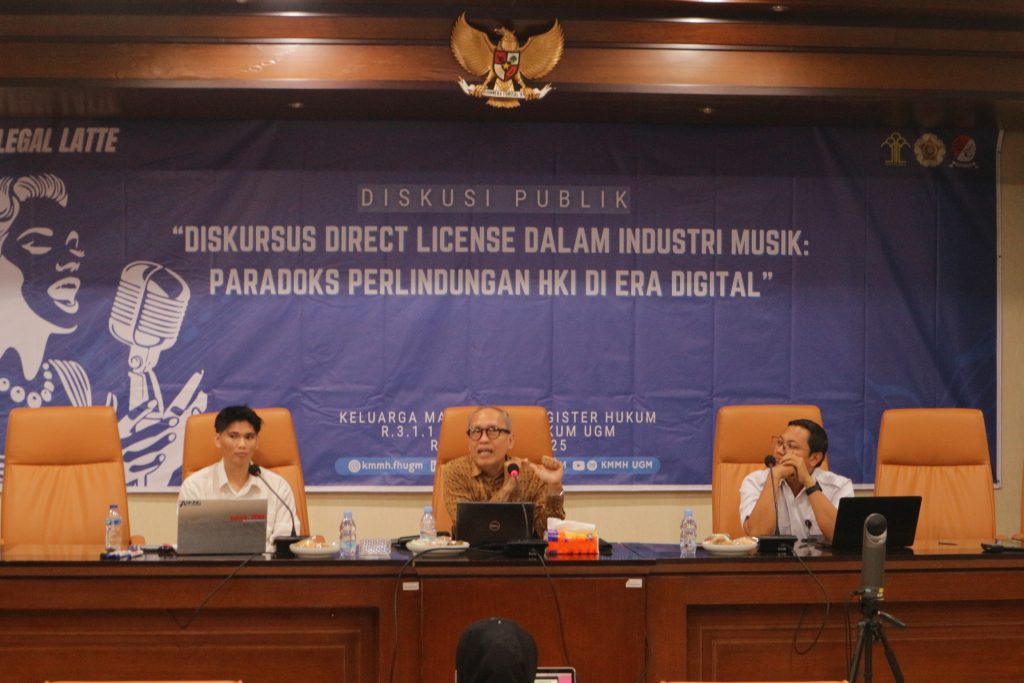
The Master’s Program in Business and Public Law Student Association (KMMH) at the UGM Faculty of Law held a public discussion titled “The Discourse on Direct Licensing in the Music Industry: The Paradox of Intellectual Property Protection in the Digital Age” in response to the controversy surrounding the direct licensing model in the music industry. This academic forum featured two main speakers: Vanny Aldilla from the Regional Office of the Ministry of Law and Human Rights of the Special Region of Yogyakarta, and Prof. Tomi Suryo Utomo, S.H., LL.M., Ph.D., from the Faculty of Law at UGM. The discussion was moderated by Hizkia Stevanus Lumenta, a Master of Business Law student, who led the Q&A session and summarized intellectual property law issues in the digital realm. Using a multidisciplinary approach, the speakers highlighted the challenges of copyright protection, the dynamics of the creative economy, and the need for adaptive regulations for music industry stakeholders.
The event took place on Wednesday (May 14, 2025), from 1:00 p.m. to 3:10 p.m. WIB in Room 3.1.1 of the UGM Faculty of Law and was attended by a diverse group of participants—ranging from students and practitioners to musicians and music enthusiasts. The event began with opening remarks from the Chair of KMMH, represented by Naufal Rizqiyanto, Head of the KMMH Research and Studies Department, who emphasized the importance of critical dialogue for the development of business law studies. The official opening remarks were delivered by Dr. Totok Dwi Diantoro, S.H., M.A., LL.M., Secretary of the Business and Public Law Program at the UGM Faculty of Law, who reaffirmed the faculty’s commitment to addressing contemporary intellectual property issues
Speaking on behalf of the Yogyakarta Regional Office of the Ministry of Law and Human Rights, Vanny Aldilla explained that the legal basis for direct license is found in Article 9(1) of Law No. 28 of 2014 on Copyright. Government Regulation No. 56 of 2021 on the Management of Royalties for Song and/or Music Copyrights. The implementing regulations for the Government Regulation are set forth in Minister of Law and Human Rights Regulation No. 9 of 2022. Under the Copyright Law, these music royalties are centralized through an institution known as LMKN. The Government Regulation stipulates that commercial use in the form of commercial public services must pay royalties to creators, copyright holders, and/or related rights holders through LMKN. The one-stop royalty payment system under the Copyright Law via LMKN is referred to as a direct license. direct license.
The Yogyakarta Regional Office of the Ministry of Law and Human Rights has gained some experience since the enactment of the Government Regulation—and even since the enactment of the Copyright Law—in fulfilling its mandate to ensure the continued operation of the LMKN. Although the LMKN was established to collect royalties, it still faces challenges in covering all 33 of Indonesia’s major regions.
“For example, here in DIY alone, there are already a great many cafes, hotels, and shopping centers that actively play songs or music to support their commercial activities. At the beginning and end of each year, the DIY Regional Office of the Ministry of Law and Human Rights conducts monitoring of these establishments. Based on the results of monitoring and evaluation conducted in the field, many of the managers and users of this music still lack information, so it is frequently found that the payment of royalties remains a point of confusion. “Is this necessary or not? Because when people visit a café or a restaurant, they assume that the music we’re playing is from YouTube, or free songs from SpotifyThis serves as a reminder for us to educate the public about music copyright,” explained Vanny Aldilla.

From an academic perspective, Prof. Tomi Suryo Utomo, S.H., LLM., Ph.D., views the issue of direct lisence as an interesting topic. As an academic, he believes one must approach this issue objectively. There are three key points to focus on. First, the contradictions in the articles that form the backdrop to the problem. Second, the consequences of these contradictions, which create tension among parties within the music industry—specifically between songwriters and rights holders. Third, the conflict between songwriters and LMKN.
Prof. Tomi Suryo Utomo highlighted the legal complexities arising from contradictions between provisions in the Copyright Law, particularly between Article 9(3), Article 23(5), and Article 81. He explained that while Article 9 grants creators the exclusive right to authorize or prohibit the use of their works, Article 23 introduces a collective management system through LMK, whereas Article 81 allows creators to grant direct licenses. It is this tension between individualistic and collective approaches that has sparked the controversy surrounding direct license. Prof. Tomi also questioned the effectiveness of royalty management by LMKN, particularly regarding the transparency and accountability of royalty distribution.
As a solution, Prof. Tomi proposed the implementation of blockchain technology to automatically track the use of songs on various digital platforms such as Spotify and YouTube, as well as at concerts or performances. With this technology, songwriters can directly view usage data for their works in a transparent manner without having to rely on reports from specific institutions. According to him, if transparency can be ensured through this technology, then the controversy surrounding direct license and the role of LMKN can be minimized. This discussion reflects the need for regulations that are more robust and adaptable to technological advancements and the creative industry in the digital age.
Reportase: Akbar Sitti Erlina, S.H (Departemen Kajian Hukum dan Penelitian)
Editor: Public Relations