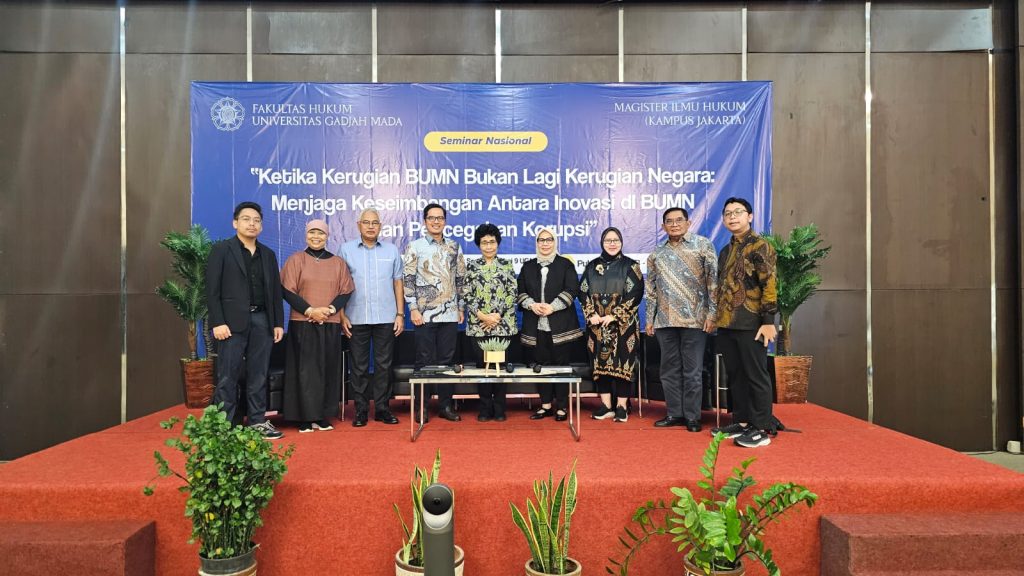
On Saturday, March 1, 2025, a national seminar titled "When BUMN Losses Are No Longer State Losses: Balancing Innovation in State-Owned Enterprises and Corruption Prevention" was held at the UGM Master of Laws (MIH) Program, Jakarta Campus.
The seminar was organized to examine in depth the implications of the revised State-Owned Enterprise Law (Undang-Undang BUMN) for corporate governance, business innovation, and state financial oversight. Through this forum, the aim was to broaden understanding of the welfare state concept and the strategic role of state-owned enterprises (BUMN) in the national economy. The seminar also sought to identify emerging legal challenges, explore potential solutions in BUMN oversight, and foster constructive dialogue among academics, practitioners, and stakeholders — with a view to creating a more transparent, professional, and welfare-oriented model of BUMN governance.
The seminar was opened by Muhammad Jibril, S.H., M.PrivateLaw., as MC, who then invited Prof. Adrianto Dwi Nugroho, S.H., Adv.LL.M., LL.D., Vice Dean for Academic Affairs, Student Affairs, and Partnerships, to deliver the opening address. The event was also attended by the Head and Secretary of the MIH Program Jakarta Campus: Dr. Ninik Darmini, S.H., M.Hum. and Dr. Agustina Merdekawati, S.H., LL.M. The first session was moderated by Febri Diansyah, S.H.
The first speaker, Irene Putrie, S.H., M.Hum., discussed the regulatory framework governing state financial management and BUMN. She noted that while BUMN assets are separated from the state budget (APBN), they remain part of state finances and must be managed responsibly. The Constitutional Court's ruling affirms that oversight by the Supreme Audit Agency (Badan Pemeriksa Keuangan/BPK) remains essential to ensure compliance with good governance principles — enabling state assets to be managed optimally in the interest of public welfare.
The second speaker, Eri Hertiawan, S.H., LL.M., MCIArb., AIIArb., addressed the Constitutional Court's ruling that state financial losses must be grounded in criminal intent (mens rea). He noted that while the revised BUMN Law provides for the separation of state assets, it does not displace the Anti-Corruption Law (Undang-Undang Tindak Pidana Korupsi/UU Tipikor). Directors and commissioners of BUMN must therefore continue to comply with Good Corporate Governance (GCG) principles to avoid legal consequences harmful to both the state and the company.
The third speaker, Eddie Widiono, former President Director of PT PLN (Persero) (2001–2008), discussed how Indonesia is currently in the midst of a major transition in the energy sector — driven by the growing adoption of electric vehicles and the digitalization of the electricity industry. The changes to the BUMN Law, from Law No. 19 of 2003 to Law No. 1 of 2025, reflect the government's effort to create a more adaptive and innovative business environment. These regulations create opportunities for BUMN to strengthen their role in research and development, accelerate investment, and collaborate with the private sector and academia.
The fourth speaker, Dr. Albertina Ho, S.H., M.H., noted that BUMN play a strategic role in the national economy, but that their profits and losses are not automatically treated as part of state finances. This distinction is crucial in the context of the Anti-Corruption Law — particularly when determining legal accountability for alleged state losses. BUMN regulations affirm the principles of good governance, prohibit abuse of authority, and establish the application of the business judgment rule as a framework for evaluating the decisions of directors and commissioners. While BUMN are not state institutions, their employees may still be categorized as public officials under the scope of the Anti-Corruption Law.
The second session was moderated by Umar Mubdi, S.H., M.A. Dr. Anas Puji Istanto, S.H., M.H., Lakso Anindito, S.H., LL.M, dan Dr. Sigid Riyanto, S.H., M.Si.
Discussed the various forms that state losses can take both in terms of general state finances and BUMN and underscored the importance of distinguishing between losses caused by corruption and those arising from management errors without criminal intent. He noted that BUMN governance continues to follow private law principles, with transparency and accountability as the mechanisms for maintaining a balance between public interest and business objectives.
Lakso Anindito, S.H., LL.M. argued that the revised BUMN Law provides greater legal certainty for directors and management in making business decisions — particularly regarding the application of the business judgment rule. The legislation clarifies the boundary between business losses and criminal acts of corruption, while upholding the principles of transparency and accountability. He acknowledged, however, that proving elements of unlawfulness remains challenging, and that a careful legal approach is needed to ensure these provisions are effective without impeding strategic decision-making.
Finally, Dr. Sigid Riyanto, S.H., M.Si. noted that corruption in BUMN is a serious problem causing substantial state financial losses, and reflects systemic practices across multiple sectors. The legal status of BUMN assets remains a matter of ongoing debate — between state ownership and corporate governance principles. Accordingly, he argued that reformed oversight mechanisms and the transparent application of the business judgment rule are essential to ensuring professional BUMN governance and preventing abuse of power that damages the state. Through this seminar, it is hoped that all participants — students, academics, legal practitioners, and stakeholders — will gain a comprehensive understanding of the implications of the revised BUMN Law for corporate governance, business innovation, and corruption prevention. The discussions generated are expected to yield critical insights and actionable recommendations for government, business, and civil society in ensuring that BUMN remain a driving force of national economic growth without sacrificing transparency and accountability.
Authors: Ramzy Oansa Ilham / Debby Citra Dewi (MIH Jakarta Campus)